








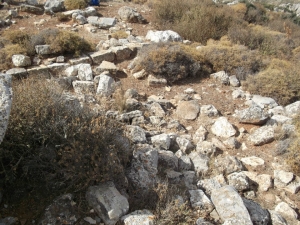
West of the village Tylisos in Malevizi province rises the mount Pirgos with its peak reaching an altitude of 684m. In this steep peak the archaeologist Stylianos Alexiou in 1963 identified one of the most important Minoan Peak Sanctuaries of Central Crete. Religious figurines and stone horns were found, and a rectangular building measuring 13m x 4.50m came to light. It can be reached by walking about 20 minutes from the nearest parking area that is reached by a rural road.
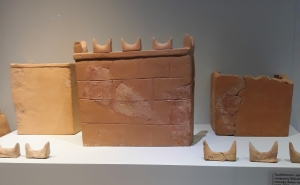
The hill Katrinia in the area of Piskokefalo, province Sitia, hosted one of the most important peak sanctuaries of Minoan Crete, where pilgrims from the surrounding areas came to praise their deities and devote their tributes. Three sacred caves have been identified in the same area, just like in other peak sanctuaries in Crete (e.g. Giouchtas, Pirgos near Tylissos, etc.).
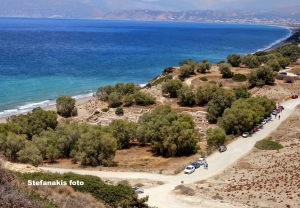
The archaeological site of Kommos is located 4km west of Phaestus, near Pitsidia and Matala. Kommos (or Komos) was a small Minoan town founded in 2000BC and served the port needs of Phaestus, with which it was linked by road. Kommos was probably destroyed by an earthquake in 1700BC, but survived up to the Hellenistic period.
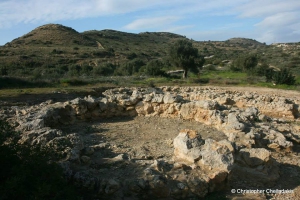
The historic Monastery of Odigitrias on the way to Agiofaraggo hides many treasures. Beyond the monastery itself with such great history and the tower of Xopateras, it conceals another surprise north of the monastery. This is the prepalatial necropolis of Odigitria, named after the monastery, as we still don’t know the name of the town it belonged to.
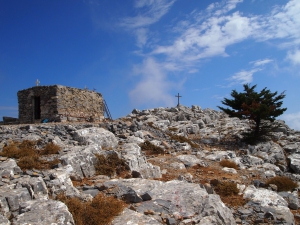
Kofinas is the highest peak in the wild Asterousia Range with an altitude of 1231m and gets its name from its shape resembles an inverted basket (kofini in Greek). The top, with stunning views to the Libyan Sea, today hosts a temple of the Holy Cross (Timios Stavros), celebrating on September 14.
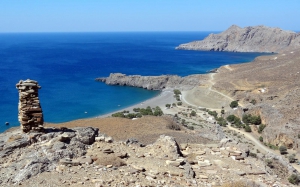
On the rocky hill Papouri, located northeast of the beach of Tripiti, high above the tavern, we meet the remains of a Minoan settlement. The first excavations were made in 1986-88 by archeologist Antonis Vasilakis. A vaulted tomb of 2800-2000BC was also been found 200m on the south.
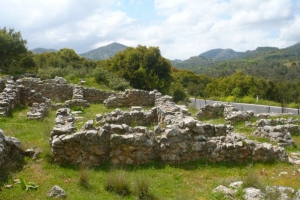
The Minoan mansion of Sklavokambos was discovered in 1930, while constructing the main road to Anogia and part of it was destroyed by the works. It is a multiple-story building with a main room where a clay ox head was found, along with a Late Minoan IB period style jug and a stone rhyton. The building had at least 17 rooms.
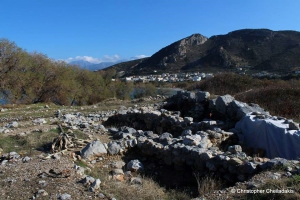
Priniatikos Pirgos is a small peninsula that separates the two beaches of Agios Panteleimon Karavostasis upon which an important Minoan settlement has been identified. The settlement has been mapped by the American and Irish Archaeological School. It was inhabited from the Minoan till the Ottoman Era and was highly depended on its harbor. Important findings are kilns for ceramics production.
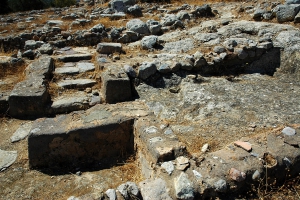
The Minoan settlement of Vasiliki is located across the exit of the gorge of Ha and near the Minoan settlement of Gournia, at an elevated point that controlled the valley of Ierapetra.
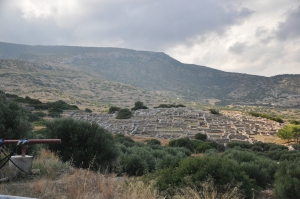
The archaeological site of Gournia is located on a hill west of Pachia Ammos, near the road connecting Agios Nikolaos to Ierapetra, 19km east of Agios Nikolaos. The city flourished in the Minoan period and is the most complete excavated Minoan town in Crete. Because of its good conservation, it was named as the "Pompeii of Crete". The excavation of Gournia was implemented by an American Archaeology Group, headed by Harriet Boyd, in 1901-1904.
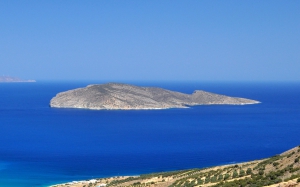
Psira is a small uninhabited islet located 1 mile north of Tholos beach, situated at the northeastern edge of the Gulf of Mirabello. In Psira a Minoan settlement of 15-20 acres has been found, being one of the most important sites in Crete.
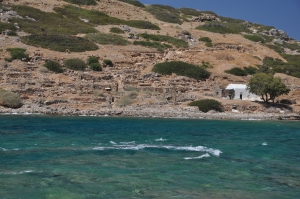
The islet Scoglio de Muflo of the Venetians, which is the island opposite of Mochlos, seems to have been a very important commercial center and port in antiquity till the Byzantine Era. The island, also called Psilos (i.e. Flea) (opposed to a larger island to the west called Psira, i.e. lice) is an archaeological site that still gets excavated.
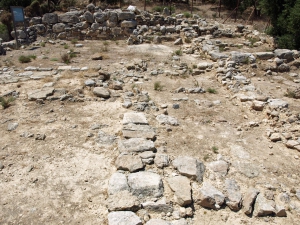
At position Riza, close to Achladia village N. Platon revealed in 1952 a Minoan Rural Mansion (1600-1550BC). The building occupies an area of 270 sqm and consists of 12 apartments with a main entrance on the east, an entrance hall, kitchen, storerooms and (possibly) a stall.
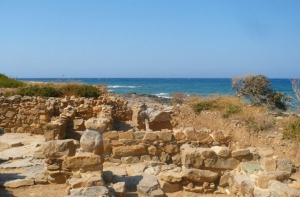
At Papadiokambos archaeologists have identified a Minoan house of fishermen and farmers covering 130 square meters, which has provided them with great information about the diet of the Minoans. It seems that the house was destroyed while the housewiveswere cooking waiting for their men,but they were lucky to escape alive (but hungry). But the family dog had a bad fortune, as he was found below the collapsed roofs.
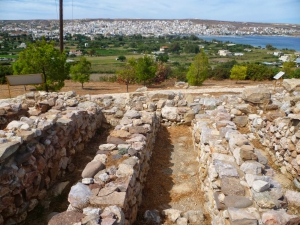
The Minoan settlement of Petras was built on a low hill near the present city of Sitia. It is believed by many researchers that this was the site of ancient Etea or Etida, from where the sage Myson came from.
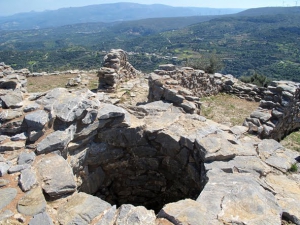
A particular Minoan farmhouse of elliptical shape has been found at position Souvloto Mouri, near Chamezi village. The farmhouse was excavated in 1902 by Xanthoudidis and its shape has been studied by archaeologists.
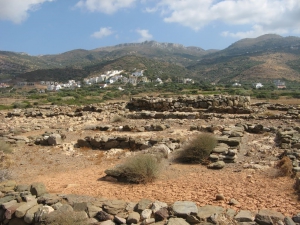
The ruins of the largest Minoan cemetery in Crete have been discovered in this area with 252 graves from the early Minoan period, 1800 vases and many artefacts buried with the dead.
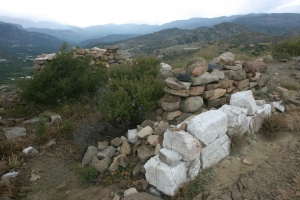
The unknown Minoan settlement of Pirgos is located shortly east of the coastal village of Myrtos, by Ierapetra, on a low hill overlooking the east bank of the River Krygios (Cold). It is located on a position overlooking the sea (south) and the forested mountains of Dikti (north) and was selected for settlement by the Minoans ,after leaving the nearby peak of Fournou Kefali. The settlement flourished from 2200 to 1450BC.
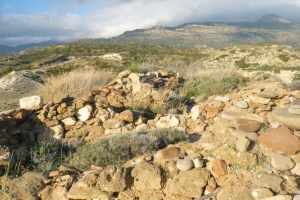
The Minoan settlement at ‘Fournou by in Myrtos is a prime example of an establishment of the first phase of the Minoan civilization, before the construction of palaces. The settlement appears to have been founded before 2500 B.C., and had a violent end before 2100 B.C. It was walled, built on a hill, and contained about a hundred rooms in thick array.
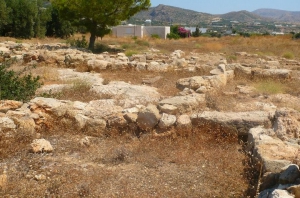
The very quiet area of Makrigialos with the plain and the sheltered beach could not be ignored by the Minoans, who left important traces of habitation. The main finding is a rural mansion, a miniature Minoan palace in position Plakakia, found in 1971 by Kostas Davaras.
Also read:
- Home
 Beaches
 Nature
 Past
Past Destinations
 Highlights
 West Crete
- Central Crete
- East Crete
- Towns
- Chania Prefecture
- Chania
- Paleochora
- Kissamos
- Georgioupolis
- Chora Sfakion
- Loutro
- Rethymnon Prefecture
- Rethymnon
- Agia Galini
- Plakias
- Spili
- Anogia
- Heraklion Prefecture
- Heraklion
- Hersonissos
- Malia
- Matala
- Agia Pelagia`
- Archanes
- Kokkinos Pirgos
- Lassithi Prefecture
- Agios Nikolaos
- Elounda
- Sitia
- Ierapetra
- Makrigialos
- Palekastro
- Zakros
- Lassithi Plateau
- Get Prepared


