Crete may not be in Africa, but its landscapes and native flora often evoke the African continent. One of the most characteristic examples is the Cretan date palm (Phoenix theophrasti), a rare palm species native to the Aegean region. Along the coastline of Crete, there are several beaches where palm trees create an exotic landscape reminiscent of the African coast.
Vai and Preveli are home to the two largest and best-known palm groves in Crete. Smaller natural palm groves and clusters can also be found at Itanos, Martsalo, Agios Nikitas, Souda and Aspri Limni.

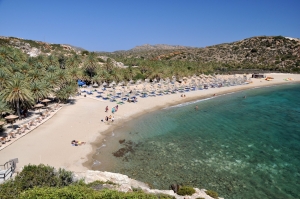
It is certainly the most famous beach in southern Crete, accepting thousands of visitors every summer. During the 60s and 70s, it was a favorite destination for hippies. On the banks of the Grand River, there is a large colony of Theophrastus palm trees, which give the region a sense of an African landscape.
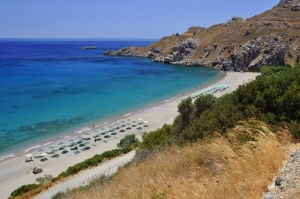
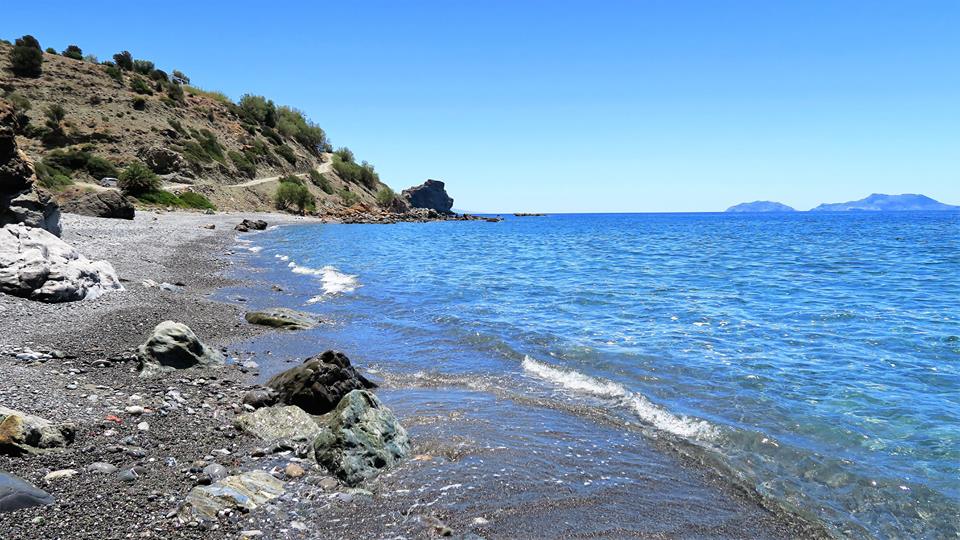
Souda beach near Plakias
It is actually the last beach of the vast beachfront of Plakias, called Yialia, which starts at Shinaria, several kilometers away. Unlike the true meaning of the name (the Latin word suda means narrow passage), the bay of Souda is quite large.

Finikidia beach at Agios Pavlos
Finikidia beach is located in the territory of the village of Saktouria of Agios Vasilios, between Agia Galini and Agios Pavlos. It is formed near a stream, on the banks of which there is a fairly large cluster of Cretan palm trees (Phoenix theophrastii).

Aspri Limni beach
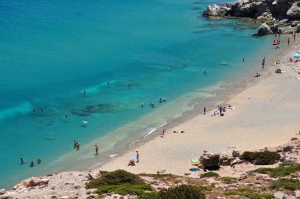
Aspri Limni (i.e. White Lake) is one of the most gorgeous beaches in Crete, that almost nobody knows. This is a small secret beach, located 500m west of Chrysoskalitissa monastery and 70km southwest of Chania. Thousands of visitors are attracted by the nearby exotic Elafonissi lagoon, but actually nobody has heard of this magnificent neighboring place.

Martsalo beach
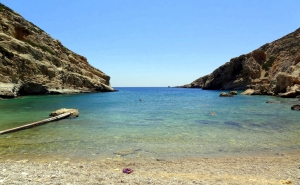
Martsalo is a secluded beach in the west Asterousia Mountains, one of the most inaccessible areas of Heraklion. It is located just a few kilometers from the “horn” of Messara Plain, the Cape Lithino, and 80km southwest of Heraklion.

Itanos beaches (Erimoupolis)
The name is taken after the ancient city Itanos, sited in the area. Next to the archaeological site of Itanos there are the three consecutive bays of Erimoupolis (a second name of the region). Thus, you can combine your visit to the archaeological site with a dip in the cool waters. It is noteworthy to tell that part of the ancient Itanos is under water. Thus, a unique experience is to snorkel above the ruins, which now house only fish!

Vai palmgrove
Vai was totally unknown until the early 1970s, when a popular commercial for the Bounty chocolate with coconut was filmed here, using the magical background of palm trees. In the advert, coconuts were falling from trees, however Vai palms produce dates. Consequently coconuts had to be falsely hung to create the right impression. The ad made this unknown earthly paradise renowned throughout the world.

Stalida beach
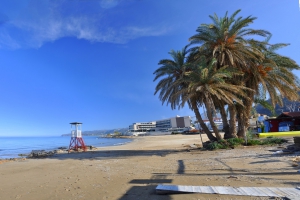
Stalis (or Stalida) is located 30km east of Heraklion, in the midway of Malia and Hersonissos. From a small seaside village set up by the residents of Mohos, Stalis is today a popular tourist resort, which is united with Malia town. The only difference with Malia is that Stalis attracts mainly families and things here are more peaceful.