Explore Underground Crete

Caves

It is a Spelunker's World

Cavers say that Crete has some of the most
challenging and spectacular caving systems in Europe
but even first-time cavers can enjoy its underground scenery.

Caving | Zoniana | Idaean | Diktaean | Melidoni | Cave Diving

Visitable Caves

Diktaean

Explore

Cave Fauna

Bats

Explore

Activities

Caving

Explore

Caves

The intense karst landscape of Crete is associated with the presence of thousands of caves, potholes, sinkholes and underground watercourses. Caves have been used by humans since prehistoric times as places of habitation, burial and worship. A characteristic example is the rock art in Skordalakia Cave near Asfendou, whose exact dating remains a subject of scientific research.

During the Minoan period, many caves became important sanctuaries. Eileithyia, the goddess of childbirth and protector of pregnant women, was worshipped in the Cave of Eileithyia at Amnisos and the Cave of Inatian Eileithyia at Tsoutsouras. The Diktaean Cave and the Idaean Cave became associated with the myth of the birth and upbringing of Zeus in Crete. In later centuries, ancient religious traditions gave way to Christian asceticism, and many caves were transformed into chapels, hermitages and monastic communities. Such places are associated, among others, with Saint Paul, Saint Gerasimos and Saint John the Hermit.

The caves of Crete are also associated with tragic moments in the island’s history. In the caves of Melidoni, Milatos and Kryonerida, as well as in Tigani Cave at Gramvousa, civilians who had sought refuge inside were killed during the period of Ottoman rule and the Cretan revolutions.

Approximately 5,200 caves and potholes have now been recorded in Crete, and their number continues to increase as exploration progresses. Particularly important areas for speleological research are the White Mountains, the Psiloritis Natural Park, Mount Strouboulas and the Sitia Natural Park. The White Mountains are home to Gourgouthakas and Lion Cave, the two deepest explored caves in Greece, both exceeding a depth of 1,100 metres. Exploring them requires specialist equipment, training and the participation of organised speleological teams.

Some caves have been developed and are open to the public, including the Diktaean Cave at Psychro, the Gerontospilios Cave at Melidoni and Sfendoni Cave at Zoniana. Beyond their geological, archaeological and historical value, caves are fragile ecosystems inhabited by bats, invertebrates and other species adapted to the particular conditions of the underground environment. Visits to undeveloped caves should therefore be undertaken with respect for the cave environment and only by properly prepared visitors.

Diktaean Cave

Diktaean Cave

1 1 1 1 1 1 1 1 1 1 Rating 3.64 (48 Votes)
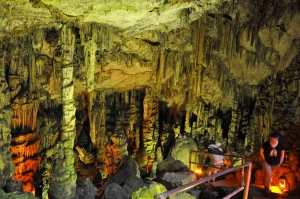
The impressive cave of Zeus, the Diktaean Cave, is located just 10 minutes walking-distance from Psychro, in Lassithi Plateau, at an altitude of 1025m. In Psychro there is plenty of parking areas, with plenty of restaurants nearby. Two paths leading to the cave start from the parking area. The easiest path is the left one, because in the right path (the oldest) the stones are worn by thousands of tourists and are slippery.

Read more ...

Labyrinth Cave

Labyrinth Cave

1 1 1 1 1 1 1 1 1 1 Rating 3.45 (32 Votes)
Cave Labyrinth is located 50km south of Iraklion, on a small hill, 3.5 km north of Kastelli village in Messara Plain. It was a huge artificial cave with labyrinthine corridors longer than 2.5km long and several rooms that did not lead anywhere, which served as a quarry for the extraction of stones used for construction of the Minoan palace at Phaestus.

Read more ...

Cave of Elephants

Cave of Elephants

1 1 1 1 1 1 1 1 1 1 Rating 3.76 (37 Votes)
The submarine Cave of Elephants is located in Drepano area of Akrotiri, in Chania prefecture and out of Souda Bay. The cave was discovered in 1999 by the snorkeler Manolis Efthymakis and was then showed in January 2000 in Star TV by the professional diver and filmmaker G. Tzanakis.

Read more ...

Melidoni Cave

Melidoni Cave

1 1 1 1 1 1 1 1 1 1 Rating 3.27 (31 Votes)
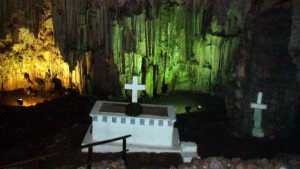
The Cave of Melidoni is located approximately 1,800 meters northwest of the homonym village of Mylopotamos. Gerontospilios, as also called, is very important due to the archaeological findings, some of which are exhibited in the Archaeological Museum of Rethymnon. Moreover, the cave has played a tragic role in the history of Cretan revolution against the Turks, in 1824.

Read more ...

Idaean Cave

Idaean Cave

1 1 1 1 1 1 1 1 1 1 Rating 3.38 (16 Votes)
Ideon Cave (or Ideon Antron) is located on the eastern slopes of Mount Ida (Psiloritis), in the plateau of Nida. The distance of the cave from Anogia is 24km and from Rethymno it’s 78km. The cave has not any special geological value, but has enormous mythological and cultural value, as this is the cave in which, according to the legend, the greatest Greek god, Zeus, was grown up. Today, thousands of tourists visit the cave every year, especially during the summer months.

Read more ...

Gerani Cave

Gerani Cave

1 1 1 1 1 1 1 1 1 1 Rating 3.65 (71 Votes)
Τhe cave of Gerani is one of the most important and most beautiful caves in the prefecture of Rethymno and in whole Crete. It is located 7 km west of Rethymnon, at the location "Kamari" and close to the beach of Gerani. The cave was accidentally discovered on March 15, 1969 during construction works for the modern highway.

Read more ...

Milatos Cave

Milatos Cave

1 1 1 1 1 1 1 1 1 1 Rating 3.94 (16 Votes)
Milatos Cave, also known as Rapas cave, is located 3km northeast of Milatos at an altitude of 155m. In order to reach the cave, the visitor should drive 2.5km east of Milatos (following the road sings) and then walk in the uphill footpath that leads to the cave entrance (10-15 minutes walking). Cave is easily accessible, is open to visitors, but torches are necessary for those who want to see the darker points of the cave.

Read more ...

Arkoudospilios Cave

Arkoudospilios Cave

1 1 1 1 1 1 1 1 1 1 Rating 3.94 (16 Votes)
Arkoudospilios (Bear Cave) or the Cave of Panagia Arkoudiotissa is located in Avlaki gorge of Akrotiri (Chania), 2km north of the Gouvernetou monastery, in the gorge connecting Gouvernetou with Katholiko Monastery. The cave is known for the bear-shaped rock that made the cave a place of worship of the ancient goddess Artemis.

Read more ...

Download Free Premium Joomla Templates • FREE High-quality Joomla! Designs BIGtheme.net