







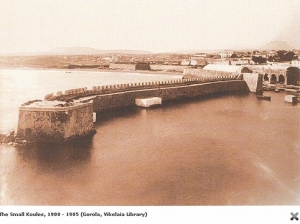
Opposite the Great Koules of Heraklion (Rocca al Mare), which still dominates the entrance to the Venetian port of the city, the Turks founded a smaller tower. It was the only fortification work that the Turks added to the harbor area throughout the period of their domination on the island.

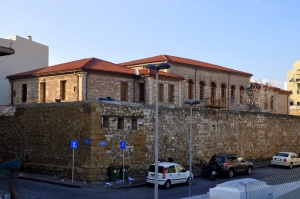
The building operated as a nunnery (Monasterio Greco Madonna Acrotiriani) during the Venetian Era (17th century) and was a dependency of the monastery of Panagia Akrotiriani Toplou by Sitia. A document of 1671 states that the main temple was dedicated to St. John the Theologian, while there was another church dedicated to St. Peter.
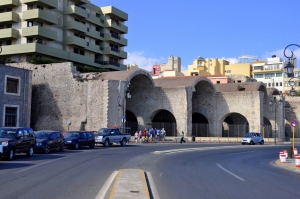
At the port of Heraklion we see even today part of the shipyards (arsenals) consisting of large elongated domed rooms. They are the shipyards of the Venetians where they housed, stored, constructed and repaired their ships.

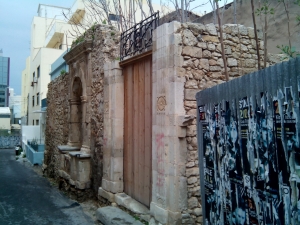
The Fountain of Ibrahim Babas is located, in a terrible situation, in current Almyrou street, just north of the Park Theotokopoulos. Unfortunately, strangers have stolen parts of elaborate relief plates that adorned the fountain. The fountain is fitted on the exterior wall of the house of Ibrahim Baba that has now collapsed.
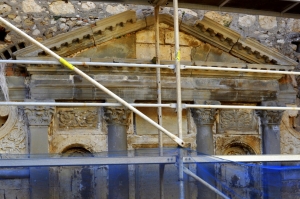
Priuli Fountain or Fontana Nuova is located at Delimarkou Street, behind the Bodossakio School and opposite the Venetian gate of Dermatas. It was built near the end of the great siege of Candia (1648-1669), after the Ottoman besiegers interrupted the water supply from the aqueduct that carried water from Youchtas area.
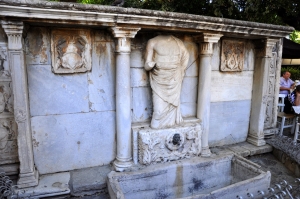
On the north side of the Kornarou square we meet the Venetian Bembo Fountain and the Turkish sebil (charity fountain) built later. The fountain was constructed between the years 1552-1554 during the rule of the captain Gian Matteo Bembo, who first watered Candia with spring water via aqueduct.
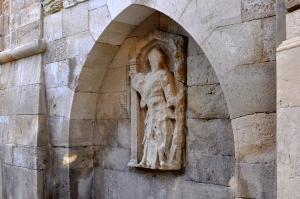
The fountain that we meet today in the north wall of the Venetian Loggia was built by the Duke Jiovani Sagredo during 1602-1604 to serve the nobles who were gathered in the Loggia.
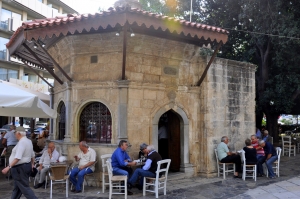
The sebil of Kornarou Square, which now houses a municipal coffee shop, was built in 1776 by Hadji Ibrahim Aga who spent his entire fortune on its maintenance. It is a polygonal building with arched windows. Under each window there was a tap and a stone trough.
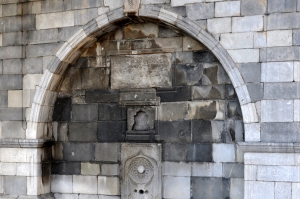
In today's Zografou Street existed until the early 20th century, the house of Chanialis. The house exterior hosted an elaborate fountain, which was moved to its current location, at the exit of St. George's gate.
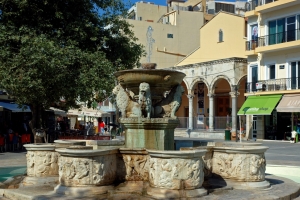
The fountain of Morozini (known as Lions) is one of the nicest Venetian monuments of Candia (current Heraklion). The fountain was watered by the spring of Karidaki and the watered traveled about 15km in a gigantic aqueduct, one of the longest in the then world.
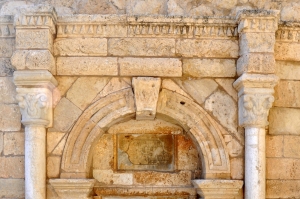
The fountain is located at Michelidakis street, behind the Historical Museum of Crete. The fountain was not originally here, but adorned the exterior of the house of the doctor Idomeneas Markatatis. We can see two columns with capitals that bear performances with plants and an Ottoman inscription.
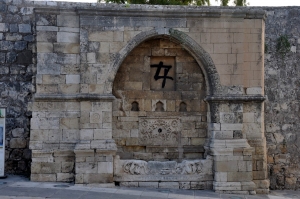
The fountain of Yenitsar Aga is located at the beginning of the Avenue Ikarou, below the epigraphy collection and opposite the Archaeological Museum. It was originally embeded outside a beautiful mansion on the corner of the streets Markou Avgeri and Paleologou, which was demolished in 1980.

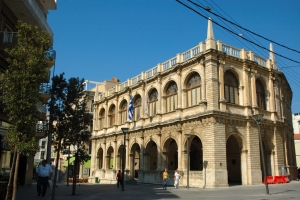
The Venetians used to build a luxurious building in each of their cities, where the nobles could pleasantly spend their time and socialize. In Candia, they built the Loggia (meaning Noble Club) which is now met on the August 25 street.
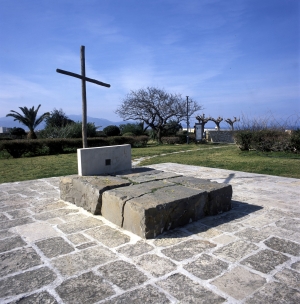
The grave of the important Cretan writer Nikos Kazantzakis (1883-1957) is located at the highest point of the Walls of Heraklion, the Martinengo Bastion, with panoramic views to the ugly, but also historical, concrete jungle of Heraklion.
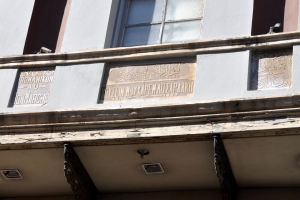
The building at 8 Agiou Mina Str was a drapery shop owned by Hussein Muharem Litsardakis. Built of stone and wood with a tiled timbered roof, it was erected in the closing years of Ottoman rule and inaugurated in 1892.
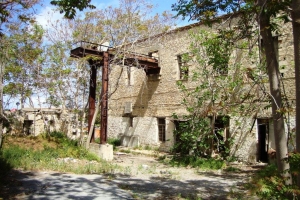
The derelict flour mill of Kastrinakis is located within the Municipal Parking of Heraklion and has been declared as a protected monument since 1997, awaiting patiently for its restoration. The land was purchased by Nikolaos Kastrinakis in 1896 and in 1904 he built the initial flour mill and the furnaces.
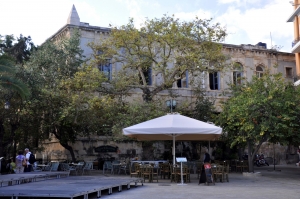
The Venetian armoury (Armeria or Armarento) is situated between the Loggia and St. Titus Square. Although it served a different purpose than the noble's club, the two buildings formed a single complex.
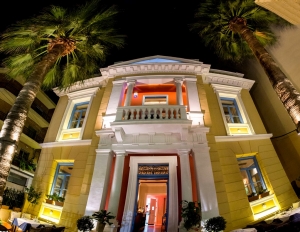
Here we meet an important sample of later Neoclassicism in Heraklion built in 1907 belonging to Chatzidakis family. The building is known as French School because it housed the French Institute of Heraklion in the past. The floor plans are very similar to another well-known building of Crete, the villa of Koundouros at Chania.
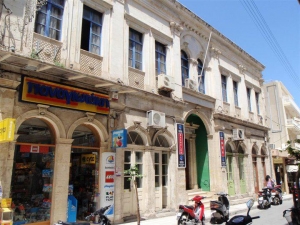
It is a wood and stone building with a roof in three sections. The main entrance is set back in a recess in the wall. There are eight arched thresholds on the ground floor, with an equal number of pilasters above. The wide variety of architectural features employed includes cornices with cyma moulding, pilasters, capitals of various types and parapets embellished with rosettes.
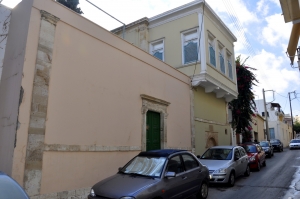
The building at 17 Halbherr Str. during the Ottoman Era was the residence of Mirtza Efendis. It is a two-storey wood and stone building with later additions in reinforced concrete. A high wall marks out the entire property.
- 1
- 2
Also read:
- Home
 Beaches
 Nature
 Past
Past Destinations
 Highlights
 West Crete
- Central Crete
- East Crete
- Towns
- Chania Prefecture
- Chania
- Paleochora
- Kissamos
- Georgioupolis
- Chora Sfakion
- Loutro
- Rethymnon Prefecture
- Rethymnon
- Agia Galini
- Plakias
- Spili
- Anogia
- Heraklion Prefecture
- Heraklion
- Hersonissos
- Malia
- Matala
- Agia Pelagia`
- Archanes
- Kokkinos Pirgos
- Lassithi Prefecture
- Agios Nikolaos
- Elounda
- Sitia
- Ierapetra
- Makrigialos
- Palekastro
- Zakros
- Lassithi Plateau
- Get Prepared


