


• Home
  • ⭐ Travel Guide for Island Crete ⛵, Greece❗ - Φαγητό

  • Since the early Christian years, Crete became a cradle of Orthodox Christianity. This is reflected on the hundreds of religious monuments on the island. Even the struggles for liberation, in most cases, started from the monastic communities.

    Religious tradition is very intense in all areas of Crete and is present in everyday life of the Cretans. Crete has an autonomous Archbishopric, separate from the rest of Greece. With thousands of places of worship and dozens of monasteries that have played a special role in the consolidation of Christianity and the struggle against the invaders, Crete is an ideal religious and historic destination.

    Since the early Christian times, when Paul the Apostle visited Crete and preached the new religion for two years, the Christian tradition developed through the centuries. Remote places of monastic self-exile, traces of early Christian basilicas, cavernous chapels and painted Byzantine churches are found everywhere on Crete.

    Many monasteries played an important historical role during the struggles of the Cretans for liberation. Moreover, Cretan iconography flourished especially in the Venetian Era, with El Greco and Michael Damascenus being the most important representatives.

    Before continuing his journey to Rome, Paul the Apostle, stayed two years in Crete to preach Christianity. This was the starting point for a century-long ascetic tradition, which is still vivid and alive. Before leaving to Rome, his follower Titus, was announced the first bishop of Crete.

    The new forbidden religion started spreading slowly around the island. Especially after the issuance of the Edict of Milan in 313 AD, which permanently established religious tolerance for Christianity within the Roman Empire, the first monumental temples were constructed.

    According to tradition, Paul the Apostle lived for two years in a small cave at Kali Limenes, which is open to visitors.

  • The first basilicas, temples of a specific architectural type, were founded in the 4th century AD. Their remnants are still awe-inspiring due to their size and imposing appearance.

    In Crete about 80 basilicas have been identified. This number indicates economic well-being, since the construction of such large monuments was very expensive. Gortys, Crete's capital till the Arab rule, hosted the largest of those, dedicated to Saint Titus. Its remains are located near the village Mitropoli, while there is a smaller basilica within the archaeological site of Gortys, also dedicated to Saint Titus.

    Apart from the basilicas of Gortys, the visitors can see ruins of similar religious monuments at Hersonissos, Fragokastelo, Elounda, Almyrida, Panormos, Goulediana, Sougia, Eleftherna and other parts of Crete.

  • Paul the Apostle left a great legacy for the future preachers of the Christian faith. His replacement, Saint Titus, soon became widely known for his prominent personality. Today his skull is stored in the imposing church of Saint Titus in Heraklion.

    Another important religious figure, who is considered the founder of asceticism on the island, was Saint John the Hermit. John arrived in Crete with 98 other hermits from Egypt and lived in caves, at the site where Azogyres Monastery is located today. Later, he lived alone in caves of Marathokefala and Akrotiri Cape, where a rich ascetic tradition was developed.

    Another bishop of Crete, Saint Myron from Rafkos, is celebrated with a splendor in the village Agios Mironas. Holy water gushes in the cave where he lived. Last, during the empire of Decius, ten Christians were beheaded for their faith in Christ. Today, the village Agii Deka (“Ten Saints” in Greek) is built on the site where the martyrs lost their lives.

    Pope Alexander V (1409-1410), given name Peter Philagris, came from Crete.

  • The arrival of St. John the Hermit in Crete was the beginning of a great ascetic tradition that continues to the present day. Hundreds of hermits secluded in the most remote parts of the island, forming ascetic communities that later evolved to thriving monasteries.

    A special sample of hermitage is the Catholic Monastery at Akrotiri Cape in the caves of which hermits lived their monastic life away, from worldly pleasures. Equally important were the religious sites of the secluded peninsulas Gramvousa and Rodopos, where several small monasteries developed.

    The greatest hermitage of all was the naturally isolated, and impassable range of Asterousia in southern Heraklion. Hundreds of caves from Saint Nikitas to Cape Lithino still host hermits. The Relations between them were so limited that in Agiofarago and Martsalo they gathered only once a year, in cave Goumenospilio and counted how many of them survived each year.

    In eastern Crete, the north province of Mirabello is the largest field of asceticism with dozens of small monastic establishments. Here hermits built small monasteries, where they usually lived alone.

  • In Crete there are more than 800 churches adorned with wonderful frescoes, which depict the evolution of ecclesiastical art from the early Byzantine times to the Cretan School of Painting during the Venetian Era. There are some specific areas with an impressive number of such temples.

    Apart from the great religious center of Mirabello, the area of Avdou and Episkopi by Heraklio boasts a large number of monuments of outstanding artistic and religious significance. The region that can be characterized as the largest hagiographic park site in Crete includes the provinces Selino and Kissamos. It hosts dozens of chapels bearing frescoes, painted by prominent artists of their time.

    Magnificent samples of hagiography and ecclesiastical architecture are located in many other parts of Crete. One of the most famous monuments is Panagia Kera in Kritsa, while other important temples are Saint Nicolas in Kyriakosellia, Panagia in Meronas, Varsamonero, Panagia Kera Eleousa in Kitharida and more.

  • During the transition from the worship of Roman deities to Christianity, many of the previous habits were incorporated into the new religion. Devotional caves and Minoan peak sanctuaries continued to serve the worship of Twelve Olympians and were later adapted to the Roman religion, before transforming to Christian temples.

    Caves in steep cliffs and canyons are still used as places of worship. In canyons, temples are usually dedicated to Saint Anthony, such as in the gorges of Patsos, Agiofarago, Samaria, Platania, Gallos, Kotsifos. Other well-known cavernous chapels are Saint Anthony at Koudoumas, Hagia Sophia in Topolia, Agia Dynami in Argyroupoli, Saint John by Kapetaniana, Panagia Kera Spiliotissa inAgios Thomas, Saint John the Hermit at Akrotiri and Marathokefala, Panagia Arkoudiotissa at Gouverneto, Saint Andrew at Finokalias, Panagia Spiliotissa in Houdetsi, Santa Fotini in Avdou, and more.

    Today, temples have been built on the site of former Minoan peak sanctuaries and serve Orthodox Christianity. Most of them are dedicated to the Holy Cross or the Prophet Elijah. The churches of Christ at the sacred mountain of the Minoans, Youchtas, the Holy Cross on the highest peak of Crete and at Kofinas, Saint Panteleimon at the site of ancient Rizinia, All Saints at Vrisinas and more are very impressive.

  • On the occasion of the feast of Saints of the Orthodox Christian calendar, many local feasts are organized in villages and towns of Crete, especially in August.

    The feasts, along with religious and worship importance, contribute to the preservation of customs and traditions and to the social interaction of among the local communities. After the festivities in the temples, locals gather at the central squares of the villages and celebrate with music and dance till the early morning hours.

    One of the most important religious traditions in Crete is the celebration of Christmas Mass in a real manger in the cave Marathokefala. Also during the festival of Saint John the Theologian at Marmaketo, on Lassithi plateau, the dried orchids of the epitaph bloom again. In Agios Thomas and on the Asterousia range ancient habits revive; temples and houses are surrounded with waxed ropes, to keep evil spirits away.

    Ancient customs for curing patients are still alive. In Sfakia patients devote dough dolls to Saint Anthony to cure their illnesses and in Psiloritis they devote human shaped breads, lazaropsoma, during memorial services. During the celebration of Agia Pelagia, patients bury their aching legs or hands in the sand of the beach. In Achlade clothes are put on the sacred turpentine tree of Saint Fanourios.

    Apart from the common Easter customs in Greece, Crete has some special local traditions to show. These include the auction of the Cross, the blessing of sheep under the epitaph, the burning of Judas, the transferring of the Holy Light at home while keeping silent and leaving red eggs on graves.

    There are more customs, such as Klidonas, celebrated on the day of Saint John the Baptist in late June. During the feast of the Transfiguration of Christ, pilgrims devote the first grapes of the season to bless their vineyards, while on the same day at the top of the peak Afendis of range Dikti, participants try to find coins in the soil around the church. On 3rd November, on the celebration day of Saint George “Methystis” (methystis, one who makes you drunk) barrels with wine are first opened.

    The Villages Asi Gonia and Karoti at Rethymnon host the celebration of Saint George. Sheep are milked before the priest and milk is shared to the congregation.

  • Visitors of Crete have the opportunity to admire collections of ecclesiastical art in numerous museums and open exhibitions around the island. Very old icons, priestly vestments, manuscripts, seals and books are some common exhibits.

    Well organized ecclesiastical collections are housed in the Byzantine Museum of Chania, the Ecclesiastical Museum of Rethymnon and the Byzantine Collection of Heraklion hosted in the Basilica of Saint Catherine of Sinai.

    Important monasteries often house folklore or religious museums with very interesting exhibits. Such collections include the monasteries of Arkadi, Toplou, Tzagaroli, Gonia, Chrysopigi, Preveli, Kalyviani and the Ecclesiastical Museum of Roustika.

1 1 1 1 1 1 1 1 1 1 Rating 5.00 (1 Vote)
Church of Holy Trinity in Ligortynos

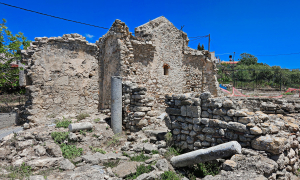
The ruined church of the Holy Trinity (Agia Triada) is located within the boundaries of the settlement of Ligortynos in the province of Monofatsi. Its use is placed from the post-Byzantine period to the Venetian period, and more specifically between the 11th and 15th centuries, with most findings dating to the 12th and 13th centuries.

Read more ...
1 1 1 1 1 1 1 1 1 1 Rating 5.00 (1 Vote)
Church of Saint Isidore in Kakodiki

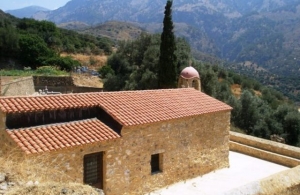
The church of Saint Isidore (Agios Isidoros) is built on a small plateau atop a hill in the small settlement Tzinaliana in Kakodiki, province Selino. It belongs to the architectural type of the one-room arched-roofed temples. At the entrance we can see two parts of an ancient Doric architrave.
Read more ...
1 1 1 1 1 1 1 1 1 1 Rating 5.00 (2 Votes)
Saint Nicholas church at Moni

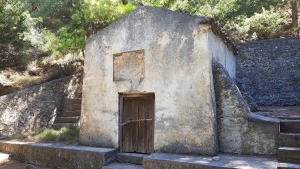
The church of Saint Nicholas (Agios Nikolaos) is built in a rural area northeast of the village Moni, province Selino. Its oldest eastern section was built in the architectural type of a single-storey arched temple with blind arches on the side walls.

Read more ...
1 1 1 1 1 1 1 1 1 1 Rating 3.50 (2 Votes)
Mary of Egypt Church at Samaria

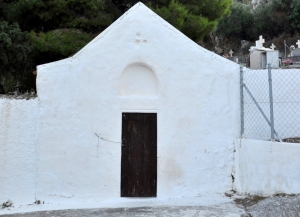
The small single-nave arched temple of Mary of Egypt is located in the Samaria deserted settlement, inside the imposing gorge of Samaria, accessed by a short path. According to one option, the name of the Samaria Canyon derives from the corruption of the name of Osia Maria (Saint Mary). The church celebrates on April 1st, when several mountaineering clubs of Crete participate in the festival.

Read more ...
1 1 1 1 1 1 1 1 1 1 Rating 5.00 (1 Vote)
Life Giving Spring church at Kavousi

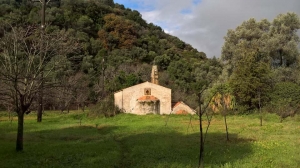
The church of Zoodochos Pigi is located at the position Sfakias and serves as the cemeterial church of the village Kavoussi. It is dedicated to the Theotokos and has the name of the Life giving Spring (Zoodochos Pigi), referring to the Marian pilgrimage of the same name in Constantinople.

Read more ...
1 1 1 1 1 1 1 1 1 1 Rating 5.00 (2 Votes)
Church of Saint Basil in Vavouledo

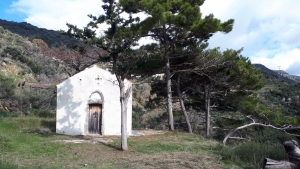
The church of Saint Basil is located to the north of the village of Vavouledo, province Kissamos, which is one of the many neighborhoods of Palea Roumata. The current church is the extension in the 19th century of the initial smaller single-nave arched church of the Savior Christ, dating back to the 15th century.
Read more ...
1 1 1 1 1 1 1 1 1 1 Rating 5.00 (1 Vote)
Church of Saint Athanasius in Kefali

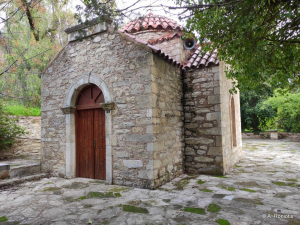
The church of Saint Athanasius (Agios Athanasios) is located just outside the village Kefali of the area called Nine Villages in Kissamos province. The single-nave arched temple is surrounded by a beautiful piney park and its interior has a reinforcing arch.

Read more ...
1 1 1 1 1 1 1 1 1 1 Rating 5.00 (1 Vote)
Saint Paraskevi church at Ambelouzos

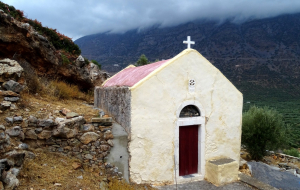
The church of Agia Paraskevi of Meritis is located within the boundaries of the Agricultural School of Messara at the entrance of the village of Ambelouzos. The church is the only surviving remnant of the small monastery that functioned as part of the Monastery of Saint Fanourios in Valsamonero.

Read more ...
1 1 1 1 1 1 1 1 1 1 Rating 5.00 (1 Vote)
Saint Anthony church at Kavoussi

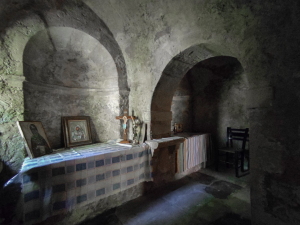
The church of Agios Antonios (Saint Anthony) is located at position Vrysidia, above the beach of Tholos, in Kavousi, Ierapetra province. The church was a katholikon (main temple) of a small monastery that is placed chronologically at the end of the 14th century. In fact, there is a visitor inscription with the year 1390.

Read more ...
1 1 1 1 1 1 1 1 1 1 Rating 4.50 (1 Vote)
Saint Anthony church at Ano Asites

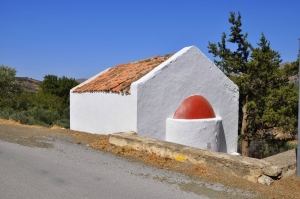
The cavernous church of St. Anthony (Agios Antonios), maybe a former monastery, is located above the starting point of the gorge of Kato Asites, at a beautiful green location with plane trees and springs.

Read more ...
1 1 1 1 1 1 1 1 1 1 Rating 5.00 (1 Vote)
Saint George church at Ano Viannos

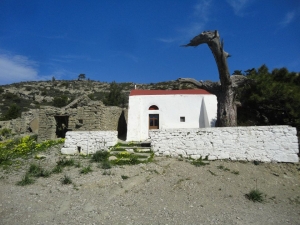
The church of Agios Georgios is located in the plane of Ano Viannos, on the road that leads to the Monastery of Agia Moni. It is a small vaulted and single-aisled church with its interior bearing frescoes of Ioannis Mousouros, dating back to the beginning of the 15th century (there is the date 1401). The temple was built at the expense of Georgios Damoro.
Read more ...
1 1 1 1 1 1 1 1 1 1 Rating 5.00 (1 Vote)
Christ Savior church at Pano Karkasa

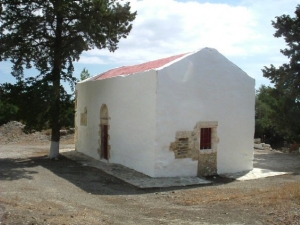
The church of Christ the Savior is located at Pano Karkassa, at the outskirts of the village of Anatoli in province Ierapetra and is dedicated to the Transfiguration of Christ. The temple was part of the ruined monastery Karkassia, the cells of which were later rebuilt into the residences we see today.
Read more ...
1 1 1 1 1 1 1 1 1 1 Rating 5.00 (1 Vote)
Holy Apostles church at Kato Karkassa

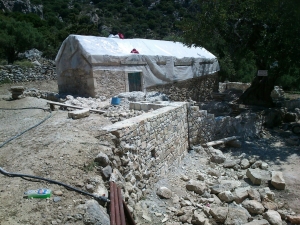
The church of the Holy Apostles, Saints Peter and Paul, is located at Kato Karkasa on the outskirts of the village Anatoli, province Ierapetra. The temple near the fountain was the cathedral of today's ruined Monastery of Karkassia, from which few traces of buildings to the south of the temple are preserved.
Read more ...
1 1 1 1 1 1 1 1 1 1 Rating 5.00 (1 Vote)
Church of Panagia Keragrammeni

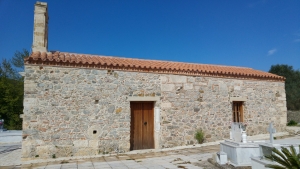
The church of Panagia (Our Lady) Keragrameni is located north of the village Stavros or Kapistri in the province of Ierapetra. The one-storey church is dedicated to the Birth of the Theotokos and is built near a spring that gives life to vineyards and orchards.
Read more ...
1 1 1 1 1 1 1 1 1 1 Rating 4.00 (2 Votes)
Church of Christ the Savior in Plemeniana

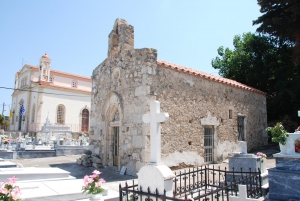
The cemeterial temple of Christ the Savior is dedicated to the Transfiguration of the Savior and is located in the village of Plemeniana in province Selino. It is built on the site of an Early Christian temple, as can be seen from the many marble architectural members that are embedded into the walls or are scattered around.
Read more ...
1 1 1 1 1 1 1 1 1 1 Rating 5.00 (1 Vote)
Michael Archangel church in Kakodiki

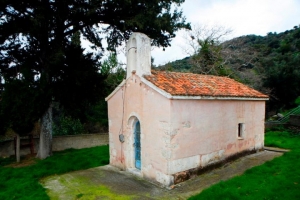
The cemeterial temple of Michael Archangel is located next to the church of the Holy Trinity (Agia Triada) in Kakodiki, province Selino, and is an elongated arched church with a pointed arch, reinforced by three reinforcing arches (sfendonia) supported by pillars.
Read more ...
1 1 1 1 1 1 1 1 1 1 Rating 0.00 (0 Votes)
Panagia Church at Kadros

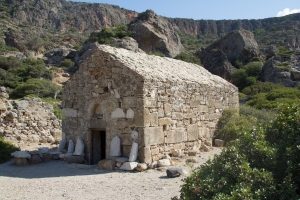
The Church of Panagia (Our Lady) Bitsiani or Pitsiani is located in the position Kaouriana of the small settlement Kadros in Kakodiki, province Selino, and is dedicated to the Nativity of the Virgin Mary (feast. September 8th).
Read more ...
1 1 1 1 1 1 1 1 1 1 Rating 5.00 (1 Vote)
Panagia Church at Lissos

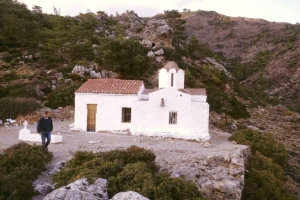
At the site of the ancient seaside town of Lissos, west of Sougia, there are the remains of two 6th-century triple-aisle wooden-roof basilicas with a slightly protruding transverse aisle, which were discovered in 1955 by archaeologist N. Padouvas.
Read more ...
1 1 1 1 1 1 1 1 1 1 Rating 5.00 (2 Votes)
Church of Saint Irene in Sougia

To the north of the Sougia settlement, the church of Saint Irene (Agia Irini) is preserved in the architectural type of the single-nave church with a dome, to which an arched-roof narthex was added in a second stage, which survives as a late reconstruction of its dome.

Read more ...

Also read:

Download Free Premium Joomla Templates • FREE High-quality Joomla! Designs BIGtheme.net