








 Saint Onoufrios monastery at Voulismeni
On a small hill north of Voulismeni, in the area of Neapolis in Lassithi, stands the old Monastery of Saint Onuphrius (Agios Onoufrios), a particularly important monastic complex of Mirabello. The surviving remains include the church, which served as the monastery’s catholicon, as well as ruins of the monks’ cells and other auxiliary buildings.
Insufficient historical evidence survives regarding the foundation and operation of the monastery. The church is believed to have been constructed during the 13th century, in the early centuries of Venetian rule, while retaining strong influences from the Middle Byzantine architectural tradition. Its different construction phases cannot be determined with complete certainty.
The church is a single-nave barrel-vaulted building, with a reinforcing transverse arch supported on corbels. Its southern façade is of particular interest, as it is articulated by three blind arches. The arches are framed by brickwork and a sawtooth ceramic band, while additional decorative brick elements appear between them. These features represent revivals of architectural motifs from the Middle Byzantine period.
A doorway made of grey limestone was later added to the western blind arch, replacing the original entrance, while a window was opened in the central arch. These alterations probably date from the 16th or 17th century. The elaborate doorway consists of two arches terminating in a carved floral ornament.
The interior of the church is decorated with noteworthy frescoes. The prevailing interpretation dates the paintings to the second half of the 14th century, although an earlier study attributed them to the late 12th or early 13th century. The iconographic programme includes scenes from the Gospel cycle, such as the Nativity, the Presentation of Christ in the Temple, the Raising of Lazarus, the Entry into Jerusalem, the Crucifixion and the Ascension, as well as possible representations of the Washing of the Feet and the Presentation of the Virgin in the Temple.
The Virgin Mary with archangels is depicted in the sanctuary apse, while other surviving representations include the Virgin Platytera, the Annunciation, prophets, hierarchs and various saints. Among the identifiable figures are Saint Stephen, Saint Cyprian, Saint Eleftherios, Saint Menas, Saint Nestor, Saint Nikitas and Saint George on horseback.
Of particular importance is the compact and relatively rare iconographic cycle dedicated to Saint Onuphrius, which develops mainly along the northern wall. It includes episodes from the life of the ascetic saint, among them a representation of Saint Onuphrius with the lion. Although much of the painted decoration has deteriorated, its careful execution, expressive figures and rich range of subjects can still be appreciated.
To the north and west of the church survive the remains of the buildings that formed the monastic complex, including monks’ cells and auxiliary spaces. Their arrangement created an almost enclosed and protected compound around the catholicon. According to local testimonies, the buildings were used at different times by a monastic community, as the residence of a wealthy landowner and later as the residence of a Muslim agha.
During these later phases, alterations were made to the old buildings, including the opening of new windows and doorways and the adaptation of the rooms for residential use. The wider complex also included storage areas, a well and a threshing floor, which served the daily needs and agricultural activities of the small monastic community.
The monastery was eventually abandoned, although the precise date on which it ceased to operate remains unknown. The church was restored in 1985 and returned to Christian worship, but the former monastic community was not re-established. The present appearance of parts of its masonry is largely the result of these restoration works.
The Monastery of Saint Onuphrius is today one of the most distinctive medieval monuments of Mirabello, primarily because of the architecture of its catholicon and the rare fresco cycle dedicated to its patron saint. Other historic monastic monuments in the wider area of Voulismeni include Panagia Vigliotissa and the Monastery of Saint Anthony at Fraro.
Source: Cretan Panorama, March–April 2008, feature on the Monastery of Saint Onuphrius at Voulismeni, pp. 148–163.


Nearby places of interest
Straight-line distances
 0.7 km
Lord Christ church in Neapolis
 0.8 km
Fraro Monastery at Neapolis
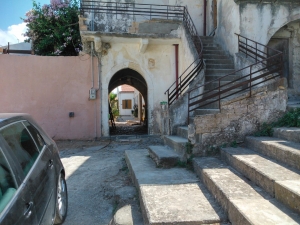 1 km
Tower of Maslum Karakasis
 1.2 km
Megali Panagia church at Neapolis
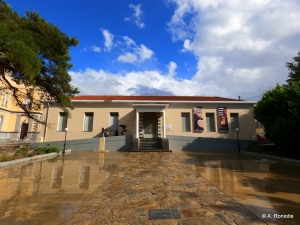 1.2 km
Folklore Museum of Neapolis
 1.3 km
Panagia Vigliotissa church at Voulismeni
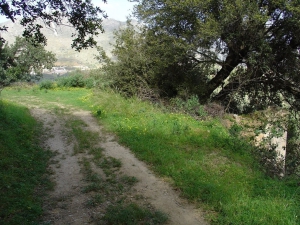 1.3 km
Pashaligo Grove
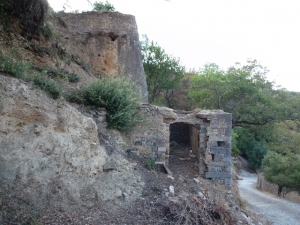 1.3 km
Pasqualigo Chateau
 1.5 km
Panagia Keragoniotissa monastery at Latsida
 2 km
Lord Christ Monastery at Nispitas
 2.5 km
Koufi Petra Monastery near Neapolis
 2.5 km
Kremasta Monastery near Neapolis
 2.6 km
Nikithianos windmills
 2.8 km
Ancient Dreros
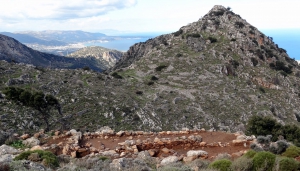 2.9 km
Anavlochos settlement
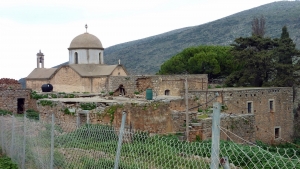 3.3 km
Monastery of Saint George at Xera Xyla
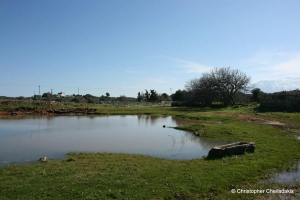 3.4 km
Kourounes Pond
 3.5 km
Cretan House of Vrahassi
Additional Info
- Location: Lassithi Prefecture
- Type: Church
- Accessibility: Dirt track


