Following the capture of Constantinople by the Fourth Crusade in 1204, the rights of sovereignty over Crete were granted to Boniface of Montferrat, who transferred them to the Republic of Venice. Although the agreement was concluded in 1204, the Venetians did not effectively establish their authority over the island until 1211, following several years of conflict with the Genoese.
The Venetians called the island the Kingdom of Crete or Regno di Candia and established Candia, present-day Heraklion, as its administrative capital. The island was initially divided into feudal estates granted to Venetian settlers and noble families, while its administration was closely connected to Venice’s political and commercial interests in the eastern Mediterranean.
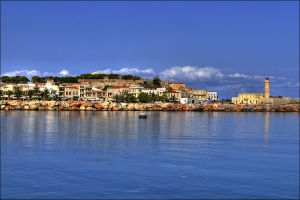
The principal cities and harbours were reorganised and protected by powerful fortifications. Massive defensive walls, fortresses, harbours, shipyards, fountains, loggias and public buildings transformed their appearance. Important surviving examples include the Venetian shipyards of Heraklion, the city’s Venetian fountains and the magnificent Loggia of Candia.
The long period of Venetian rule was not always peaceful. Heavy taxation, social inequality, the feudal system and religious tensions caused numerous uprisings among the local population. These included revolts led by the Kallergis family and the Revolt of Saint Titus in the 14th century, in which Venetian colonists also rebelled against the central authorities of Venice.
Over the centuries, a distinctive society developed in which Crete’s Orthodox and Byzantine traditions interacted with the intellectual and artistic influences of the Italian Renaissance. Particularly after the fall of Constantinople in 1453, scholars and artists helped transform Crete into one of the most important cultural centres of the Greek world.
The Cretan School of icon painting reached its height through artists such as Michael Damaskinos and Dominikos Theotokopoulos, better known as El Greco. Important works associated with this tradition are displayed in the Byzantine Collection of Heraklion. Literature, poetry, music and theatre also flourished, producing masterpieces such as Erotokritos by Vitsentzos Kornaros and Erophile by Georgios Chortatzis. This period of cultural prosperity became known as the Cretan Renaissance.
The Ottoman campaign to conquer Crete began in 1645. Chania and Rethymno fell relatively quickly, while Candia resisted a siege that lasted from 1648 until 1669. The surrender of the city ended Venetian rule over the main body of Crete and marked the beginning of Ottoman rule.
Venetian presence in the region did not completely end in 1669. The fortified islets of Souda, Gramvousa and Spinalonga remained under Venetian control. Gramvousa was captured by the Ottomans in 1692, while Souda and Spinalonga were surrendered in 1715, bringing the Venetian presence around Crete to a final end.