Following the capture of Constantinople by the Fourth Crusade in 1204, the rights of sovereignty over Crete were granted to Boniface of Montferrat, who transferred them to the Republic of Venice. Although the agreement was concluded in 1204, the Venetians did not effectively establish their authority over the island until 1211, after several years of conflict with the Genoese.
The Venetians called the island the Kingdom of Crete or Regno di Candia and established Candia, present-day Heraklion, as its administrative capital. Crete was organised according to Western feudal models, and estates were granted to Venetian settlers and noble families in exchange for military and administrative obligations. The island occupied a strategic position along the maritime routes connecting Venice with the Aegean and the eastern Mediterranean.
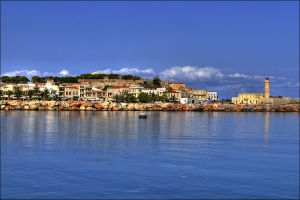
The principal towns and harbours were reorganised and protected by powerful fortifications. Defensive walls, castles, harbours, shipyards, fountains, loggias and public buildings transformed the urban landscape, and many of them still survive. Important examples include the Venetian shipyards of Heraklion, the Loggia of Candia, the Morosini Fountain and the Venetian Harbour of Rethymnon.
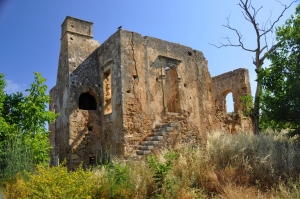
The countryside was organised around feudal estates, agricultural settlements, monasteries and country residences, such as the Trevisan mansion at Kokkino Metochi. Agricultural production, especially wine, grain and olive oil, supplied both local markets and the wider Venetian commercial network. Heavy taxation, social inequality and the obligations imposed upon rural communities, however, repeatedly caused unrest.
The long period of Venetian rule was far from peaceful. Numerous revolts broke out across the island, often led by powerful Cretan families such as the Kallergis. A particularly important uprising was the Revolt of Saint Titus in the 14th century, in which Venetian settlers also participated in opposition to taxation and the central administration of Venice. Over time, however, relations between the Greek and Latin populations became increasingly complex, contributing to the formation of a distinctive Cretan society.
The Orthodox and Byzantine traditions of Crete interacted with the intellectual and artistic influences of the Italian Renaissance. Particularly after the fall of Constantinople in 1453, the island developed into one of the most important cultural centres of the Greek world. The Cretan School of icon painting produced major artists such as Michael Damaskinos and Domenikos Theotokopoulos, better known as El Greco. Important works from this artistic tradition can be seen in the Byzantine Collection of Heraklion.
Literature, poetry, music and theatre also flourished. The most celebrated works include Erotokritos by Vitsentzos Kornaros and the tragedy Erophili by Georgios Chortatzis. This creative synthesis of Byzantine tradition and Western Renaissance influences became known as the Cretan Renaissance.
The Cretan War and the end of Venetian rule
The Ottoman campaign to conquer Crete began in 1645. Chania and Rethymnon were captured relatively quickly, while Candia resisted one of the longest sieges in European history. The siege began in 1648 and ended in 1669, when the Venetian commander Francesco Morosini surrendered the city to the Ottomans.
The surrender of Candia brought Venetian rule over the main island to an end, but Venice retained several fortified islets. Souda, Gramvousa and Spinalonga remained under Venetian control. Gramvousa was captured by the Ottomans in 1692, while Souda and Spinalonga were surrendered in 1715, bringing the Venetian presence around Crete to its final end.