








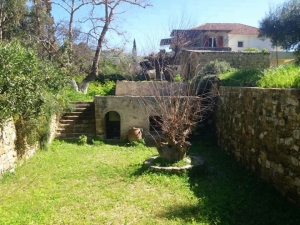
In the village Potamida, province Kissamos, lies the Kalogridis family watermill. The watermill was restored in 2013 by the locals and became operational again. The locals in the past used to bring their cereals to the watermill. Then, with the help of water, the millstones turned the mill, producing the precious flour.
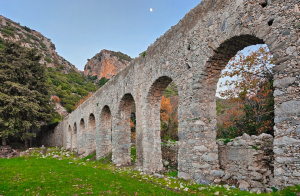
The watermill of Agia Fotia is located below the church of Saint Photini (Agia Fotia), at the exit of the Agia Fotia Gorge at the foot of Mount Vorizis and very close to Spili.
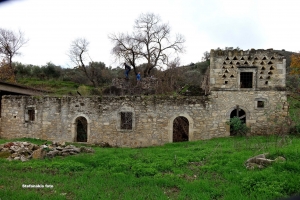
On the road that connects village Vori with the palace of Phaestus and next to the banks of river Geropotamos, we meet the ruined watermill of the area that locals call Gerontomylos (old mill). It is said that the area around the mill was a favorite place for the Greek writer Nikos Kazantzakis.

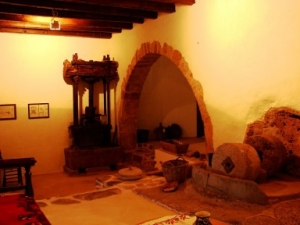
Next to the lush green Springs of Ano Zakros one can visit the Museum of Water and Hydraulic housed in three restored watermills since 2007.
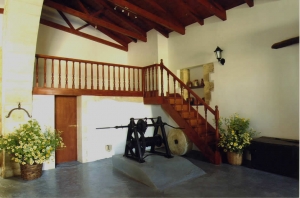
In the central square of the village Chromonastiri is the old oil mill of Prinaris family, fully renovated, with all its old equipment that can work till today.
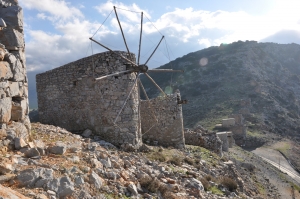
At position Seli Ambelou, at the northern entrance to the Lasithi Plateau, we are welcomed by the most important old windmill park of Crete. Here you still see 24 of the 27 initial windmills, which all belonged to the type Axetrocharis.
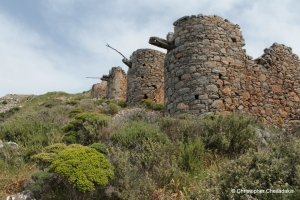
North of Fourni village, Merambelo district, we still meet one of the most impressive windmill park of Crete. There are still standing 13 windmills in a row at location Galaropetra. Others survive in good condition and others have collapsed.
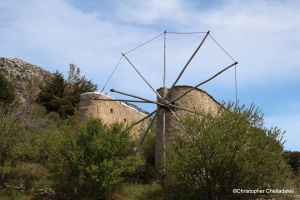
Within walking distance from the ruined village Argiro Nero, between the villages Zenia and Exo Potami we meet the small cluster of windmills of Katakalou. The mills are located in the same residential complex of Katakalou among vineyards and orchards. The mills operated after the destruction of the larger mill park of Zaroma, west of Mesa Potami.
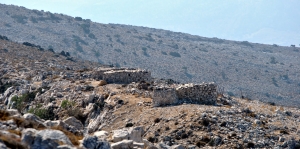
At this point there is a rough unknown windmill group that consisted of 10 mills and operated until May 1867. In these mills, local chieftains had gathered their wounded men during the titanic ten-day battle of Lassithi.
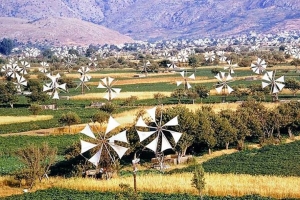
Lassithi plateau hosted, after the 1950s, the first, largest and most beautiful wind farm in the world with approximately 13000 windmills with a total installed power of above 5MW. The windmills operated as pumping engines above the wells of the plain to water the crops in summer.
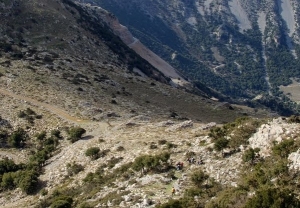
During the battle of Lassithi in 1867, the 10 windmills that stood near Potami village and were mainly used for milling, were destroyed by the Turks. The windmill park was then moved to Katakalou and Asfendami areas, and later moved to the big mill park of Ambelos.
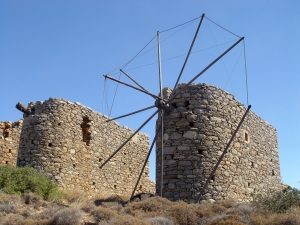
One of the large windmill parks of Merambelo district is located at Vrouhas village and consists of nine mills. They all turned only in a certain wind and their type is called Axetrocharis (this has rectangular shape with a round side where the mill is installed). In Crete we meet another type, Xetroharis that is completely circular, turning to all winds.
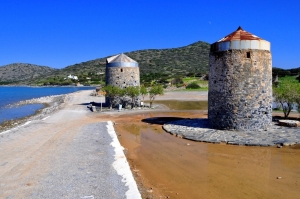
Contrary to the tradition of building mills on mountains, on the seaside of Elounda's ancient saltpans, we meet three windmills, at the scenic point where a canal connecting the lagoon with the south shores has been constructed. They all are completely circular, turning to all winds (this type is called Xetrocharis.
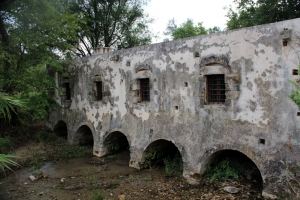
It is a two-room mill of the years of Venetian rule. It functioned as a mill of any kind of flour, until 1960. It is a unique sample of a mill with two carved stone and wooden water towers “Vagenas” (water pipelines in the rotors).
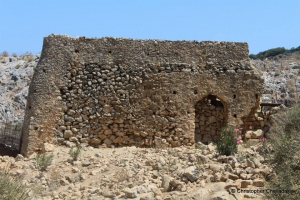
Bitzariano is a small abandoned scenic settlement close to Kastelli, Pediada district, and a suburb of Karouzana village. It name is taken after the surname Bitzarakis. Near the village runs the river that gathers water from the north Kasteli plain. The value of water was very high, as the locals built many watermills in order to shred the grain of the area.
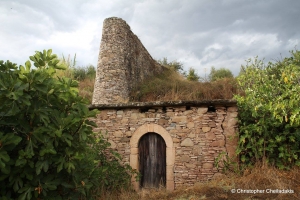
Just a few meters out of the village Gonies at province Malevizi, on the road that leads to the beautiful village Kamaraki with the two wonderful caves, we meet Paliomylos (Old Mill). The Paliomylos is one of the many mills that once decorated the ravines of the island
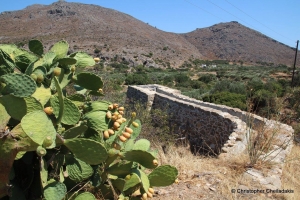
Sitia province, because it hosts many springs, hosted several places with watermills. Almost every village hosted one or more mills, unlike most places of Eastern Crete where windmills were used, because of the lack of water. One of the best preserved watermills that is still preserved in a very good condition is the watermill of Chochlakies. Chochlakies is a very small village with a very few residents today at the eastern end of Crete. The watermill of Chochlakies is built on the east end of the village, right on the path that leads to the gorge of Chochlakies and the beach of Karoumes.
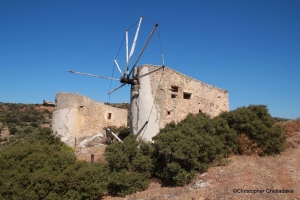
Near the settlement of Marnellides, Merambelo district, we still meet one of the many windmill parks of Crete. There are still standing 8 windmills in a row, while a little further up the mountain there is a ninth secluded windmill. . Others survive in good condition and others have collapsed. Marnellides mills are of the more usual windmill type of Crete that turns only in a certain wind and is called Axetrocharis (this has rectangular shape). These mills were used for grinding grain.
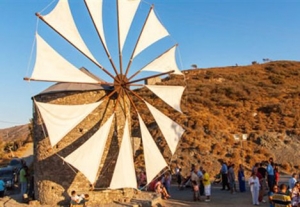
Above the village Gonies we meet the beautiful windmill of Manousakis, built in 1904 for grinding grain. The restored mill, fully functional today, ceased its commercial operation in 1988, and it was impossible to overcome the technological development of the time.
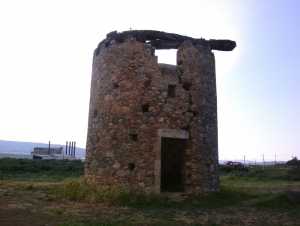
The Mill of Gazepis near the village Nipiditos has been declared a protected monument by the Modern Monuments Service. Here, Mathios Apostolakis from Nipiditos who was called with the nickname Gazep (ie "reactionary"), in the 19th century built a windmill.
- 1
- 2
Also read:
- Home
 Beaches
 Nature
 Past
Past Destinations
 Highlights
 West Crete
- Central Crete
- East Crete
- Towns
- Chania Prefecture
- Chania
- Paleochora
- Kissamos
- Georgioupolis
- Chora Sfakion
- Loutro
- Rethymnon Prefecture
- Rethymnon
- Agia Galini
- Plakias
- Spili
- Anogia
- Heraklion Prefecture
- Heraklion
- Hersonissos
- Malia
- Matala
- Agia Pelagia`
- Archanes
- Kokkinos Pirgos
- Lassithi Prefecture
- Agios Nikolaos
- Elounda
- Sitia
- Ierapetra
- Makrigialos
- Palekastro
- Zakros
- Lassithi Plateau
- Get Prepared


