







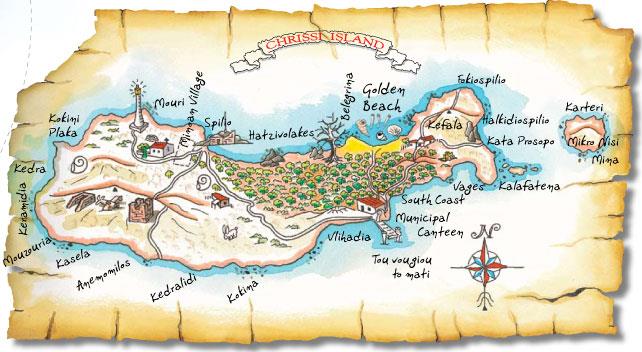

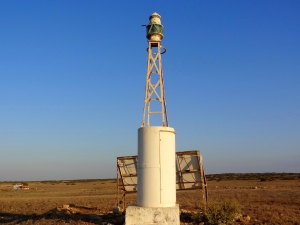
At the west part of Chrissi islet you will meet the small lighthouse, powered by photovoltaic panel. The lighthouse is located close to the small chapel of Agios Nikolaos (Saint Nicholas) and the dried lake of the island.

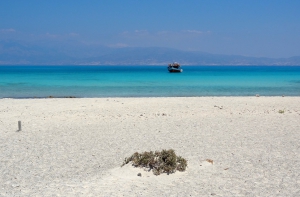
The thousands of visitors arriving daily by boat from Ierapetra to Chrissi island mainly swim on the beach of Belegrina or Golden Beach. Bright blue waters, white sand with pink shades from the thousands of broken shells, and the junipers that hold the sand with their huge roots are the backdrop that makes anyone fall in love with this place.

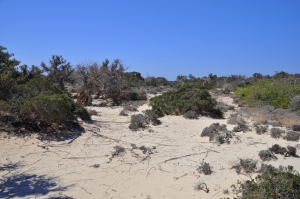
The dunes of the central narrowest part of the island of Chryssi, we meet one of the most important juniper wood (sp. Juniperus macrocarpa) in Greece, which has prevailed (erroneously) with the name cedarwood. In other parts of the island, such as west and east, we encounter vegetation with Juniperus phoenicea being the main plant.

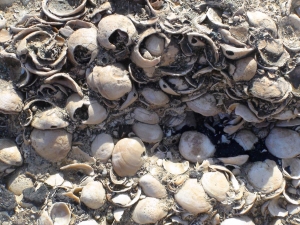
Chrissi can be considered a paradise for geology enthusiasts. One of the most spectacular geological sights of the island can be seen east of Belerinina beach, where you will meet thousands of fossils, mainly bivalves. The fossils form a so-called thanatocoenosis, that is, dead shells that have been gathered there by the streams and have fossilized over time.

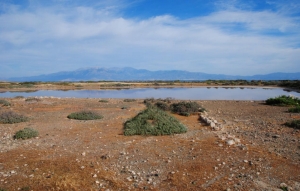
Next to the only house of Chrissi island, at position Spilios, we meet the old saltpan where salt was produced in the past. In winter the spot turns into a small pond with brackish water and it attracts many migratory birds. This is not the only pond on the island, as a smaller one is formed in the location of Kaki Alyki.

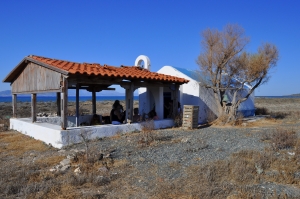
The church of Agios Nikolaos is located on the northern side of the island Chrissi, at the site where Tyrian purple was produced and graves are located. It dates back to the 13th century, although it has undergone more recent interventions. The temple is built on the site of an ancient building.

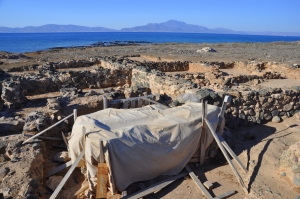
An important settlement of the Minoan and Roman period has been found in the island Chrysea of ancient Greeks, the present island of Chrissi or Gaidouronisi. Buildings and at least three carved tombs have been identified near the church of Agios Nikolaos and the lighthouse on the island. The settlement was probably used for the production of Tyrian purple from the shells of Murex brandaris, exactly like the neighboring isle of Koufonissi.
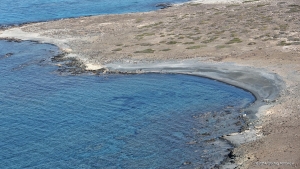
At the western end of the island of Chrissi, the small Cape Kendra is formed and right next to we meet the southernmost beach of the island. There is no high vegetation for shade, while the bottom, as in the whole island, is mainly rocky. You can combine your visit to the lighthouse and Agios Nikolaos with a walk to Kendra.
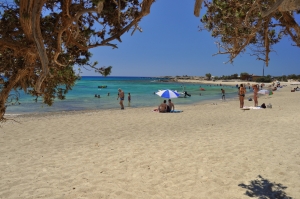
The position on the southern side of the island of Chryssi where the the boats carrying visitors from Ierapetra stop is called Vougiou Mati. To the west of the quay a small rocky bay is formed with small caves. On the east side of the quay, a long rocky beach is formed, which visitors prefer when the most popular beach of the island, Belegrina or Golden Beach in the north, is wavy.
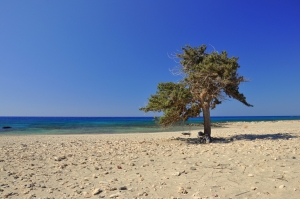
At the eastern end of the juniper wood of Chrisi we meet the small beach at Fragou Mnima. The area hosts a small saltpan, which the locals call Kaki Alyki and in winter it turns into a small swamp.
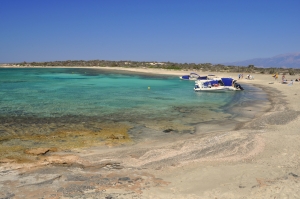
At the eastern part of the island of Chryssi and on the south side of the island the large beach of Vages is formed. Vages generally has a rocky bottom, except for the eastern edge where there is sand.
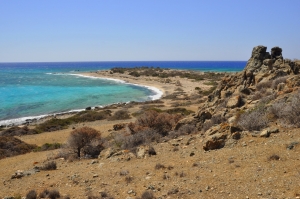
At the eastern end of the island of Chrissi lies the beautiful beach of Kataprosopo (=face to face), which faces the island of Mikronissi. Mikronissi is a great refuge for marine avifauna. In fact, the beach is divided into two by a thin strip of rocky land, while the vegetation in juniper is clearly more limited than the other beaches of the eastern part of the island. The waters are shallow and do not exceed 5m to Micronissi, making it ideal for snorkelling.
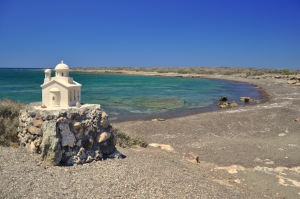
Approximately 500m west of the main harbor Chrissi island, approximately in the middle of the southern side of the island, a dirt road leads us to the beautiful Vlychadia beach. The beach has black and red chalk that comes from red lava, while the bottom is mainly rocky.
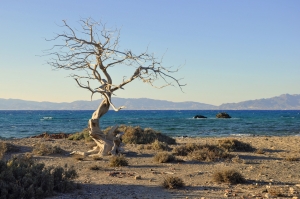
The longest beach on the island of Chrissi is Hadzivolakas, which extends west of the central beach of Belerinna. The beach has mainly rocky seabed and is ideal for isolation as most of the island's visitors are limited to Belegrina.
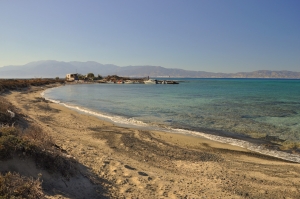
At the western end of the long beach of Chatzivolakas on the island of Chrissi, we find the beach Avlaki. Avlaki has rocky seabed, like almost the whole island. At the end of the beach there is the second harbour of the island at position Spilios and the only house in Chrissi built in the middle of the 20th century. The name Spilios (cave) is taken after an old house built in the rock.
Also read:
- Home
 Beaches
 Nature
 Past
Past Destinations
 Highlights
 West Crete
- Central Crete
- East Crete
- Towns
- Chania Prefecture
- Chania
- Paleochora
- Kissamos
- Georgioupolis
- Chora Sfakion
- Loutro
- Rethymnon Prefecture
- Rethymnon
- Agia Galini
- Plakias
- Spili
- Anogia
- Heraklion Prefecture
- Heraklion
- Hersonissos
- Malia
- Matala
- Agia Pelagia`
- Archanes
- Kokkinos Pirgos
- Lassithi Prefecture
- Agios Nikolaos
- Elounda
- Sitia
- Ierapetra
- Makrigialos
- Palekastro
- Zakros
- Lassithi Plateau
- Get Prepared


