







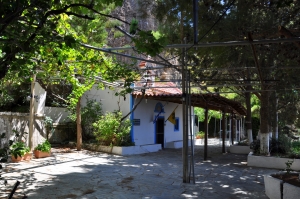
The small monastery of Panagia at Ligia is dedicated to Zoodochos Pigi (Life Giving Spring) and is located in a wooded area near village Stavrochori, province Sitia. There are several dirt roads leading to the site, with the most passable (5.2 km long) starting from the church of Agios Fanourios on the road that connects Koutsouras with Stavrohori.
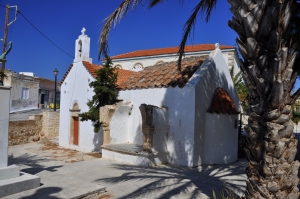
The central square of the picturesque village Lithines in the province Sitia hosts the Old School, which today operates as a cultural center. Just a few meters further we meet the Byzantine church of Agios Athanasios, dating back to the 15th century, but it does not bear frescoes.
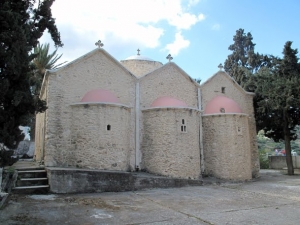
The imposing three-aisled church of Saint John the Theologian (Agios Ioannis) in Mesa Mouliana is located at the edge of the village and is the result of successive interventions in the original medieval Byzantine single-aisled church. .
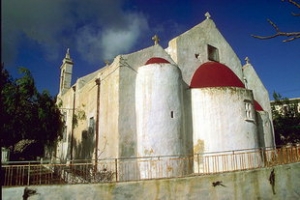
The three-aisled church of Panagia is located in the center of the village Epano Episkopi near Sitia and is dedicated to the Nativity of the Virgin, to Saint John the Baptist and Saint George.
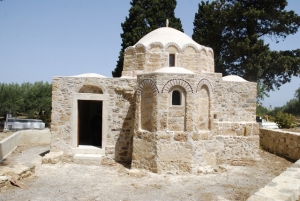
Ο μικρός οικισμός της Κάτω Επισκοπής Σητείας υπήρξε πιθανότατα έδρα της Επισκοπής Σητείας κατά τη δεύτερη βυζαντινή περίοδο. Στο νεκροταφείο του χωριού βρίσκεται ο ναός των Αγίων Αποστόλων Πέτρου και Παύλου, ο οποίος αποτελεί μετασκευασμένο λουτρό του 11ου αιώνα, πιθανώς της επισκοπικής κατοικίας που βρισκόταν απέναντι.
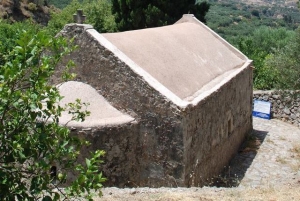
The church of Christ the Savior is located in the lush location of Mesa Pandeli or Pano Pandeli, on the outskirts of the village Chandras in province Sitia, and is dedicated to the Transfiguration of the Savior.
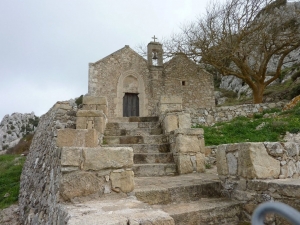
The church of Saint George (Agios Georgios) is located at the highest point of the ruined Medieval settlement of Voila, on the outskirts of Armeni village of Sitia, and very close to the imposing Venetian tower of Salamon family.
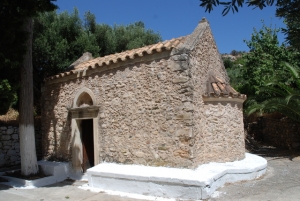
The church of the Apostles (Agii Apostoloi) is located in the ruined settlement of Andromyli, north of Lithines. It is a two-aisled church, the northern aisle of which is an addition to the original 9th-century single-nave church.
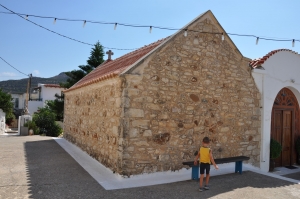
The Church of Panagia (Our Lady) in Lithines, province Sitia, is located in the center of the village. It consists of the original Byzantine church of the Dormition of Theotokos, which is strangely honored at the Birth of the Virgin.
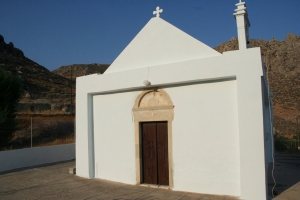
The settlement of Kalo Nero at province Sitia belongs to the village Pervolakia and was originally developed around the monastery of Panagia, dedicated to Zoodochos Pigi (Life Giving Spring). The monastery probably functioned for the first time in the 15th century next to the important spring of water in the area and functioned possibly as the religious center for the hermits who lived in the many caves around.

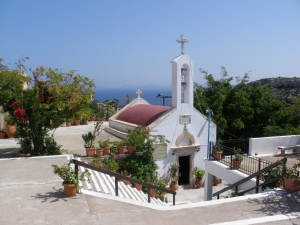
The Monastery of Panagia Faneromeni (Revealed Virgin Mary) in Trachilas area of Sitia is located on the edge of a steep area between the Cape Trachilas and Babakia, about 1.5km away from the sea and 8km west of Sitia town. It is built in a lush green area, next to the small gorge of Agii Pantes (All Saints), ideal for an easy walk.
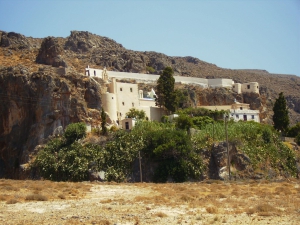
The Monastery of St. John in Kapsas is located 9km east of Makrigialos next to Goudouras. This is owned by Toplou Monastery, near Sitia, and is dedicated to the Beheading of St. John the Baptist, celebrated on August 29.
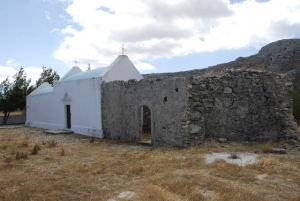
Agia Sophia is an old abandoned monastery located on the plateau of Armenochantrades. The monastery is surrounded by walls and in the center there still stands the church of Hagia Sophia. All around there are the ruins of the monk cells and some renovated buildings.
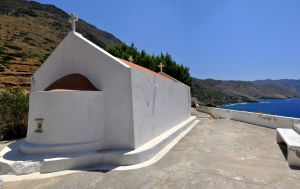
Below Liopetro Peak there is the very old church of St. John that once operated as a monastery, accessible through a very bad road starting from the main road connecting Lassithi to Sitia (initially cement road). The background to the towering phyllitic rocks of Liopetro is impressive.
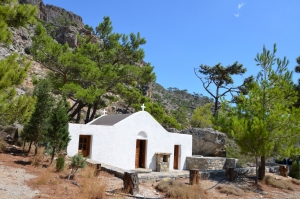
The Church of Transfiguration of Christ is located in the beautiful canyon Orino and you will meet it during the descent of the trail that leads in Koutsouras. The church bears remarkable frescoes in very good condition and has impressive architecture, as it is a single-nave barrel-vaulted with two equal-sized rooms on the sides.
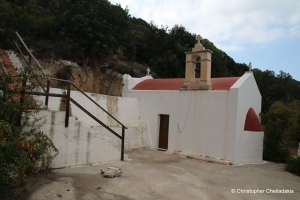
At the western village of Sitia province, Lastros we meet the church of Panagia Myrtidiotissa at position Sygomalia. The chapel celebrates every year on September 24th and is one of the few called "Myrtidiotissa" in Crete. The church is located at an idyllic countryside location overlooking the sea and the village of Lastros. The area is covered by maquis vegetation of wild olive, oak, locust trees and brushwood.
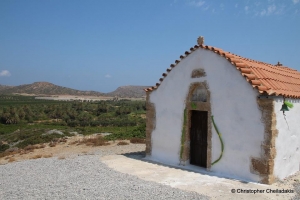
On the hillside just before the palm grove of Vai, province Sitia, we meet the picturesque chapel of St. John the Theologian. Saint John is a typical temple of east Crete; it is single aisled and quite old. It belongs to the neighbouring monastery of Toplou. From the temple, the view to the palm grove and the wider valley is very nice. The church is very old but the interior does bear any frescoes.
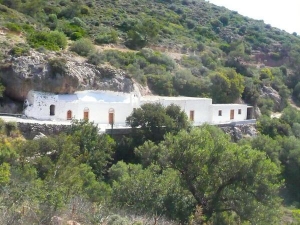
In a lush green ravine formed between Analipsis and Pefki we meet the former monastery of St. George of Samakidis. The church celebrates on November 3rd and is built in a cave. According to tradition, in 1471 Joseph Samakidis, who lived in the monastery of Panagia Kera by village Pilalimata left his monastery due to pirate raid.
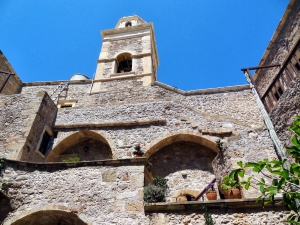
Toplou Monastery is located in the northeastern tip of Crete, at the base of Sidero Cape, 10km east of Sitia and 6km north of Palekastro. The monastery is one of the most historic monasteries of Crete and is known for its vast real property. In religious circles it is known as the Monastery of Panagia Akrotiriani, while the locals just call it the Great Monastery.
Also read:
- Home
 Beaches
 Nature
 Past
Past Destinations
 Highlights
 West Crete
- Central Crete
- East Crete
- Towns
- Chania Prefecture
- Chania
- Paleochora
- Kissamos
- Georgioupolis
- Chora Sfakion
- Loutro
- Rethymnon Prefecture
- Rethymnon
- Agia Galini
- Plakias
- Spili
- Anogia
- Heraklion Prefecture
- Heraklion
- Hersonissos
- Malia
- Matala
- Agia Pelagia`
- Archanes
- Kokkinos Pirgos
- Lassithi Prefecture
- Agios Nikolaos
- Elounda
- Sitia
- Ierapetra
- Makrigialos
- Palekastro
- Zakros
- Lassithi Plateau
- Get Prepared


