








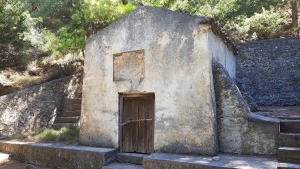
The small single-nave arched temple of Mary of Egypt is located in the Samaria deserted settlement, inside the imposing gorge of Samaria, accessed by a short path. According to one option, the name of the Samaria Canyon derives from the corruption of the name of Osia Maria (Saint Mary). The church celebrates on April 1st, when several mountaineering clubs of Crete participate in the festival.
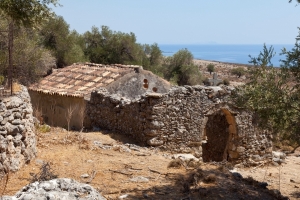
The church of Saint George (Agios Georgios) is located near the monastery Panagia Thymiani, in the periphery of Komitades village, province Sfakia. It consists of the original single-storey 14th-century arched-roofed temple, to which an extension was added, the roof of which has now collapsed.
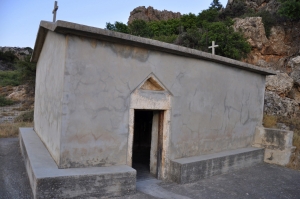
The church of Agia Paraskevi is located southeast of the village Argoules, above the small stream that ends on the beautiful beach of Agia Marina. It is a small single - nave, arched temple that has undergone a draft and inappropriate restoration with cement, as the southern wall had collapsed and its murals were in danger.
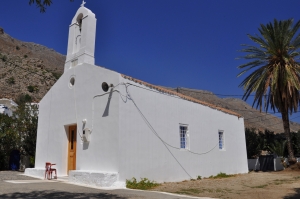
In the middle of the settlement of Loutro we meet the beautiful and spacious temple of Panagia, dedicated to Zoodochos Pigi (Life Giving Spring) celebrating five days after Easter. The courtyard has a large Cretan date palm tree and a well with water.
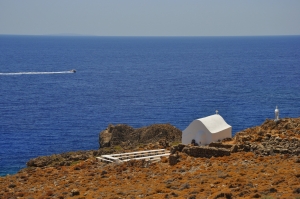
Between Loutro Sfakion and the famous beach of Glyka Nera, at Perlovakia, we meet the white brushed chapel of the Holy Cross (Timios Stavros) where a big feast takes place on September 14th every year.
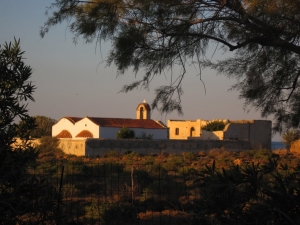
Among the greenhouses of Fragokastelo plain and above Orthi Ammos beach we meet the abandoned small monastery of Agios Haralambos. It is said that there settled in 1821 the monks Gregory and Magdalene, although it is believed that the monastery is much older.
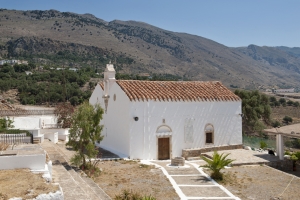
The monastery of Panagia Thymiani is located near Sfakia at position Thyme Armi and is one of the most historic sites in Crete. Here on May 29, 1821, the chieftains of Crete preached revolution against the Ottoman Empire. Therefore, the monastery is also called Agia Lavra of Crete (Agia Lavra is a monastery in Peloponnese from where the great Greek Revolution of 1821 started, leading to the liberation of Greece).
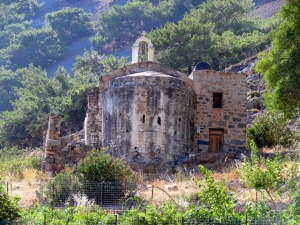
One of the most important Byzantine monuments is located in the gorge of Samaria, at the site of a former a temple of town Tarra (1st century AD). The initial church was a three-nave basilica and today what we see is the Byzantine church that was built in place of the initial.
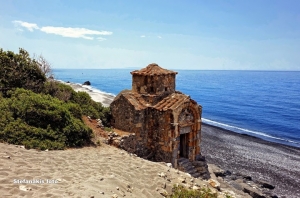
Saint Paul is a very old Byzantine church that was built at the place Selouda. The church is on the spot where Saint Paul reportedly baptized people on his way to Rome. It is a very picturesque small church, built on the beach using stones from the beach itself. This is why it is not easy to see the church from far.
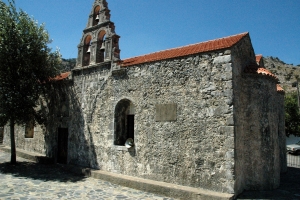
At position Ano Rouga of the deserted village Kallikratis, Sfakia province, we meet the two-aisled church of the Virgin Mary and Archangel Michael, built in the 19th century. The belfry of 1893 is very interesting and the sundial embedded on the wall.
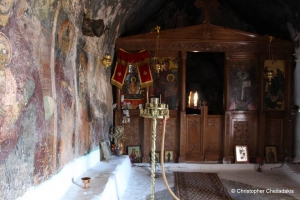
At the mountainous forested village of Agios Ioannis, Sfakia district, we meet the small church of Panagia that celebrates the day of the Assumption, on August 15. It is located on the outskirts of the large forest of St. John and is directly opposite the church of St. John, which gives its name to the village.
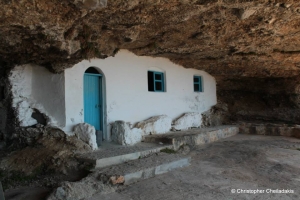
East of Sfakia, on the beach of Ammoudi, above Ammoudi we meet the church of Agios Haralambos. This is a typical cavernous chapel of the coasts and inland of Sfakia province. It is quite spacious because it is built in a relatively large cave. The location of the cave can be accessed via a short path that starts from the beach, but there is also a road that reaches the place.
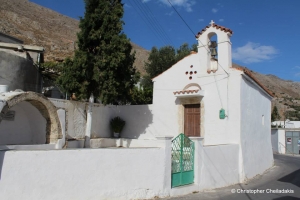
In the center of the historic village Vouvas at Province Sfakia, just on the main street, we meet the centuries-old church of Agia Paraskevi. It is the oldest church of Vouvas and it was adorned by exceptional frescoes. Today only a small part of these frescoes survives. What makes this church unique in Sfakia is that it is the only one where we meet frescoes with sinners at the time of their punishment in hell.
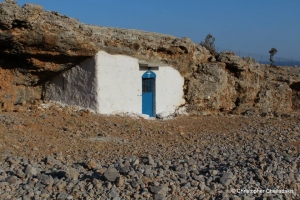
It is located very close to the road and south of the village in a remote place with many caves. The small church is at the starting point of a small ravine that ends at a steep beach. The colors on the walls are white with some touches of blue in some places reminding of a Cycladic island.
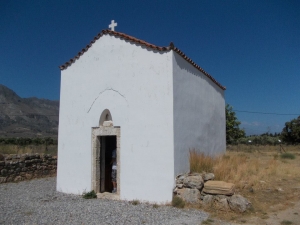
The Venetian church of Agios Nikitas (13th century) is located approximately 300m NE of Fragokastelo castle, on the ruins of an Early Christian Basilica of the 6th century. The walls bear frescoes from the Venetian era.
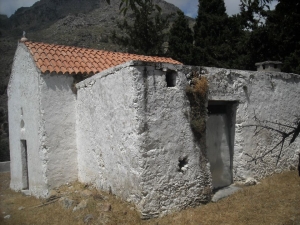
The church of Saint George is located above the deserted village Kolokasia in province Sfakia, near Frangokastello, at the exit of the gorge Asfendou. This temple gives the current official name of the village Kolokasia, Agios Georgios.
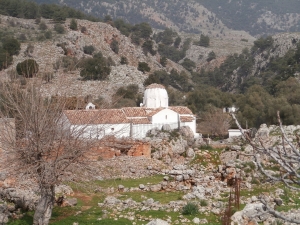
The impressive church of the Archangel Michael (celebr. November 8) on the edge of the canyon of Aradena is a cruciform church with a dome and is dated back from the 14th century, built on a former basilica of the 5-6th century that belonged to the city Aradin. It bears frescoes of the 14th centur and a mark with the date 1546.
Also read:
- Home
 Beaches
 Nature
 Past
Past Destinations
 Highlights
 West Crete
- Central Crete
- East Crete
- Towns
- Chania Prefecture
- Chania
- Paleochora
- Kissamos
- Georgioupolis
- Chora Sfakion
- Loutro
- Rethymnon Prefecture
- Rethymnon
- Agia Galini
- Plakias
- Spili
- Anogia
- Heraklion Prefecture
- Heraklion
- Hersonissos
- Malia
- Matala
- Agia Pelagia`
- Archanes
- Kokkinos Pirgos
- Lassithi Prefecture
- Agios Nikolaos
- Elounda
- Sitia
- Ierapetra
- Makrigialos
- Palekastro
- Zakros
- Lassithi Plateau
- Get Prepared


