East Crete beaches

Pahia Ammos

Lassithi

Pahia Ammos village

Pacheia Ammos is a seaside village in the province of Ierapetra, situated on the Gulf of Mirabello near the narrowest part of Crete.

Pacheia Ammos is located approximately 20km east of Agios Nikolaos and 13km north of Ierapetra, on the main road connecting Agios Nikolaos with Sitia. The village stands on the northern side of the Isthmus of Ierapetra, at the edge of a fertile plain covered with olive groves.

Its position between the principal towns of Lassithi, the beach of Pacheia Ammos and the important archaeological sites of the surrounding area have contributed to the village’s mild tourist development. Visitors will find tavernas, cafés, small hotels and rooms for rent.

The name of the village refers to the coarse sand that once covered much of its long seafront. The location is mentioned as early as the 17th century, although the modern settlement developed mainly during the 20th century. The name is also written as Pahia Ammos, Pachia Ammos or Pacheia Ammos.

Archaeological sites and attractions

The wider area has been inhabited since antiquity and has traditionally been associated with the ancient town of Minoa, although its precise identification is not considered certain. Pacheia Ammos is home to the INSTAP Study Center for East Crete, which supports archaeological research, the study of finds and the conservation of ancient sites throughout eastern Crete.

Approximately 2km west of the village lies the Minoan town of Gournia, one of the best-preserved settlements of Minoan Crete. Its ancient name remains unknown. The town developed on a low hill and preserves houses, workshops, paved streets, storage rooms, a small palace and a public shrine. It flourished particularly during the Late Minoan period and is now one of the most important archaeological sites in eastern Crete.

Further west, the historic Monastery of Panagia Faneromeni is built on a steep hillside overlooking the Gulf of Mirabello. South of Pacheia Ammos, visitors can explore the Early Minoan settlement of Vasiliki, which developed at a strategic position on the Isthmus of Ierapetra.

Near Vasiliki lies the village of Monastiraki, known for its old watermills. Above the area rises the imposing Ha Gorge, one of the most spectacular technical canyons in Crete.

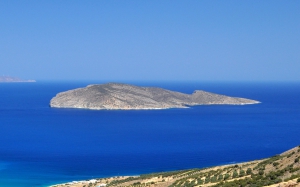
The small islet of Konida can be seen opposite the village. Further east lie the archaeologically important islet of Pseira and the islet of Mochlos, also known as Agios Nikolaos.

  • 1
  • 2
Voulisma beach (Golden Beach)

Voulisma beach (Golden Beach)

1 1 1 1 1 1 1 1 1 1 Rating 2.64 (776 Votes)
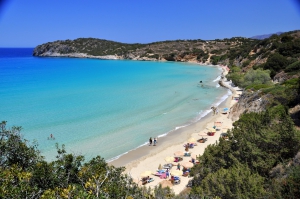
In front of the touristic settlement, there is a nice sandy beach with turquoise waters. The sea surface is mainly flat because the beach has an easterly orientation. while winds in Crete come mainly from the west. The beach is organized with umbrellas, sunbeds, and water sports.

Read more ...

Ha Gorge

Ha Gorge

1 1 1 1 1 1 1 1 1 1 Rating 4.24 (29 Votes)
One dominant feature of the area of Ierapetra, in front of the beautiful village and the minoan settlement of Vassiliki is the Gorge Ha. It is considered one of the wildest gorges in Crete, a rare morphological phenomenon of nature, probably caused by tectonic earthquake.

Read more ...

Gournia beach

Gournia beach

1 1 1 1 1 1 1 1 1 1 Rating 1.11 (156 Votes)
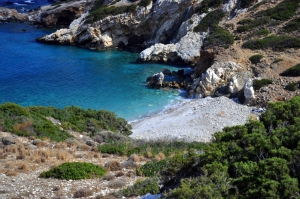
It is a small and secluded pebbly beach within a rocky bay. It is totally unorganized without any facilities. There is a nice cave in the sea, however the sea streams gather a lot of rubbish at the wider area. The next beach you'll meet is the beach with the abandoned camping site of Gournia. It is very secluded, but rubbish is very often due to the currents.

Read more ...

Gournia Minoan Town

Gournia Minoan Town

1 1 1 1 1 1 1 1 1 1 Rating 4.11 (9 Votes)
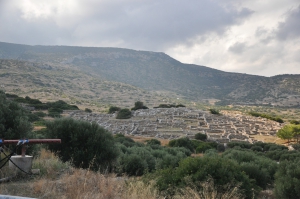
The archaeological site of Gournia is located on a hill west of Pachia Ammos, near the road connecting Agios Nikolaos to Ierapetra, 19km east of Agios Nikolaos. The city flourished in the Minoan period and is the most complete excavated Minoan town in Crete. Because of its good conservation, it was named as the "Pompeii of Crete". The excavation of Gournia was implemented by an American Archaeology Group, headed by Harriet Boyd, in 1901-1904.

Read more ...

Pahia Ammos beach, Ierapetra

Pahia Ammos beach, Ierapetra

1 1 1 1 1 1 1 1 1 1 Rating 1.20 (169 Votes)
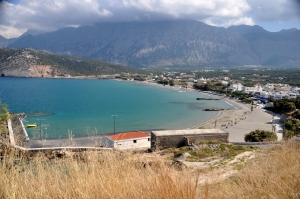
Pahia Ammos is located 20km east of Agios Nikolaos, on the road connecting Agios Nikolaos with Sitia and Ierapetra. It is a large village, built on the north side of the narrowest part of Crete, at the exit of a fertile plain with olive groves. The local beach and the sights of the surrounding area have contributed to the mild development of the village. In the village you will find small hotels, rooms and taverns.

Read more ...

Faneromeni Monastery near Gournia

Faneromeni Monastery near Gournia

1 1 1 1 1 1 1 1 1 1 Rating 4.21 (14 Votes)
The Monastery of Panagia Faneromeni (i.e. Revealed Holy Mary) or Virgin Mary of Gournia is located northwest of Pachia Ammos, 24km south of Agios Nikolaos. It is a male monastery built on a steep slope at an altitude of 540 meters with stunning sea views. The monastery church is built inside a cave.

Read more ...

Psira Islet

Psira Islet

1 1 1 1 1 1 1 1 1 1 Rating 4.00 (8 Votes)
Psira is a small uninhabited islet located 1 mile north of Tholos beach, situated at the northeastern edge of the Gulf of Mirabello. In Psira a Minoan settlement of 15-20 acres has been found, being one of the most important sites in Crete.

Read more ...

Kamini beach at Gournia

Kamini beach at Gournia

1 1 1 1 1 1 1 1 1 1 Rating 1.02 (149 Votes)
Kamini is an area with 5 pebble beaches in a series close to the famous Minoan settlement Gournia by Pahia Ammos. The area is located north of the site and was the access point of Gournia people to the sea. Therefore we still meet Minoan buildings in the area with the most important almost on the sea level.

Read more ...

  • 1
  • 2

Also read:

Download Free Premium Joomla Templates • FREE High-quality Joomla! Designs BIGtheme.net