The Venetian Rouga Maistra

25th August
Street

25th August Street

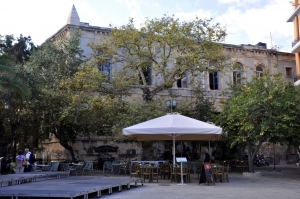
25th August Street is one of the most beautiful and historically important streets in Heraklion. Lined with imposing neoclassical buildings, it connects the Venetian harbour with Lions Square. Some of the city’s most important monuments stand along the street, including the Venetian Loggia and the Church of Saint Titus.

During the Venetian period, the street was known as Ruga Maistra, meaning the Main Street, while under Ottoman rule it was called Vezir Çarşısı, or the Vizier’s Market. It later acquired the evocative name Street of Illusion, because its elegant neoclassical buildings gave newly arrived visitors the impression of an exceptionally prosperous and aristocratic city. That impression changed when they ventured into the poorer neighbourhoods and quarters of the Grand Castle.

The present name commemorates the tragic events of 25 August 1898 according to the calendar then used in Crete, corresponding to 6 September in the modern Gregorian calendar. On that day, which was also the feast of Saint Titus, a British military detachment attempted to install Christian officials at the customs house of Heraklion, implementing a decision by the Great Powers to transfer control of the island’s revenue services.

The action provoked a violent response from armed members of the city’s Muslim population. British troops and Christian civilians were attacked, while homes and businesses were looted and set on fire. Hundreds of Cretan Christians were killed, together with 18 British servicemen and the British vice-consul, Lysimachos Kalokairinos.

The massacre prompted decisive intervention by the Great Powers. Those responsible were brought to trial and the Ottoman troops were forced to withdraw from Crete. A few months later, the autonomous Cretan State was formally established, opening the way for the eventual union of Crete with Greece in 1913.
Hotels near 25th August Street in Heraklion

Morozini Fountain

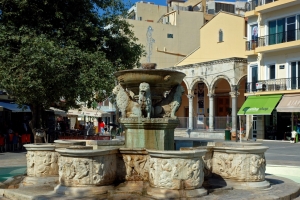
Morosini Fountain – Lions of Heraklion

1 1 1 1 1 1 1 1 1 1 Rating 4.63 (8 Votes)
The Morosini Fountain, widely known as the Lions, is one of the most important Venetian monuments in Heraklion. It was commissioned by Francesco Morosini, the Venetian General Provisioner of Crete, and inaugurated on 25 April 1628, the feast day of Saint Mark, patron saint of Venice.

Read more ...

Saint Titus

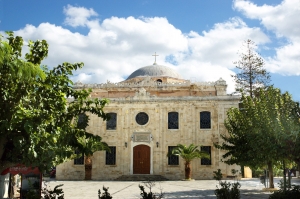
Saint Titus

1 1 1 1 1 1 1 1 1 1 Rating 5.00 (3 Votes)
During the second Byzantine period, as the largest and prime official church in the city of Chandax, St. Titus became the seat of the new Orthodox Diocese of Crete. The Venetians later installed a Catholic archbishop and converted the church into a Catholic cathedral.

Read more ...

Saint Mark Basilica

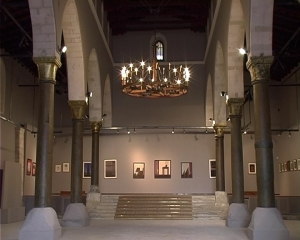
Saint Mark Basilica

1 1 1 1 1 1 1 1 1 1 Rating 3.67 (3 Votes)
The Municipal Gallery of Heraklion is hosted in the Basilica of Saint Mark in the center of Heraklion, just opposite the famous Lions’ fountain. The basilica was built by the Venetians in 1239, was destroyed by an earthquake in 1303 but restored immediately,

Read more ...

The Venetian Loggia of Candia

The Venetian Loggia of Candia

1 1 1 1 1 1 1 1 1 1 Rating 3.50 (2 Votes)
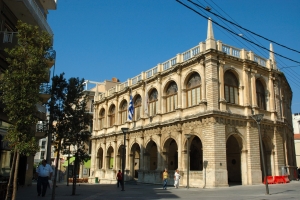
The Venetians used to build a luxurious building in each of their cities, where the nobles could pleasantly spend their time and socialize. In Candia, they built the Loggia (meaning Noble Club) which is now met on the August 25 street.

Read more ...

Sagredo Fountain

Sagredo Fountain at the Venetian Loggia

1 1 1 1 1 1 1 1 1 1 Rating 3.50 (2 Votes)
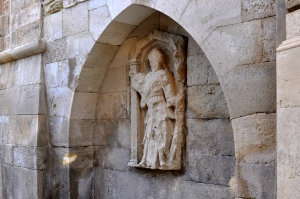
Sagredo Fountain is one of the historic Venetian fountains of Heraklion and is now incorporated into the northern wall of the Venetian Loggia. It was constructed between 1602 and 1604 on the initiative of Giovanni Sagredo, Duke of Crete, to supply water to the Loggia.

Read more ...

Saint Demetrius of the Carpenters

Saint Demetrius of the Carpenters

1 1 1 1 1 1 1 1 1 1 Rating 1.50 (2 Votes)
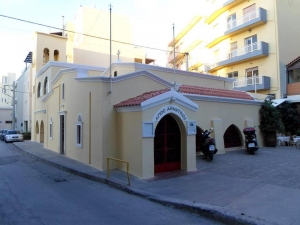
The Church of Saint Demetrius of the Port, near the Venetian harbour of Heraklion, stands on the site of an older church dedicated to the same saint. During the Venetian period, Saint Demetrius was the patron of the city’s carpenters’ guild, and the church consequently became known as Saint Demetrius of the Carpenters.

Read more ...

Liopyrakis Megaron

Liopyrakis Megaron

1 1 1 1 1 1 1 1 1 1 Rating 0.00 (0 Votes)
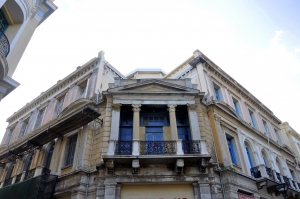
The “Liopyrakis Megaron” is undoubtedly the most important sample of the romantic neoclassical style in Heraklion. It is a work of the architect Dimitris Kyriakou. Its construction began at the end of the first decade of the 20th century. It was one of the most luxurious mansions that were constructed in the first two decades in a very central street, the 25th of August Avenue.

Read more ...

Venetian armoury (Armeria)

Venetian armoury (Armeria)

1 1 1 1 1 1 1 1 1 1 Rating 3.50 (2 Votes)
The Venetian armoury (Armeria or Armarento) is situated between the Loggia and St. Titus Square. Although it served a different purpose than the noble's club, the two buildings formed a single complex.

Read more ...

Also read:

Download Free Premium Joomla Templates • FREE High-quality Joomla! Designs BIGtheme.net