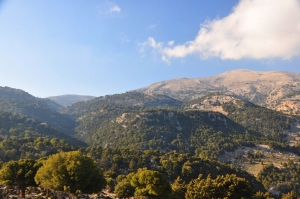
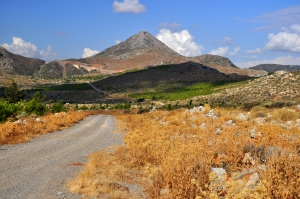
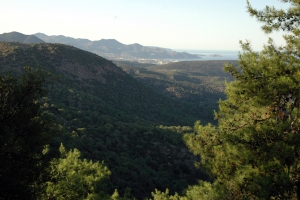
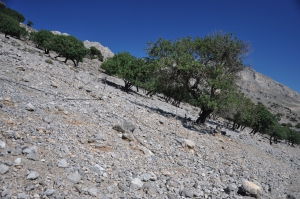
Crete's wooded landscapes form a mosaic of vegetation, including phrygana, maquis, open woodland and denser forests. Transitions between these communities are often gradual, so the boundaries between woodland, scrub and open terrain are not always clear. This pattern reflects the long interaction of climate, soils, geological history and human activity.
Phrygana often dominate the driest areas, while denser scrub and woodland develop under more favourable conditions. Carob trees, wild olives, kermes oaks, lentisks, strawberry trees, heathers, other oaks, cypresses, maples, holm oaks and laurels contribute to the island's vegetation. Their distribution depends on moisture, bedrock, slope aspect and land use and does not everywhere follow strict altitudinal boundaries.
Characteristic trees of the mountain forests include the kermes oak, cypress and Cretan maple. Depending on local conditions and grazing pressure, kermes oak may remain a low shrub or grow into a large tree. The Rouvas oak forest stands out in the Psiloritis Range, where kermes oaks grow alongside maples, cypresses, holm oaks and other species. The area also supports the endemic Cretan zelkova and Cretan cephalanthera, one of the island's rare orchids.
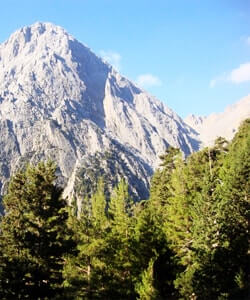
The spreading cypress forms impressive stands in the White Mountains and Samaria National Park. On windswept slopes, the trees often develop low or twisted forms, while in Apokoronas they extend to lower elevations. Cypress woods and mixed stands also occur in mountainous Kydonia and the Kritsa and Kroustas area. Cretan maple grows both in the mountain zone and in lower gorges.
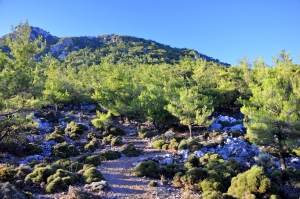
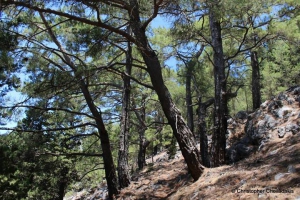
Turkish pine forms important forests in southern and eastern Crete. Characteristic areas include Selakano in the Dikti Range, Thripti, Kato Symi, Vorizia, Koudoumas, Prina and the southern slopes of the White Mountains and the Asterousia Mountains. Pine forests are also associated with the island's beekeeping tradition. In some areas, pines spread into abandoned farmland, as has happened on Gavdos, demonstrating that the wooded landscape continues to change.
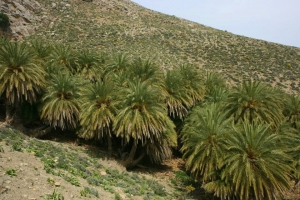
Particularly distinctive are Azilakodasos near Malia and Krasi, with its large holm oaks, and the carob woodland at Tris Ekklisies. Chestnut trees and groves occur in wetter parts of western Crete, particularly Kissamos, while strawberry trees form part of scrub communities in various areas. The palm groves of Vai and Preveli consist of the native Cretan date palm, with smaller stands also found at other coastal sites.
Forests and scrub provide refuge for many animals and birds, including the Cretan wildcat. Their value is not confined to dense, shady stands: open woodland can also support considerable biodiversity and rare species.
Grazing, fires, logging, cultivation and the abandonment of old fields have influenced the present form of Crete's forests. Protecting them is important for conserving biodiversity, retaining soil and water and safeguarding an inseparable part of the island's natural and cultural landscape.