Frescoed Churches

Crete

Frescoed Churches

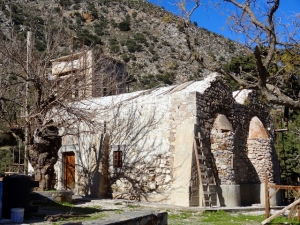
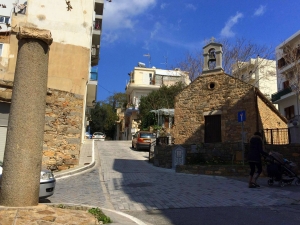
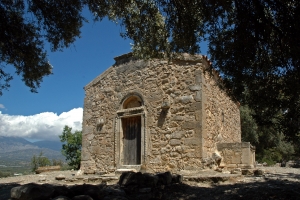
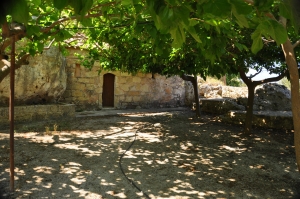
Crete can rightly be described as a vast Byzantine park, with hundreds of churches adorned with remarkable frescoes. Most of these paintings date from the period of Venetian rule, when Byzantine religious tradition continued to flourish on the island and gradually incorporated artistic influences from the West. Together, these monuments illustrate the development of ecclesiastical painting from the early Byzantine period to the renowned Cretan School of icon painting.

Entire regions of Crete, particularly the historical provinces of Kissamos, Selino and Pediada, preserve an exceptionally large number of frescoed churches. Many are small, single-nave rural chapels whose modest exterior gives little indication of the artistic treasures preserved inside. Their walls portray scenes from the life of Christ and the Virgin Mary, figures of saints and hierarchs, representations of the Last Judgement and, occasionally, rare episodes associated with the saint to whom each church is dedicated.

Fewer frescoed churches survive in areas such as the former province of Temenos, around Candia, where prolonged warfare, repeated destruction and the great Ottoman siege of the city caused extensive damage to religious monuments and settlements. Elsewhere, frescoes survived beneath layers of plaster or limewash, which sometimes protected them from deliberate destruction, smoke, humidity and the passage of time.

The scale of this artistic heritage is impressive. In the Topographical Catalogue of the Frescoed Churches of Crete, compiled by the Italian archaeologist and researcher Giuseppe Gerola in the early 20th century, more than 800 frescoed churches are recorded. Many remain scattered throughout the Cretan countryside, forming one of the richest collections of medieval ecclesiastical painting in the Mediterranean.

Saint George Monastery in Vrachasi

Saint George Monastery in Vrachasi

1 1 1 1 1 1 1 1 1 1 Rating 4.50 (2 Votes)
The monastery of Agios Georgios in Vrachasi is located 1km southwest of the village Vrachasi, near Neapolis. The monastery has actively participated in the revolutionary movements against the Turks, during which it suffered tremendous damages.

Read more ...

Panagia Vrefotrofos Temple at Agios Nikolaos

Panagia Vrefotrofos Temple at Agios Nikolaos

1 1 1 1 1 1 1 1 1 1 Rating 4.50 (2 Votes)
The church of the Virgin ‘Panagia Vrefotrofos’ (the protector of infants) is located in the center of the city of Agios Nikolaos, near the sea. It's construction dates back from the 12th century and it bears frescoes of the 14th century.

Read more ...

Church of Saint Marina at Ravdoucha

Church of Saint Marina at Ravdoucha

1 1 1 1 1 1 1 1 1 1 Rating 4.67 (3 Votes)
On the main road leading from the village Ravdoucha to the beach, we meet the Byzantine church of Agia Marina with spectacular sea views, built in a rock recess. The church bears frescoes that have suffered considerable damage. As in many churches of the peninsula Rodopou, so here too we see engravings of the travelers of the era.

Read more ...

Panagia Church at Lambini

Panagia Church at Lambini

1 1 1 1 1 1 1 1 1 1 Rating 4.17 (3 Votes)
The church of Panagia Lambini is a tetrastyle cruciform church (11th-12th century) with a dome and a very impressive bell tower. The imposing church functioned as a Diocese of Lambi, while in 1950 the locals identified on a frescoe of the Virgin Mary the surname Lambini (shining).

Read more ...

Church of Saint George at Sklavopoula

Church of Saint George at Sklavopoula

1 1 1 1 1 1 1 1 1 1 Rating 4.00 (2 Votes)
The church of St. George at Sklavopoula bears frescoes of two phases. The oldest (sanctuary and a part of the north wall) dates back from 1290, while the second phase (the rest of the north wall and west wall) dates back from the 14th century.

Read more ...

Church of Saint Paraskevi at Episkopi

Church of Saint Paraskevi at Episkopi

1 1 1 1 1 1 1 1 1 1 Rating 4.50 (2 Votes)
A small, single-nave, barrel vaulted church that is located on the south side of the square, which has the same name. The church dates back to the period of the Venetian Rule, more specifically to the 15th century. There are two entrances, one on the west and one on the north, with ornate Venetian aedicules. On the monolithic lintel of the north entrance, there are two elaborate spirals. Just in front of the Altar, there is a tomb, whose owner is unknown.

Read more ...

Church of Panagia at Kapetaniana

Church of Panagia at Kapetaniana

1 1 1 1 1 1 1 1 1 1 Rating 4.00 (2 Votes)
Kapetaniana village is located on the site of the former Monastery of the “Lord Have Mercy”, one of the most important centers in Crete for monasticism where arts and culture flourished. During the Ottoman Era the monastery was abandoned.

Read more ...

Also read:

Download Free Premium Joomla Templates • FREE High-quality Joomla! Designs BIGtheme.net