Frescoed Churches

Crete

Frescoed Churches

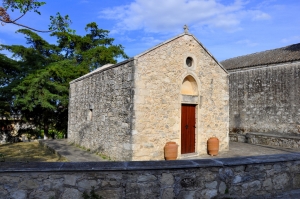
Crete can rightly be described as a vast Byzantine park, with hundreds of churches adorned with remarkable frescoes. Most of these paintings date from the period of Venetian rule, when Byzantine religious tradition continued to flourish on the island and gradually incorporated artistic influences from the West. Together, these monuments illustrate the development of ecclesiastical painting from the early Byzantine period to the renowned Cretan School of icon painting.

Entire regions of Crete, particularly the historical provinces of Kissamos, Selino and Pediada, preserve an exceptionally large number of frescoed churches. Many are small, single-nave rural chapels whose modest exterior gives little indication of the artistic treasures preserved inside. Their walls portray scenes from the life of Christ and the Virgin Mary, figures of saints and hierarchs, representations of the Last Judgement and, occasionally, rare episodes associated with the saint to whom each church is dedicated.

Fewer frescoed churches survive in areas such as the former province of Temenos, around Candia, where prolonged warfare, repeated destruction and the great Ottoman siege of the city caused extensive damage to religious monuments and settlements. Elsewhere, frescoes survived beneath layers of plaster or limewash, which sometimes protected them from deliberate destruction, smoke, humidity and the passage of time.

The scale of this artistic heritage is impressive. In the Topographical Catalogue of the Frescoed Churches of Crete, compiled by the Italian archaeologist and researcher Giuseppe Gerola in the early 20th century, more than 800 frescoed churches are recorded. Many remain scattered throughout the Cretan countryside, forming one of the richest collections of medieval ecclesiastical painting in the Mediterranean.

Saint Demetrius Galatoktistos at Kastri

Saint Demetrius Galatoktistos at Kastri

1 1 1 1 1 1 1 1 1 1 Rating 4.00 (2 Votes)
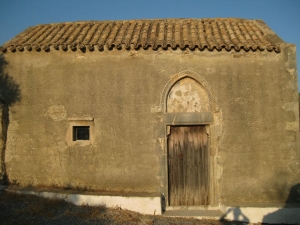
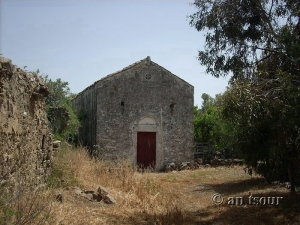
The Venetian church of Agios Dimitrios is located Kastri settlement and was the main church of the homonymous monastery. Today the cells and the other buildings of the monastery are deserted. The church is single-nave, vaulted and two entrances (south and west). The name Galaktoktistos means built with milk and is taken after the legend according to which the church was built with milk offered by the local shepherds.

Read more ...

Church of Saint George at Embaros

Church of Saint George at Embaros

1 1 1 1 1 1 1 1 1 1 Rating 4.33 (3 Votes)
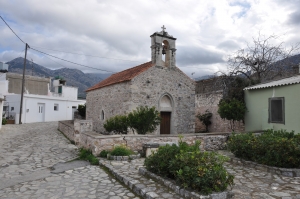
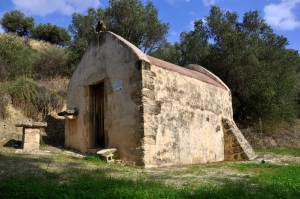
The church of St. George at center of the village Embaros is the most important Byzantine monument in the wider area. The church was built in 1436 and bears frescoes drawn by the painter Manuel Fokas in the 15th century.

Read more ...

Church of Christ the Savior at Tylissos

Church of Christ the Savior at Tylissos

1 1 1 1 1 1 1 1 1 1 Rating 3.50 (2 Votes)
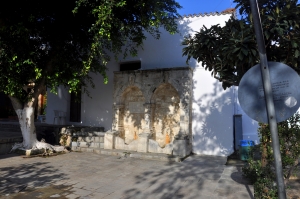
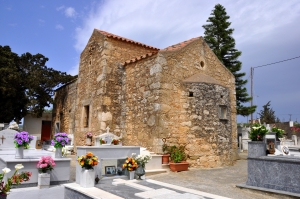
The single-aisled vaulted church of Jesus Christ in the old central Square of Tylissos has undergone alterations through the centuries. It’s interior houses an arcosolium (funerary monument of the founder of the church) while there is an exceptional fountain with Arabic inscriptions embedded on its exterior wall.

Read more ...

Saint John Voulgaris Monastery at Melambes

Saint John Voulgaris Monastery at Melambes

1 1 1 1 1 1 1 1 1 1 Rating 4.00 (3 Votes)
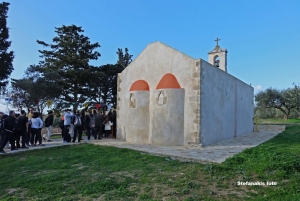
The monastery of Saint John at location Voulgaris today is uninhabited and only the church of St. John the Baptist (celebrating on June 24) and a few traces of cells survive. The monastery operated probably from the 15th century and soon gained a huge fortune (thousands of olive trees).

Read more ...

Saint Paraskevi church at Aitania

Saint Paraskevi church at Aitania

1 1 1 1 1 1 1 1 1 1 Rating 5.00 (2 Votes)
A few meters north of Aitania village starts an impressively steep downhill dirt road leading to the church of Agia Paraskevi. Agia Paraskevi is located in a valley of incredible beauty filled with ancient tall cypress trees that dominate throughout the region. Just below the small chapel, before water drilling changed the underwater water level, there was a sping called Lazarakis which has now dried up. The church of Agia Paraskevi, despite its small size has an impressive history.

Read more ...

Church of Archangel Michael at Arkalohori

Church of Archangel Michael at Arkalohori

1 1 1 1 1 1 1 1 1 1 Rating 4.33 (3 Votes)
The funerary temple of Archangel Michael at Arkalohori is a cruciform temple with the main aisle being lower than its vertical aisle. Also there is a narthex with a dome. The church bears frescoes of the 13th century (the frescoes in the narthex date back from the 14th century).

Read more ...

Church of Saints Nicholas and Charalambos at Miliarisi

Church of Saints Nicholas and Charalambos at Miliarisi

1 1 1 1 1 1 1 1 1 1 Rating 4.50 (2 Votes)
The cemeterial temple of St Nikolaos and St Charalambos at MIliarisi is very special because it is dikonchos (double-niche), a type that is rare. The type of dikonchos church differs from the two-aisled as there is a common roof for both aisles, without interference of wall between the aisles.

Read more ...

Saint Anthony church at Episkopi

Saint Anthony church at Episkopi

1 1 1 1 1 1 1 1 1 1 Rating 4.00 (2 Votes)
The church of Saint Anthony at Episkopi is located in a beautiful square with pine trees at the east part of the old village. It is a small single-nave vaulted church bearing parts of frescoes.

Read more ...

Also read:

Download Free Premium Joomla Templates • FREE High-quality Joomla! Designs BIGtheme.net