The Ida Range, better known as Psiloritis, rises in the centre of Crete and extends across the regions of Heraklion and Rethymno. Its highest summit is Timios Stavros, at 2456m, which is also the highest point of Crete. It is followed by Agathias at 2424m, Stolistra at 2325m, Voulomenou at 2267m and Kousakas at 2209m. Timios Stavros is only three metres higher than Pachnes, the highest summit of the White Mountains.
A large part of the range lies within the Psiloritis UNESCO Global Geopark. The area displays remarkable rock formations, major faults, fossils, karst formations, caves, deep gorges and mountain plateaus. The geological history of Psiloritis is closely connected with its biodiversity, pastoral traditions and the culture of its mountain communities.
Psiloritis offers some of the most imposing landscapes of wild beauty in Crete. Bare alpine zones, small plateaus, forests, springs, steep gorges and villages built on the mountain slopes create scenery that changes dramatically with altitude and season.
The sacred mountain of Crete
The imposing massif inspired awe from Minoan times and became associated with numerous religious traditions. The Idaean Cave, near the Nida Plateau, was believed to be one of the places where Zeus was raised. Along the route from Anogia to Nida lies ancient Zominthos, an important Minoan mountain centre with religious and economic significance.
The sacred character of the mountain continued into the Christian era. A small dry-stone chapel stands on the summit of Timios Stavros. Every year, on the eve of the Feast of the Exaltation of the Holy Cross, pilgrims from across Crete climb the mountain and spend the night near the summit before attending the service on 14 September.
The best-known routes to the summit start from the Nida Plateau and from Lakos Mygerou. The latter is the shortest ascent and follows a well-formed stone path. Even in summer, hikers must be prepared for strong winds and very low night-time temperatures. There are no reliable water sources above 2000m and very little shade, making sufficient water, suitable clothing and sun protection essential.

Rouvas forest and gorge on the southern slopes of Psiloritis
Forests and wildlife
In the past, large parts of Psiloritis were covered by extensive forests. One of the most important surviving ecosystems is the oak forest of Rouvas, near Gergeri. Sparse forests of Calabrian pine survive on the southern slopes between Zaros and Vorizia, while smaller wooded areas occur around Vromonero Plateau and Pardi near the Amari Valley.
The wildlife of Psiloritis is particularly important. Rare birds of prey, including bearded vultures, griffon vultures and several species of falcon, find refuge on its inaccessible slopes and in its gorges. The wider Rouvas area is also associated with the extremely rare Cretan wildcat.
Villages, plateaus and places of interest
Anogia, one of Crete’s most important mountain towns, lies in the mountainous Mylopotamos region. From here the road continues towards Nida Plateau, the Idaean Cave and Zominthos. On the eastern slopes are Livadi Plateau and the Skinakas Observatory, located at one of the highest points in Crete accessible by road. On the southern side, the villages of Zaros and Vorizia overlook the Messara Plain.

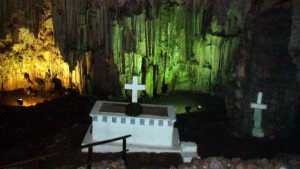
The historic Melidoni Cave on the northern outskirts of Psiloritis
Caves, water and gorges
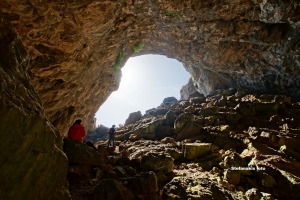
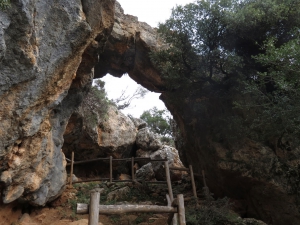
The intense karstification of Psiloritis has created numerous caves and sinkholes. The most important show cave is Sfendoni at Zoniana. Other well-known caves include Melidoni, Kamares and Chonos near Sarhos, while Voulismeno Aloni near Tylissos was formed by the collapse of the roof of a large cave.
The massif stores vast quantities of water from rainfall and snow. Underground channels carry this water towards springs and aquifers far from the high peaks. Characteristic sites include Votomos Lake at Zaros, Faneromeni Dam in Messara and the springs of the Almyros River near Heraklion.
Several deep gorges cross the slopes of Psiloritis. Among the most important are the lush Rouvas Gorge, the rugged Vorizia Gorge, Almyros Gorge and Platania Gorge in the Amari Valley. Together with the plateaus, caves and forests, they reveal the geological and ecological diversity that makes Psiloritis one of the most remarkable mountain landscapes in Crete.










.jpg)