








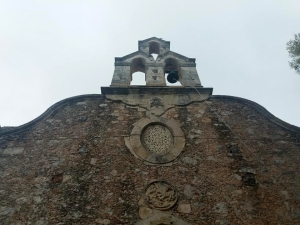
The church of the Virgin Mary (Panagia) in Kefalas, province Apokoronas, is dedicated to the Dormition of the Theotokos and celebrates on August 15th. The pillars and its enclosure date back to the mid-19th century and bear Venetian architectural elements.
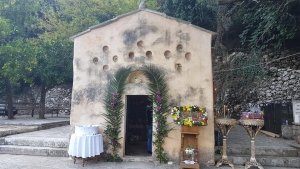
The church of Panagia Sourouthiani or Sirothiani is located in the outskirts of the village Alikambos in the province of Apokoronas, very close to a spring with fresh water. It is a small single-nave church dedicated to the Dormition of Theotokos (celebr. of August 15th) which is externally decorated with round ceramics called pinakia.
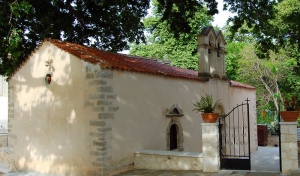
The single-nave arched church of Saint John the Theologian (Agios Ioannis Theologos) is located in the central square of the village Armeni, province Apokoronas. The church was built in the 16th century on the site of an older 13th-century domed temple, which in turn was built on the site of the central aisle of a 6th-century Early Christian basilica.
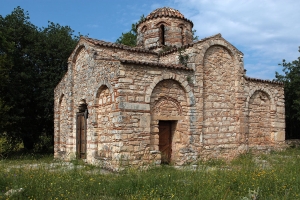
The church of Panagia Zerviotissa (i.e. left-handed) or Monastira is located east of the village Stylos, province Apokoronas. It is a 12th-century cruciform temple with an octagonal dome, each dome bearing a window on each side and supported by four pillars. The ground plan resembles a three-aisled basilica with three semi-cylindrical arches.
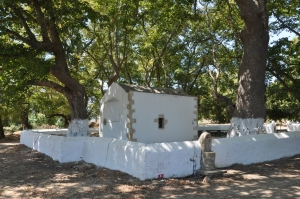
The church of Saint John the Forerunner is located just outside the village of Stylos (Apokoronas province) at position Platanakia. It is one-aisled church built in 1898 and celebrating on August 29 (a big fest takes place then). Around the church there are many plane trees which offer shade to visitors and there are benches and tables making the place ideal for picnics.
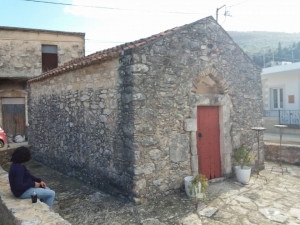
The church of Saint Nicholas (Agios Nikolaos) Maziotis is located in the village of Maza, province of Apokoronas. It is a small single naved arch-roofed temple dating back to the 13th century. Its interior has impressive frescoes by the famous hagiographer of western Crete, Ioannis Pagomenos, who is believed to be buried on the floor of the temple.

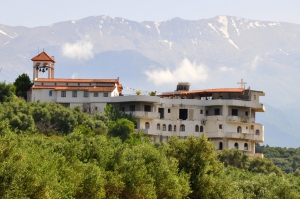
The Foundation of the Holy Cross "St. Raphael" is an informal small monastery at position Tria Kamarakia, next to the highway of Rethymnon - Chania, which is mostlycharity- oriented. The main temple is a three-aisled basilica dedicated to the Neomartyrs (Raphael, Nicholas and Irene), the Holy Cross and Saint Ephrem.
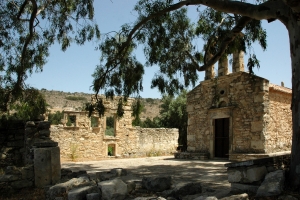
At the wider area of Vamos, at the side of the Venetian village Karydi Kartsomado and within close distance from the monastery of St. George in Karydi, we meet the ruins of the small abandoned monastery of Panagia at Katomeri.
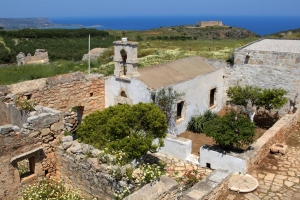
The restored Byzantine Monastery of St. John the Divine is located next to the huge Roman cisterns of the ancient city of Aptera. It is believed to have been built in the 7th century AD, as a dependency of the Monastery of Patmos island, under the supervision of which it remained till 1964 (when it was abandoned permanently).
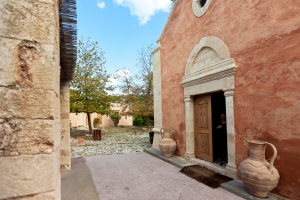
The Monastery of Saint George in Karydi (in Apokoronas Province) is located about 2km east of Vamos village. The monastery was abandoned for many years but was restored in 1996 and today it is operating normally. The monastery is unique to Apokoronas province and is the most interesting monument of folk architecture in the prefecture of Chania.
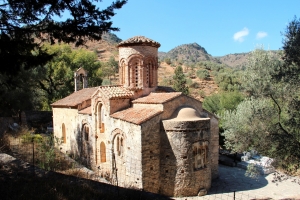
The church of St. Nicholas at Kyriakosellia belongs to the most important churches in Crete. Its walls are adorned by frescoes. It is one of the finest samples of Byzantine architecture in the island.
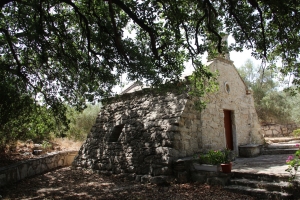
The church of St. Paul, after which the village Agios Pavlos of province Apokoronas is named, by Gavalohori, dates back from the 16th century. It has been restored and the interior does not preserve murals. Outside the temple, a cemetery has been identified which dates back from the 12th century, implying that there was an older temple here. There is a cross in the interior, bearing the date 1886.
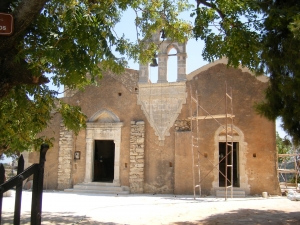
The church of Saint George at Kournas is one of the most important surviving Byzantine Monuments of Crete. It is built in a prominent position with panoramic views of the sea and probably operated as a monastery, and there are some traces of monk cells.
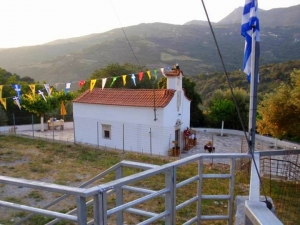
St George Galatas (Milky) at village Asi Gonia is a small single-aisled church. This temple houses one of the famous centuries-old traditions of Crete during the feast of St. on April 23.
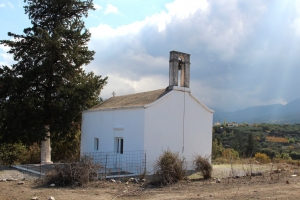
The church of Panagia Perivolitissa or Perivolitsiani is a single-aisled temple of 1570 built on a hill north of the village Nippos. The temple is dedicated to the Birth of the Virgin Mary and bears frescoes in poor condition. It is believed that the place operated as a monastery, Episcopal Seat, after the desctruction of Aptera town by an earthquake, and as a school of hagiography. In the church there are graves of monks and priests.
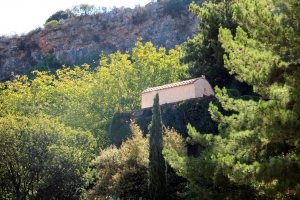
Outside the village of Fres, inside a ravine at the really beautiful position Koukou we meet the temple Virgin Mary (Panagia) of Two Rocks. Once a rock detached from the mountain and rolled down the slope. Atop of the rock, the church of Panagia was built. Adjacent there is another rock, both forming an impressive scenery.
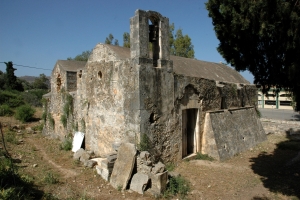
The temple of Saint John Theologian and St Nicholas is built at the entrance of the village of Stylos. This is a complex of three buildings, dating from the 13-15th century and preserving a fragmentary mural decoration of the 13th, 14th and 15th century.
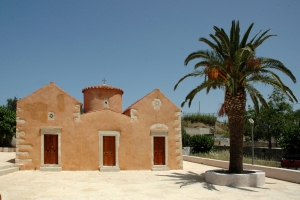
At Agii Pantes village, by Fres village, there is the Byzantine church of All Saints (Agii Pantes). The church looks like a three nave basilica with smaller central nave, but is actually a cruciform temple with a large dome.
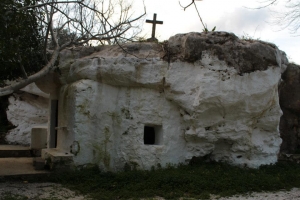
The chapel of Agia Paraskevi is accessed via the road leading to Episkopi, Rethymno, from Dramia village, Apokoronas. It is a very small cavernous rock built at the west bank of Mouselas river, that starts from Argiroupoli springs. It is a weird chapel, with irregular sides, with a unique shape in Crete.
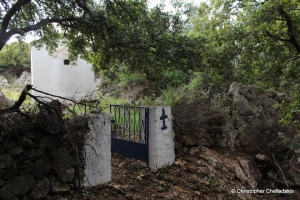
The huge platan trees around it hide its presence. Behind the chapel there is a small dark cave, where the tradition wants a shepherd to have found the icon of Panagia and then decided to build the church. The blackened ceil of the cave inspired the name of the church, which locals call Mavri Panagia (i.e. Black Virgin Mary).
- 1
- 2
Also read:
- Home
 Beaches
 Nature
 Past
Past Destinations
 Highlights
 West Crete
- Central Crete
- East Crete
- Towns
- Chania Prefecture
- Chania
- Paleochora
- Kissamos
- Georgioupolis
- Chora Sfakion
- Loutro
- Rethymnon Prefecture
- Rethymnon
- Agia Galini
- Plakias
- Spili
- Anogia
- Heraklion Prefecture
- Heraklion
- Hersonissos
- Malia
- Matala
- Agia Pelagia`
- Archanes
- Kokkinos Pirgos
- Lassithi Prefecture
- Agios Nikolaos
- Elounda
- Sitia
- Ierapetra
- Makrigialos
- Palekastro
- Zakros
- Lassithi Plateau
- Get Prepared


