







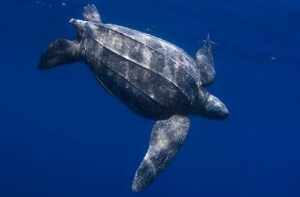
The leatherback turtle (scient. Dermochelys coriacea) is the largest reptile in the world, with its shell growing up to 250cm and its weight, sometimes, exceeding 900kg. Infrequent appearances of the species have been reported in Greece (and in Crete), while there has not been reported any case of breeding on Greek beaches.
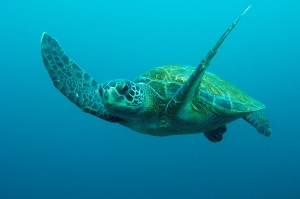
The green sea turtle (scient. Chelonia mydas) has been met very rarely in the Greek seas and there are no indications for nesting on Greek shores. It is also found rarely off the Cretan seas and is the largest sea turtle with hard shell in the world.
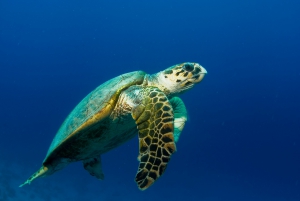
The hawksbill sea turtle (scient. Eretmochelys imbricata) is an endangered sea turtle species found primarily in tropical seas. Some of them (very few) have been met in the open sea south of Crete and in other Mediterranean areas.

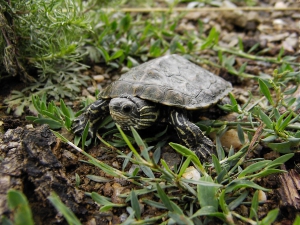
In Crete it is found anywhere there is fresh or brackish water. You'll see them sunning on the banks of rivers. When you approach their area, they disappear before you know it making a loud "plop". Crete is warm enough for them so they remain active throughout the year, but in times of drought they may get buried in the mud and hibernate during the summer.
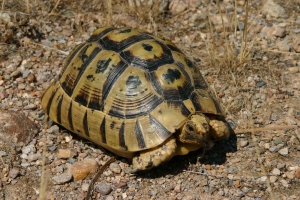
The Greek tortoise (scient. Testudo graeca) or spur-thighed tortoise is a species of land turtle, which has been introduced to the island of Crete by humans and has survived with remarkable ease. It is found near the wetlands of the island and in shady humid forests.
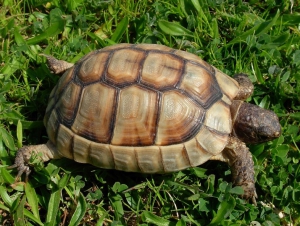
The marginated tortoise (scient. Testudo marginata) is the largest European tortoise, reaching a weight of up to 5 kg and a length of 35 cm. It is not native species of Crete, although fossils have been found on the island. However, more and more domestic tortoises appear in the Cretan countryside, as they escape from their homes.

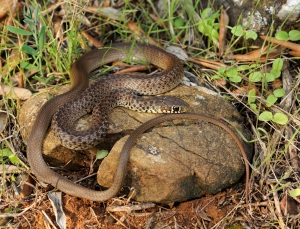
The Balkan whip snake (scient. Hierophis gemonensis or Coluber gemonensis) is a medium sized snake, which is commonly met in the island of Crete. It can reach a length of 1m, but is usually much shorter.
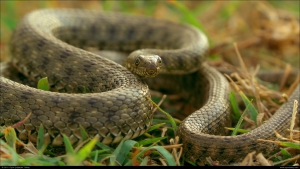
The dice snake (scient. Natrix tessellata) is a kind of water snake, which occurs frequently in the permanent wetlands, the sea shores and rock pools of Crete. Many Cretans call it as water snake, but this name actually belongs to the relative species of Natrix natrix, which is absent from the island. Finally there is the suspicion that the dice snake of Crete belongs to a separate species, but it hasn’t been confirmed yet.
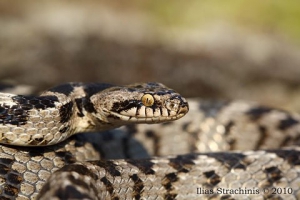
The cat snake (scient. Telescopus fallax) is the only snake in Crete with venom. However, the poison is too weak to hurt humans and is excreted in the back of its mouth, making it actually harmless. The snake feeds on small lizards and uses the poison for relaxing their bodies.
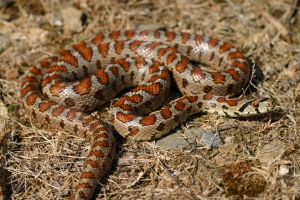
The leopard snake (scient. Elaphe situla or Zamenis situla) is the most beautiful species of snake in Greece, with characteristic orange-red markings on its back. In Crete it is called ochentri, which means viper, which is incorrect as the snake is completely harmless. This false impression has been caused by a V sign on its head, which is similar to that of vipers.

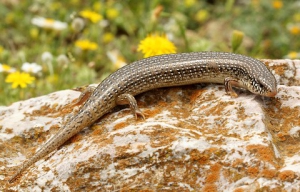
The ocellated skink (scient. Chalcides ocellatus) (or the eyed skink or gongilo), is an impressive species of skink, which is native to to Italy, Greece and North Africa. In Crete holds the mistaken impression that they are deadly poisonous and people are afraid of them.
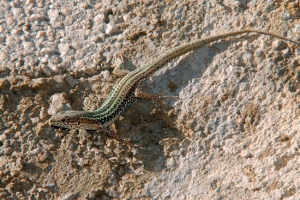
The wall lizard of Crete (scient. Podarcis cretensis) is the only endemic species of lizard on the island, which was identified as a seperate species (from Podarcis erhardii) just a few years ago.
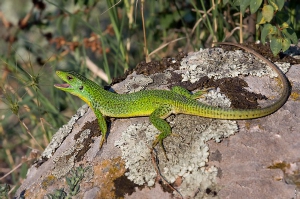
In Crete, apart from the main subspecies Lacerta trilineata trilineata, there is also the subspecies Lacerta trilineata polylepidota. The green lizards are completely harmless, although some consider them poisonous.
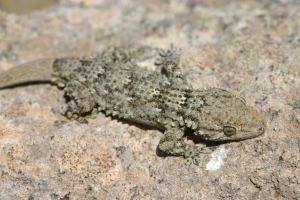
The Moorish Wall Gecko (scient. Tarentola mauritanica) is a small species of lizard that reaches a total length of 16cm and can be found on the island of Crete.
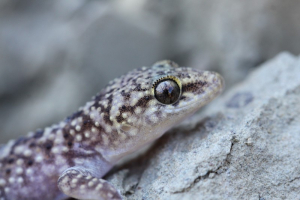
The Turkish gecko (scient. Hemidactylus turcicus) or Mediteranean house gecko is one of the most common reptiles in Crete, which is closely related to the Moorish gecko. Indeed, many people tend to confuse the two species that have similar characteristics but do not belong in the same species.
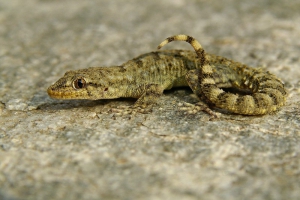
The gecko of Kotschy (scient. Mediodactylus kotschyi) is a common lizard species on Crete, which is very similar to the previous two, but belongs to a separate species. The major difference of this lizard with the other two gecko species mentioned is that it has a thin body and its fingers do not have suction cups.
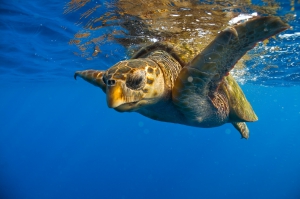
The loggerhead sea turtle (scient. Caretta caretta) is the most important sea turtle species of Greece, which is strictly protected by the Greek laws. In Greece, two organizations are involved in the protection of sea turtles, namely ARCHELON and MEDASSET, actually doing a great job.
Also read:
- Home
 Beaches
 Nature
 Past
Past Destinations
 Highlights
 West Crete
- Central Crete
- East Crete
- Towns
- Chania Prefecture
- Chania
- Paleochora
- Kissamos
- Georgioupolis
- Chora Sfakion
- Loutro
- Rethymnon Prefecture
- Rethymnon
- Agia Galini
- Plakias
- Spili
- Anogia
- Heraklion Prefecture
- Heraklion
- Hersonissos
- Malia
- Matala
- Agia Pelagia`
- Archanes
- Kokkinos Pirgos
- Lassithi Prefecture
- Agios Nikolaos
- Elounda
- Sitia
- Ierapetra
- Makrigialos
- Palekastro
- Zakros
- Lassithi Plateau
- Get Prepared


