The Cretan Tradition of

Asceticism

Religious Monuments

Hundreds of inactive monasteries, isolated monastic sites and old hermitages are scattered across Crete, from fertile plains and mountain villages to the island’s most inaccessible coasts. Many are now important religious and architectural monuments, even when only the central church, a few cells or parts of the former fortifications survive.

The arrival of Saint John the Hermit in Crete contributed to the development of a remarkable ascetic tradition that continues to the present day. Hermits withdrew to the island’s most remote locations and formed small ascetic communities, some of which later developed into organised monasteries. A characteristic example is Katholiko Monastery on the Akrotiri Peninsula, where hermits lived in caves and natural shelters in the rugged landscape. Important monastic communities also developed on the isolated peninsulas of Gramvousa and Rodopos.

The most extensive centre of ascetic life in Crete developed in the inaccessible Asterousia Mountains. Caves, small churches and hermitages formed a unique monastic landscape stretching from Agios Nikitas Monastery and Koudoumas Monastery to Cape Lithino. Notable religious sites include the Church of Saint Anthony at Agiofarago, the Cave of Saint Anthony near Koudoumas and the Monastery of Saint John near Kapetaniana.

Contact between the hermits was often very limited. According to tradition, those living in Agiofarago Gorge and Martsalo Gorge gathered once a year at Goumenospilios Cave to discover who had survived. In eastern Crete, particularly in the mountainous province of Mirabello, another extensive network of small monasteries and hermitages developed. Some were so small that they accommodated only one monk or a tiny brotherhood.

Crete’s inactive monasteries preserve valuable evidence of the island’s religious life, local architecture and regional history. Even where the monastic buildings have fallen into ruin, their churches are often still used on the feast day of their patron saint and remain closely connected with the traditions of nearby villages.

Religious Monuments of the Asterousia Mountains

Religious Monuments of the Asterousia Mountains

On the steep slopes of the Asterousia Mountains, many caves became places of prayer and retreat. From Agios Nikitas and Koudoumas to Agiofarago and Cape Lithino, small chapels and old hermitages preserve traces of this way of life. The Acts of the Apostles records a stop at Kali Limenes, or Fair Havens, by the ship carrying the Apostle Paul to Rome. Local tradition associates his stay with the small cave beside the present chapel. In Agiofarago Gorge, near the cave chapel of Saint Anthony, lies Goumenospilios Cave. According to tradition, the hermits of the area gathered there once a year, on Easter Sunday. At nearby Martsalo, the chapel of the Virgin Mary stands inside the rock at the head of the gorge. Further east, the cave church of Saint John near Kapetaniana preserves wall paintings even on its outer wall. West of Koudoumas Monastery, Avvakospilio Cave is associated with Saint Kosmas the Hermit. The brothers Parthenios and Eumenios Charitakis re-established the monastery in the late nineteenth century. At Lousoudi, near Kapetaniana, the remains of the Monastery of the Three Hierarchs reveal another side of monastic life in the Asterousia Mountains. The scholar and monk Iosif Filagris founded the monastery in the fourteenth century, and it became associated with the study and copying of manuscripts.

Read more ...

Religious Monuments at Malevizi

Religious Monuments at Malevizi

From the coast west of Heraklion to the eastern foothills of Mount Psiloritis, the former province of Malevizi preserves many traces of its religious history. Small churches by the sea, chapels beside springs and ruined monasteries in gorges show how closely places of worship were tied to the landscape. Along the coast are the Church of Panagia at Fraskia, Panagia Deligara at Ligaria and the Church of Saint Savvas at Ellinoperamata. A little further inland, the ruins of the Monastery of Saint John Farangitis lie in the Almyros Gorge. Its former main church is now known as Saint Anthony. Beside it stands the small chapel of Saint Marina, once the monastery’s cemetery chapel. In the villages of the foothills are Panagia Kera Eleousa in Kitharida, the Jerusalem Monastery in Loutraki and Panagia Kavallara in Korfes, once a dependency of Dionysiou Monastery on Mount Athos. At Keramoutsi, the apse of the Church of Panagia preserves 14th-century frescoes. Just outside Tylissos, at Loutra, the Chapel of Zoodochos Pigi stands beside the spring associated with its dedication to the Life-Giving Spring. At Ano Asites, the ruined Church of Saint Anthony stands at the entrance to the gorge that bears its name. From there, a path descends towards Panagia Faneromeni at Kerasia, linking two of the area’s country chapels on a single walk.

Read more ...

Religious Monuments of Pediada

Religious Monuments of Pediada

The former province of Pediada is home to some of Crete’s finest groups of churches with frescoes. From the early Christian basilica at Kastri in Hersonissos to the country chapels and former monastic dependencies inland, these monuments bear witness to centuries of religious life. Episkopi Pediados holds a special place in this history. The seat of the Diocese of Hersonissos was moved here in Byzantine times. East of the village, among olive groves and vineyards, stands Panagia Kera Limniotissa, once the main church of a convent. On the pine-covered hill of Toupaki, the Church of Saint George preserves frescoes depicting scenes from the saint’s life. It was once the main church of a dependency of Agarathos Monastery. Near Galifa, the Church of Saints Paraskevi and Panteleimon preserves its frescoes, while traces of old monastic cells can still be seen around the Church of Saint Demetrius. At Potamies, Panagia Gouverniotissa is known for its 14th-century frescoes. The former monastery buildings now house an exhibition of ecclesiastical treasures. More painted churches survive in the inland villages. At Sklaverochori, frescoes from the 14th and 15th centuries are preserved in the oldest part of the Church of the Presentation of the Virgin Mary. At Amariano, the small Church of Saint George Kefaliotis preserves scenes from the saint’s life, including his martyrdom on the wheel.

Read more ...

Religious Monuments of the Messara Plain

Religious Monuments of the Messara Plain

Early Christian basilicas, churches with frescoes and the main churches of small monasteries survive across the Messara Plain and along the southern foothills of Mount Psiloritis. Alongside the long tradition of hermit life in the Asterousia Mountains, the area developed a monastic tradition of its own, with small communities and monastic dependencies near villages and farmland. Traces of hermit life also survive on the slopes of Psiloritis, including the cave hermitage of Saint Efthymios in Rouvas Gorge above Zaros. Gortyn was an important centre of early Christianity in Crete. The ruins of the five-aisled Basilica of Saint Titus lie near the village of Mitropoli. The church and tombs at Agii Deka commemorate the Cretan martyrs from the reign of Emperor Decius. Further west, near Phaistos, local tradition links the Baptistery of Saint Paul in the village of Agios Ioannis to the Apostle’s journey through Messara. Near Vorizia, on the southern foothills of Mount Psiloritis, the main church of Varsamonero Monastery preserves frescoes from the 14th and 15th centuries. The transverse aisle features scenes from the life of Saint Phanourios. Lower down, near Vori, the frescoed church of Panagia Kardiotissa is all that remains of a former dependency of the monastery. Near Phaistos, the Church of Saint George of Falandra survives as the main church of a small monastery. The Church of Saint George at Agia Triada, within the archaeological site, retains fragments of its frescoes. Between Roufas and Moroni, the Church of Our Lady of the Angels at Fradio recalls another part of Messara’s religious history. A Franciscan monastery stood here in the 15th century.

Read more ...

Religious Monuments of Monofatsi

Religious Monuments of Monofatsi

In the former province of Monofatsi, religious life flourished in the hermitages of the Asterousia Mountains and in the inland villages, where small monasteries and their dependencies were established. The ruins of a three-aisled early Christian basilica survive at Ini. At Mikri Episkopi, near Partira, the ruined Church of Christ the Saviour is associated with the former Diocese of Arcadia. In Agios Thomas, the Byzantine church that gave the village its name stands in the centre of the settlement. Among the smaller places of pilgrimage is the Chapel of Saint Joasaph, carved into the rock. Just outside the village, the former monastery of Panagia Kardiotissa stands beside the Axedianos River. Elsewhere in the area, Panagia Almyri, which belongs to the parish of Megali Vrysi, draws pilgrims every year for the Feast of the Ascension. At Alagni, the Church of the Holy Apostles at the foot of Tholi Hill preserves the coat of arms of the Venetian Corner family and two tombs set in arched recesses. Another striking example survives inside Zoodochos Pigi in the abandoned settlement of Rouma. At Kastellos, near Kato Kastelliana, the churches of the Dormition, the Presentation of the Virgin Mary and Saint Anastasia survive near the ruins of the Venetian Castel Belvedere. In Pano Panagia, as the Church of the Dormition is known, traces remain of frescoes painted by Georgios Pelegris in 1467. At Ano Kastelliana, the ruined Monastery of the Holy Apostles was a dependency of Saint Catherine’s Monastery on Mount Sinai and played a part in the resistance during the German occupation.

Read more ...

Religious Monuments of Temenos

Religious Monuments of Temenos

The former province of Temenos included present-day Heraklion, known as Candia under Venetian rule, and its hinterland. The religious monuments of Heraklion are covered in a separate section. Around the city and in the villages of the former province, small monasteries, monastic dependencies, rock-cut chapels and churches with frescoes survive from Mount Juktas and the Archanes Gorge to Siva and Venerato. High on Mount Juktas stands the four-aisled Church of Afentis Christos, once the main church of a monastery that was active under Venetian rule. Just below it, on the steep cliff, are the Nuns’ Cells, known as Kelia Kalogradon. On the same mountain, the Catacomb of Saint Anthony, carved into soft limestone, shows how the rock itself was used as a place of worship. In Archanes, one of the frescoes in the Church of Archangel Michael depicts its founder holding a model of the church. In the Archanes Gorge, the ruined Panagia Karydakiani was once the main church of a small convent. The spring beside it fed the Venetian aqueduct that supplied the Morosini Fountain in the centre of Candia. Closer to Knossos, the Church of Agia Paraskevi at Sellopoulo stands beside the old settlement on the banks of the Kairatos River. In Siva, the Church of Agia Paraskevi preserves frescoes and has a sanctuary apse cut into the rock. Outside the walls of Paliani Monastery in Venerato, fragments survive of the frescoes painted by Georgios in the mid-14th century in the Church of Saint John the Theologian. Near Karkadiotissa, Astratigos at Agalantes and the Church of Saint Anthony are reminders of the network of dependencies once associated with Epanosifis Monastery. Two more recent monasteries stand on the outskirts of Heraklion. The Monastery of Agioi Theodoroi, on the road to the University Hospital, was founded around 1980. The Monastery of Saint Irene Chrysovalantou, on the southern edge of the city, was founded in 2002.

Read more ...

Religious Monuments of Viannos

Religious Monuments of Viannos

From the shores of the South Cretan Sea to the inland villages, monasteries, country chapels and churches with frescoes survive across the former province of Viannos. Local traditions link some of the old monasteries to coastal raids and the search for more sheltered sites. In the Faflagos valley, away from the coast, stands Panagia Keralimeniotissa. According to tradition, it was founded after the destruction of the earlier Monastery of Saint Procopius. Near Kastri, the frescoed Church of Saint Demetrius Galatoktistos was once the main church of a monastery whose ruined cells can still be seen. Its name comes from the story that milk was used in its construction. Above the coast of Arvi, near the gorge, stands the Monastery of Saint Anthony. Founded around 1880 by the monk Artemios, it preserves remains of its old buildings. In Ano Viannos, the Church of Agia Pelagia preserves frescoes dating to 1360. On the road to Agia Moni, a monastery dedicated to the Dormition of the Virgin Mary, the small barrel-vaulted Church of Saint George contains frescoes painted by Ioannis Mousouros in 1401. At Ano Kornias, the old monastery’s ancillary buildings, including an oven and an olive mill, survive around the Church of Saint Demetrius. The Church of Saint Theodore Stratelates stands in the old village cemetery at Hondros. At Kastri, above the Flega spring, the Church of Saint George Vagionitis has long been a local pilgrimage site.

Read more ...

Religious Monuments of Kydonia

Religious Monuments of Kydonia

Monastic life took different forms in the former province of Kydonia. On the rocky slopes of Akrotiri, hermits found shelter in caves. On the fertile plain around Chania, monasteries and their farming estates grew among olive groves and vineyards. Early basilicas and churches with frescoes survive in the inland villages. Akrotiri is home to the Monastery of Agia Triada Tzagarolon, Gouverneto Monastery and the Monastery of Saint John the Baptist at Korakies. From Gouverneto, the path descends into Avlaki Gorge, passing Arkoudospilios Cave and its chapel of Panagia Arkoudiotissa before reaching Katholiko Monastery, beside the cave associated with Saint John the Hermit. At Pazinos, the surviving fortified enclosure of the Monastery of Saint John the Merciful shows a different side of Akrotiri’s monastic architecture. South of Chania stands Chrysopigi Monastery, to which the restored Agia Kyriaki at Varypetro belongs. Two monastic dependencies in the area of Mournies and Perivolia link Kydonia with major monasteries beyond Crete. Sarakina belongs to the Great Lavra Monastery on Mount Athos, while Agia Triada is a dependency of Saint Catherine’s Monastery on Mount Sinai. At Ayia, the remains of an early Christian basilica are associated with the former seat of the Diocese of Kydonia. At Meskla, an inscription in the Church of Christ the Saviour records that Theodoros Daniil and his nephew Michail Veneris painted its frescoes in 1303. At Alikianos, the Church of Saint George preserves frescoes painted by Pavlos Provatas around 1430.

Read more ...

Religious Monuments of Kissamos

Religious Monuments of Kissamos

From the steep coasts of Rodopou and Gramvousa to the inland villages, the former province of Kissamos preserves cave shrines, the remains of small monasteries and churches with mosaics and frescoes. At Marathokefala, near Spilia, a chapel inside the Cave of Saint John the Hermit honours the saint. On the Gramvousa Peninsula, vaulted buildings from the former monastery still stand around the small Church of Saint John the Baptist. At Kolymbari, the Monastery of Panagia Odigitria at Gonia took its present form in the 17th century. Its history is linked to the Monastery of Saint George at Menies on the Rodopou Peninsula. According to tradition, pirate raids forced the monks to move south to a more sheltered site. The Monastery of Saint John at Gionas and the Monastery of Saints Peter and Paul also survive on the peninsula. Both later became dependencies of Gonia. At Episkopi Kissamou, the Rotunda of Archangel Michael dates back to the 6th century and preserves parts of its early mosaic floors. At Deliana, Gra Kera was a dependency of Gonia Monastery, while the Church of Saint John the Baptist preserves frescoes from the 13th and 14th centuries. Further south, near Vathi, the Church of Archangel Michael preserves frescoes attributed to the workshop of Ioannis Pagomenos. Near Elafonisi, Chrysoskalitissa Monastery stands on a steep rock. Local tradition links its name to a golden step on the stairway leading up to the monastery. In Kastelli Kissamou, Parthenon Monastery, dedicated to the Life-Giving Spring, played a part in local education. It housed a girls’ school and a school for deaf children, the only one of its kind in Crete at the time.

Read more ...

Religious Monuments of Selino

Religious Monuments of Selino

The former province of Selino preserves monuments from the early Christian centuries through Venetian rule and into more recent times. In Sougia, the remains of a three-aisled early Christian basilica lie beneath the present Church of Saint Panteleimon. At the archaeological site of Lissos, the churches of Saint Kerykos and Panagia were built on the sites of earlier basilicas. In Azogyres, local tradition links the Monastery of the Holy Fathers and the nearby caves to Saint John the Hermit and the 98 ascetics who lived alongside him. Konstantinos Kriaris built the monastery in 1864 at the site where the ascetics are said to have settled. Kandanos and its surrounding hamlets preserve a remarkable concentration of churches with frescoes. At Kavalariana, the Church of Archangel Michael was painted in 1327–1328. At Trahiniakos, the frescoes in the Church of Saint John the Theologian are associated with the work of Ioannis Pagomenos. Frescoes by the same painter survive in the Church of Saint George at Anydri, where they date to 1323. In other villages of Selino, the churches themselves reveal successive phases of worship. At Plemeniana, the Church of Christ the Saviour was built on the site of an early Christian church, of which some marble architectural elements survive. At Sarakina, the Church of Archangel Michael stands on the site of the central aisle of an earlier three-aisled basilica.

Read more ...

Religious Monuments of Sfakia

Religious Monuments of Sfakia

In the former province of Sfakia, religious monuments stretch from the shores of the South Cretan Sea to the gorges and mountain villages. Little written evidence survives for many of the smaller monasteries. A place of particular historical importance is Panagia Thymiani, near Komitades, where military leaders from Sfakia and the surrounding provinces gathered and proclaimed the uprising in Crete in May 1821. In Komitades, the Church of Saint George preserves frescoes painted by Ioannis Pagomenos in the early 14th century. At the mouth of Samaria Gorge in Agia Roumeli, the Church of Panagia Kera was built within the ruins of a three-aisled early Christian basilica. Parts of the basilica walls and apse still stand. Inside the gorge, in the old settlement of Samaria, stands the small Church of Saint Mary of Egypt. East of Agia Roumeli, on the shore at Selouda, the Byzantine Church of Saint Paul stands at a site traditionally associated with the Apostle’s passage through Crete. On the edge of Aradena Gorge, the Church of Archangel Michael, known locally as Astratigos, was built in the early 14th century on the site of the central aisle of an earlier basilica. At Frangokastello, the Church of Saint Nikitas was likewise built over the remains of an early Christian basilica dating to the 6th century. In Loutro, the Church of Panagia is dedicated to the Life-Giving Spring. On the coastal path from Loutro to Glyka Nera, the Chapel of the Holy Cross stands near the ruins of a small fort, known as a koules, that once guarded the route.

Read more ...

Religious Monuments of Apokoronas

Religious Monuments of Apokoronas

From the coast at Almyrida to the villages at the foot of the White Mountains, Apokoronas preserves early Christian basilicas, churches with frescoes and old monastic complexes. Near Almyrida beach, the three-aisled basilica of the 6th century retains its mosaic floor, decorated with crosses, fish and geometric patterns. In Armeni, excavations at the Church of Saint John the Theologian uncovered the remains of an early Christian basilica. At the archaeological site of Aptera, beside the Roman cisterns, stands the restored Monastery of Saint John the Theologian, built with material reused from the ancient city. East of Vamos, at the Monastery of Saint George at Karydi, the twelve arches of the old olive mill recall the importance of olive oil production to the monastery. Nearby, the Church of Panagia at Katomeri stands on the site of the former Venetian settlement of Karydi Kartsomado. In Stylos, Panagia Zerviotissa is distinguished by its octagonal dome. The Church of Saints John the Theologian and Nicholas preserves 13th-century frescoes and vaulted tombs with carved decoration. At Kyriakosellia, the frescoed Church of Saint Nicholas is notable for its tall dome. In Maza and Alikambos, the frescoes of Saint Nicholas and Panagia Sourouthiani are associated with the work of Ioannis Pagomenos. Further east, at Kournas, the Church of Saint George retains parts of its Byzantine frescoes.

Read more ...

Religious Monuments of Rethymnon province

Religious Monuments of Rethymnon province

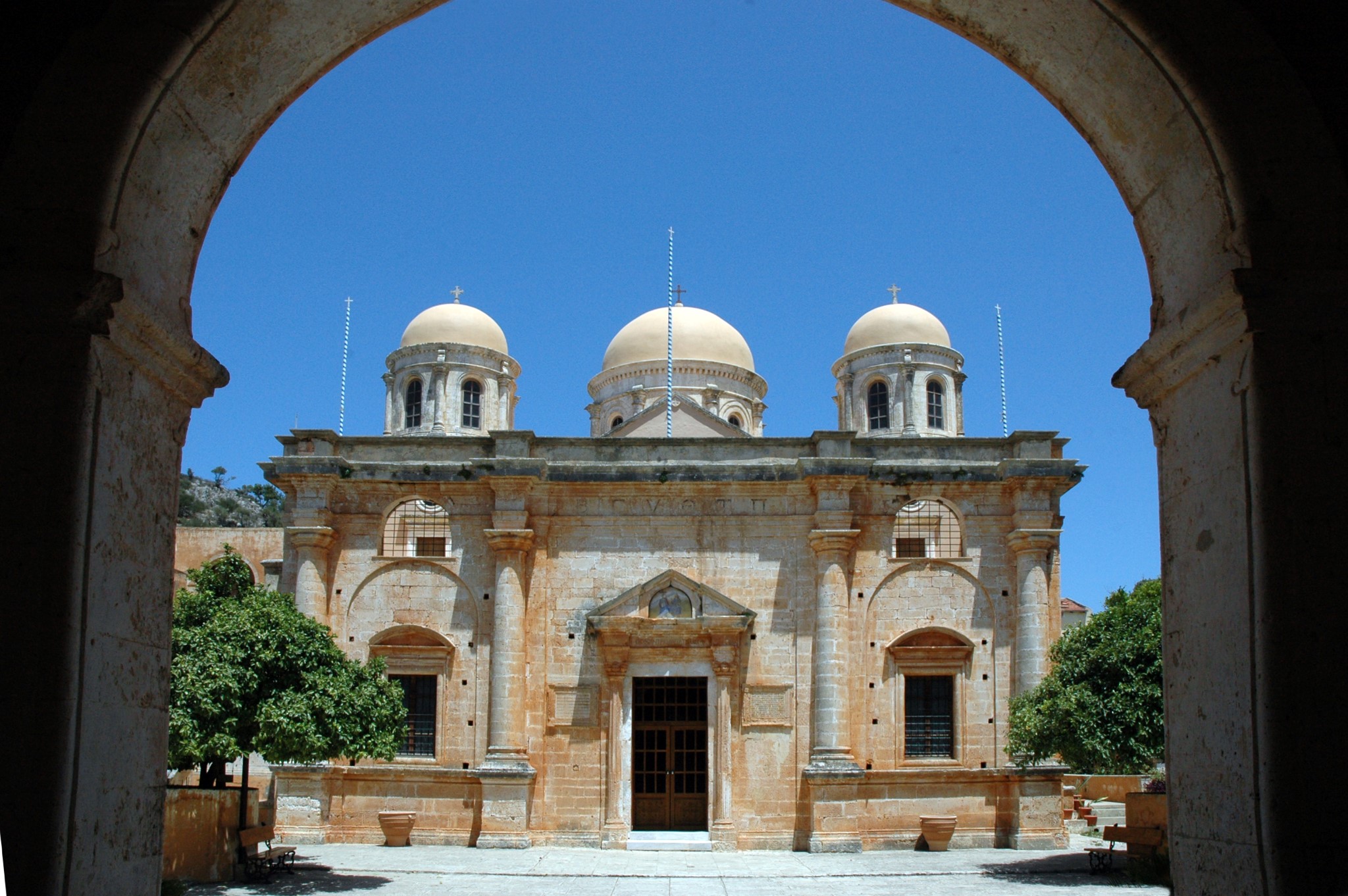
In the Old Town of Rethymnon, Christian churches and Ottoman mosques share the same narrow streets. Saint Francis was the main church of a Franciscan monastery, while the Augustinians’ monastery church became the Neratze Mosque under Ottoman rule and has the city’s tallest minaret. A separate section explores the religious monuments of the city of Rethymnon in more detail. The area’s monastic history continues beyond the city centre. The Monastery of Christ the Saviour stands in Koumbes, while Gallos is home to the restored monastic dependency of Saints Peter and Paul. Further south, at the foot of Mount Vrysinas, Agia Irini Monastery was restored and reopened after a long period of abandonment. On the road to Chromonastiri, the Church of the Dormition of the Virgin Mary and the ruins of the surrounding buildings survive at Halevi Monastery. Inland, Arkadi Monastery is known for the Renaissance façade of its main church and its role in the Cretan uprising of 1866. In Roustika, the Monastery of Prophet Elijah was also involved in preparations for the uprising. It hosted a committee that called on local leaders to assemble at Arkadi. In Myriokefala, Panagia Antifonitria is the surviving main church of the monastery founded by Saint John Xenos. Near Goulediana, at Kera Onythe, the remains of a three-aisled early Christian basilica with mosaic decoration attest to a Christian presence in the early Byzantine period. In Argyroupoli, the cave chapel of Agia Dynami stands where the spring of the same name emerges.

Read more ...
Religious Monuments of Mylopotamos

Religious Monuments of Mylopotamos

From the coast of Mylopotamos to its inland villages, early Christian basilicas, churches with frescoes and monasteries survive. At Panormo, the remains of the large three-aisled Basilica of Agia Sofia are still visible. At the archaeological site of Eleftherna, the mosaic floors of the Basilica of Archangel Michael retain geometric and floral patterns. An inscription credits Bishop Euphratas with its construction. Above the bay of Bali, on the slopes of the Talean Mountains, stands Attali Monastery. Near the coast, the shrine of Panagia Charakiani is associated with the area’s monastic and hermit traditions. At Kalo Horafi, the Church of the 318 Holy Fathers is the only surviving building of the old monastery. Local tradition links it with Vossako Monastery, in a more sheltered setting in the Talean Mountains. Inland, Diskouri Monastery and Halepa Monastery share part of their history. Diskouri supplied and cared for fighters during the Cretan uprising and was placed under Halepa in 1935. In Margarites, the Monastery of Christ the Saviour and Saint Gideon is a dependency of Karakallou Monastery on Mount Athos. Further west, Arkadi Monastery links the wider region’s monastic history with the Cretan uprising of 1866. At Episkopi Mylopotamou, the ruined Episcopal Church of Saint John recalls the former bishop’s seat. The Byzantine Church of Saint George stands out in Kalamas, while churches with frescoes survive in and around Margarites and Axos. At Fodele, the Church of Panagia preserves two layers of frescoes, the earlier of which dates to the 11th century.

Read more ...

Religious Monuments of Amari

Religious Monuments of Amari

Between Mount Psiloritis and Mount Kedros, the former province of Amari preserves early Christian basilicas, old monasteries and churches with frescoes. Near Vyzari, at a site known as Ellinika, stand the remains of a three-aisled basilica locally known as Rimokklisia. At Thronos, near ancient Sybritos, the later Church of Panagia was built over the ruins of an early Christian basilica. Parts of the original mosaic floor survive. At the heart of the valley stands Asomaton Monastery, dedicated to the Archangels. The surviving complex took shape between the 17th and 19th centuries and housed the Asomaton Agricultural School in the 20th century. On the slopes of Kedros above Ano Meros, the restored Church of Christ the Saviour was once the main church of Kaloidena Monastery. On Veni Hill, Saint Anthony’s Monastery is a dependency of Arkadi Monastery. In Meronas, the Church of the Dormition of the Virgin Mary preserves 14th-century frescoes. Just outside the village, at Sochora, stands Panagia Mavridiani. Near Nevs Amari stands Panagia Kera. At Livada near Fourfouras, Panagia Kardiotissa survives as the main church of a small convent.

Read more ...

Religious Monuments of Agios Vasileios

Religious Monuments of Agios Vasileios

From the shores of the South Cretan Sea to the inland villages, the former province of Agios Vasileios preserves historic monasteries, cave chapels and churches with frescoes. Near the Megalos Potamos River, Preveli Monastery comprises two separate complexes. The now ruined Lower Monastery of Saint John the Baptist lies further north, while the Rear Monastery of Saint John the Theologian stands closer to the sea. In Kissos, the Monastery of the Holy Spirit contributed to local education through the school it housed. Near Akoumia stands the Monastery of Saint Anthony at Katevati. The old Monastery of Saint Onuphrius survives beside a spring in a steep ravine on Mount Asiderotas. At Voulgaris, near Melambes, the Church of Saint John the Baptist and a few traces of the other buildings survive from the former monastery. In Lampini, the domed Church of Panagia preserves several layers of frescoes. In Melambes, the Church of Agia Paraskevi retains frescoes painted in two phases in the 14th century. In Kissos, the churches of Panagia and Saint John the Theologian, along with the two-aisled Church of the Transfiguration and Saint Catherine, show how much religious painting survives in a single village.

Read more ...

Religious Monuments of Sitia province

Religious Monuments of Sitia province

From Cape Sidero to the inland gorges and plateaus, the former province of Sitia preserves fortified monasteries, small shrines and churches with frescoes. East of the town, Toplou Monastery, also known as Panagia Akrotiriani, is noted for its fortress-like architecture and its collection of icons and religious treasures. These include “Great Are You, O Lord”, an icon painted in 1770 by Ioannis Kornaros of Sitia. West of the town, Panagia Faneromeni Monastery stands in the rugged Trachilas area, in the Gorge of All Saints. On the south coast near Goudouras, Kapsas Monastery is built into the rock and dedicated to Saint John the Baptist. Saint Joseph Gerontogiannis helped restore it in the 19th century. When the Cretan uprising broke out in 1866, he and his companions took refuge at the old Agia Sofia Monastery on the Armeni plateau. In Lithines, the Church of Panagia preserves 14th-century frescoes. The Last Judgement covers the entire west wall of the older aisle. In the ruined settlement of Voila, near the medieval tower, the two-aisled Church of Saint George and Saint John the Theologian contains a funerary monument depicting members of the Salomon family. At Kato Episkopi, excavations showed that the domed Church of the Holy Apostles was created in the 16th century by converting a Middle Byzantine bathhouse. In Epano Episkopi, the three-aisled Church of Panagia is dedicated to the Nativity of the Virgin Mary, Saint John the Baptist and Saint George.

Read more ...

Religious Monuments of Ierapetra province

Religious Monuments of Ierapetra province

Many small monasteries in the former province of Ierapetra grew up on the slopes of the Dikti range, near the border with Viannos, and in the Thripti mountains. Several of the monasteries closed over time, but their churches survive. At Malles, the former Monastery of Panagia Armos and the active Convent of Panagia Exakousti show two sides of this monastic tradition. Above Pachia Ammos, Faneromeni Monastery near Gournia stands on a steep slope, with its church set inside a cave. At Thripti, near the head of Ha Gorge, the small Church of Saint Anne preserves frescoes from the late 14th and early 15th centuries. In Episkopi, once the seat of the bishop of Ierapytna, stands the Church of Saints George and Charalambos. In Ierapetra itself, the Church of Christ the Saviour in Kato Mera, close to Kales Fortress, retains a Venetian-era church at its core. Offshore, the chapel of Agios Nikolaos survives on Chrissi Island.

Read more ...

Religious Monuments of Lassithi Province

Religious Monuments of Lassithi Province

From the late 13th century, the Venetian authorities banned settlement on the Lassithi Plateau, which had served as a refuge for rebels. The ban was lifted in 1463. In the centuries that followed, monastic life left its mark on the plain and the surrounding mountainsides. Panagia Kroustallenia Monastery stands on an oak-covered hill between Agios Konstantinos and Marmaketo, while Vidiani Monastery, near Kato Metohi, is dedicated to the Life-Giving Spring. Among the fields on the plain, Saint John Kambitis Church brings people from the plateau villages together for its annual feast in August. The restored Church of Saint Pelagia recalls the small monastery that stood here under Venetian rule. On the way to Aloida was the Monastery of the Holy Apostles, which was destroyed in 1823. A spring on the small Aloida plateau lies beside the Church of Saint John the Baptist. Higher up, on the Limnakaro Plateau, the Church of the Holy Spirit preserves 14th-century frescoes in its older aisle, originally dedicated to the Transfiguration of Christ.

Read more ...

Religious Monuments of Mirabello

Religious Monuments of Mirabello

The hills north of Neapolis, an area known as Upper Mirabello, were once home to many small monasteries, each housing a handful of monks. Many of these communities have gone, but their churches still stand in or near the villages. Examples include the Monastery of Kalogrades at Fourni and the Monastery of Saints Constantine and Helen at Dories. The area is also home to larger monastic complexes, such as Areti Monastery at Karydi and Kremasta Monastery near Neapolis. West of the town, the ruins of Fraro Monastery bear witness to the presence of Franciscan friars in Mirabello under Venetian rule. At Kritsa, the church of Panagia Kera is known for the frescoes that cover all three aisles. On the coast around Elounda, the remains of the early Christian basilicas at Poros and Kolokitha preserve traces of the region’s early Christian communities.

Read more ...

Εκκλησάκια δίπλα στη θάλασσα

Seaside Chapels in Crete

1 1 1 1 1 1 1 1 1 1 Rating 5.00 (1 Vote)
A wedding or baptism in a small chapel by the sea is a captivating experience for everyone present, whether the ceremony is intimate or attended by many guests. Crete offers dozens of beautiful choices, some of which are presented below.

Read more ...

Download Free Premium Joomla Templates • FREE High-quality Joomla! Designs BIGtheme.net