








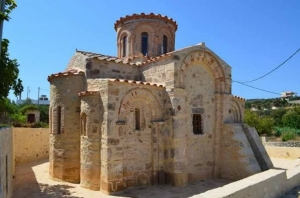
The church of Agios Dimitrios is located in the village of Agios Dimitrios, very close to Pigi, Rethymnon. It is a cross-shaped temple with dome and projecting parts to the sides. The exterior walls are framed by blind arches and a few small windows, while the dome is supported by 4 corinthian columns.
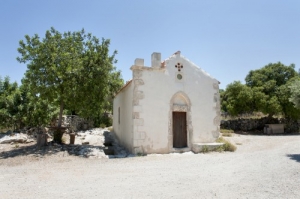
Northwest of the village Agios Konstantinos in Rethymnon province is the ruined village of Artos, which was destroyed by the Ottomans because of its revolutionary action. Access to the site is possible via a dirt road starting either from Saint Constantine or Zouridi. Today, three churches are preserved, of which Saint George stands out.
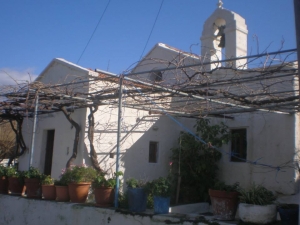
In the Barotsiana district of village Argyroupolis there is the church of Our Lady (Panagia) Barotsiani, a single-storey 13th-century church, to which a chapel of Saint Anthony was added later. The name comes from the Venetian family Barozzi, who owned the area of Argiroupolis.
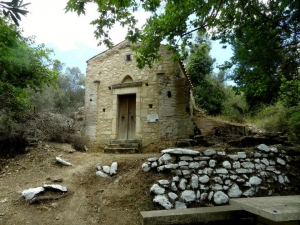
The church of Saint Kyriaki (Agia Kiriaki) is located on the banks of the river Mouselas, fed by the rich springs of Argyroupolis. It is the result of the conversion of a late Roman bath to a church in the 9th century.

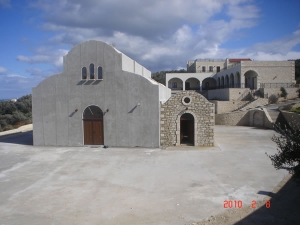
The Monastery of St. Anastasia the Roman, the first in Greece monastery dedicated to Her, was founded in 2008 and started its operation in July 2009. Apart from the main church of St. Anastasia, there is the chapel of St. Kosmas the Aetolian.
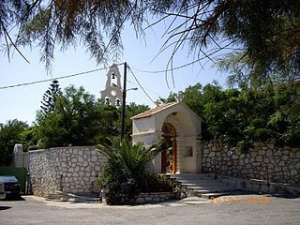
The convent of Jesus Christ (Christ the Savior) is built on the hill of Timios Stavros, in the west suburb of Rethymnon called Koumbes. The monastery was probably initially founded during the Venetian period, like several monasteries and temples in the region.
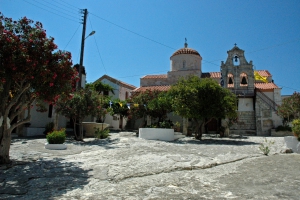
The Monastery of Prophet Elijah (Profitis Elias) is built above a hill with panoramic views, 20km south of Rethymno, next to Roustika village. It is a relatively unknown monastery throughout Crete, although it was founded in the Venetian Era and belongs to the most historic convents on the island.
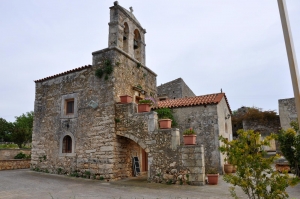
The monastery of Saints Peter and Paul is located at the settlement of Gallos, near the University of Crete. The restored monastery, for which there is no surviving information about its history, is a dependency of the Monastery of Arkadi.
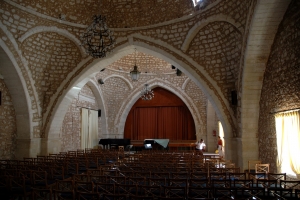
According to certain Venetian maps and the excavation reports the monastery had a rectangular plan with the cells arranged around the church. Today only the church is preserved with its original plan altered because of its conversion to a mosque and the addition of a chapel at the west.
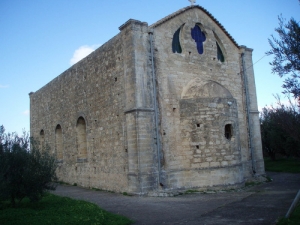
Panagia Halevi monastery is located about 6km south of Rethymnon, on the way to Chromonastiri. It's another Venetian monastery of Crete, which is deserted and surely worth restoring.
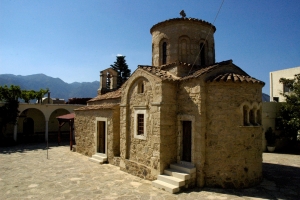
The monastery of Panagia Antifonitria is located in the village Miriokefala, 29km south of Rethymno. The monastery does not operate today and is one of the oldest monasteries in Crete. It is said to have been founded in the 11th century by St. John Xenos or Hermit. Saint John is well known for establishing several small monasteries across the island.
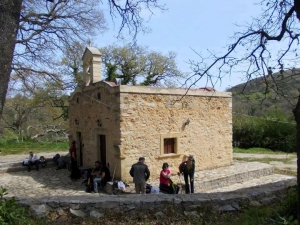
The church of Agia Paraskevi at Kastellos is a double-aisled church with a stone iconostasis. It was the temple of an old monastery, now deserted. The monastery was built at a beautiful place with tall trees perfect for a stroll.
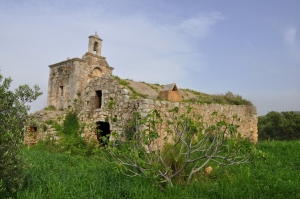
At the suburb Tria Monastiria of Rethymnon city, just opposite the entrance of the Municipal Cemetery of the city, we meet a ruined stone building with a small church on its roof, in a really beautiful grove.
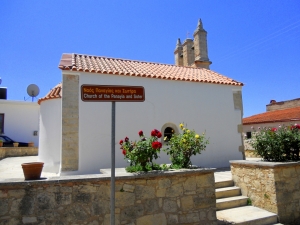
The two-aisled church of Panagia Katochoriani or Levadiotissa at Roustica is dedicated to the Assumption of the Virgin and the Transfiguration of Chist. It was founded probably in the 12th century as a single-aisled church of the Virgin Mary and in 1627 a second aisle was attached to the existing temple.
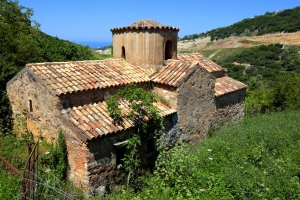
The church was recently restored by the Archaeological Service and is now open to the public. The temple was built in the Middle Byzantine period on the site of an earlier basilica of the 3rd AD century, parts of which were later incorporated the church. On the sides four rooms were built, so the final shape of the temple is rectangular.
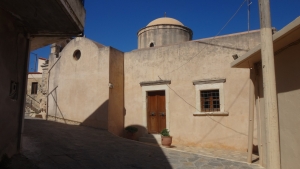
The Church of the Panagia (Virgin Mary) is located at the center of the village Kyrianna and is dedicated to the Assumption of Mary. The original church (11th century) was a cruciform temple with a dome and looked like the chapel of Saint Paul at Sfakia.
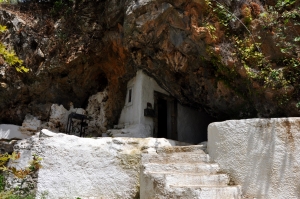
The cavernous temple of Agia Dynami (Holy Force) is located in Argiroupolis. Within this small chapel there is a huge spring of Holy Force that supplies almost entire Rethymno province with water. Inside the temple there was an impressive mosaic of Christ, which has been now replaced with a simple icon as the initial has been moved to the museum of Rethymnon.
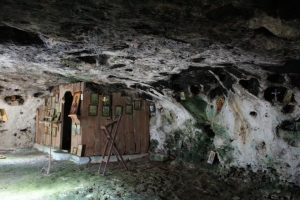
There are many cavernous chapels throughout Crete, most of them dedicated to Saint Anthony. Such one totally unknown chapel is that of Saint Anthony by Roustika, Rethymno prefecture. It is built in a cave in the heart of the cypress wood covering the Roustika Gorge and is well hidden in the dense vegetation.
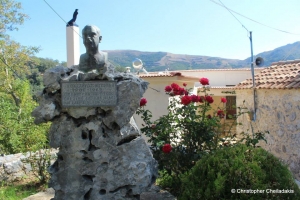
At the root of the steep and imposing range of Kryoneritis in south Rethymno lies the picturesque green village Alones. Its name is taken after its shape, which resembles a huge threshing (Aloni is threshing in Greek). In the village square under a perennial plane tree there is the beautiful humble chapel of St. Onoufrios.
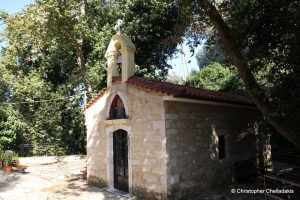
The church of Agia Paraskevi is relatively modern, but it is built over an older Byzantine church. Even today the visitor will discern small parts of the frescoes of the original church, dating before the 17th century. Inside, the church has a large collection of wonderful portable icons. Outside the church there is a large courtyard under the tall trees.
- 1
- 2
Also read:
- Home
 Beaches
 Nature
 Past
Past Destinations
 Highlights
 West Crete
- Central Crete
- East Crete
- Towns
- Chania Prefecture
- Chania
- Paleochora
- Kissamos
- Georgioupolis
- Chora Sfakion
- Loutro
- Rethymnon Prefecture
- Rethymnon
- Agia Galini
- Plakias
- Spili
- Anogia
- Heraklion Prefecture
- Heraklion
- Hersonissos
- Malia
- Matala
- Agia Pelagia`
- Archanes
- Kokkinos Pirgos
- Lassithi Prefecture
- Agios Nikolaos
- Elounda
- Sitia
- Ierapetra
- Makrigialos
- Palekastro
- Zakros
- Lassithi Plateau
- Get Prepared


