







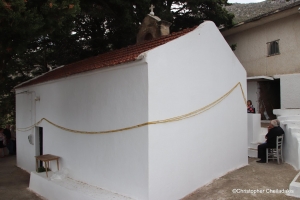
Roping off the churches, which in Crete is called "zosimo", is a custom that has its deep roots in antiquity to keep evil spirits away.

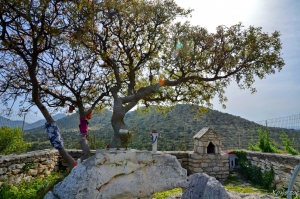
On the hill Grivila near the village Ahlade there is built the church of Saint Fanourios. Approximately 100 meters from the church there is a special tree, which is connected with a religious tradition dating back from the ancient tree-worship traditions in Crete. The tree position is called Evresi (Finding) as they say that the miraculous icon of St. Fanourios was found here.
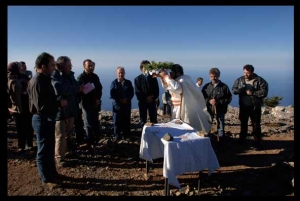
Atop the highest peak of Asterousia, Kofinas, stands the church of the Holy Cross and is accessed through a steep trail. On the Feast of Holy Cross, on September 14, dozens of people climb up there to participate in a ritual that has its roots in the Minoan times, when nature and trees were worshiped.
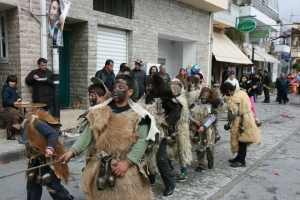
Each Year, on the day of Net Monday, a feast called apokrigiomata takes place at the scenic village of Gergeri. The name is taken after the Cretan verb apokrigiono, which means cut the meat consumption, due to the starting of the Lent. This day revives customs from all over the Greek territory with many participants parading in a carnival style.
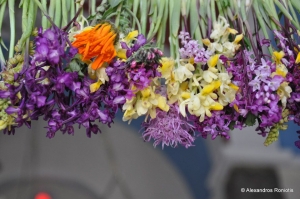
Every year, on May 8, the day of Saint John the Theologian, crowds of believers from all over Crete arrive at the small village Marmaketo, at Lasithi Plateau, to participate at the annual miracle of Marmaketo. At the main church of St. John the Theologian, on Good Friday, starts begins a customary process that ends at the feast day of St. John: On Good Friday, morning, the women of Marmaketo gather some wild orchids, called Easter flowers.
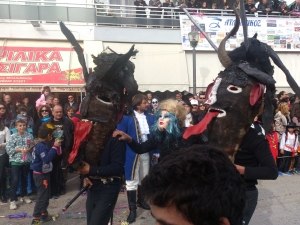
In 1958, Odysseas Mesaritakis from Sivas at Pirgiotissa Province invented a Halloween appearance that soon became the carnival trademark of Sivas. The mask of Sivas, made of the root of the local plant athanatus, and adorned with goat horns and other objects, caused the fear of the little kids at carnivals and mothers mentioned this to make the children eat all their food!
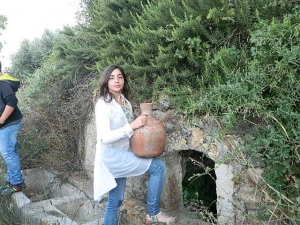
One of the most impressive and beautiful customs in Crete is Klidonas that has its roots in antiquity. Klidonas is derived from the ancient word Klidon (κληδών) meaning the sign or the omen and is celebrated every year on June 24, the day of the Birth of St. John the Baptist. Lately, many villages in Crete have years revived the old custom that was tended to disappear.
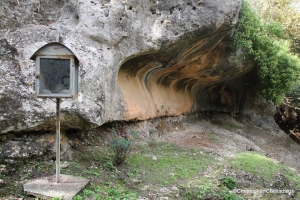
Cretan countryside is full of icon shrines; From the edges of the roads to the most unexpected places, such as beaches or mountains, gorges and woods. It is estimated that nowhere in the world there are so many religious shrines as in Crete. Most people mistakenly believe that all shrines are there to commemorate a fatal accident. However, the reality is very different for the shrines we meet in places other than the roads (where indeed, most of them are due to accidents).
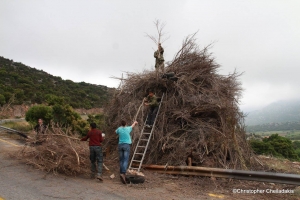
At most villages of Crete on the day of Holy Saturday we meet preparations for the founara of Judah. Founara in the idiom of Crete means a big fire that burns Judah every year. On the morning of Holy Saturday the boys of the village gather dry woods and branches near the church or at a point which is visible from all the neighborhoods of the village.
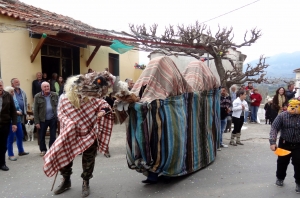
On the days of carnival (Net Monday) in several villages of Crete revive several customs and traditions, such as that of the Camel. The Camel consists of two people who are covered with clothes and ornaments forming the shape of a camel. This is driven by the camel man in the village alleys. The camel man paints his face black and is dressed in clothes, reminding of an Arab.
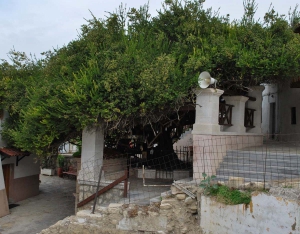
Paliani Monastery is one of the oldest monasteries in Crete and it has as a trademark a very old myrtle tree (Myrtus communis). This specific myrtle is considered sacred (Holy Myrtle) and is honored on September 24. Inside the trunk of the Holy Myrtle, as they say, is believed to be the icon of Panagia Mirtidiotissa (Virgin Mary of Myrtle).
Also read:
- Home
 Beaches
 Nature
 Past
Past Destinations
 Highlights
 West Crete
- Central Crete
- East Crete
- Towns
- Chania Prefecture
- Chania
- Paleochora
- Kissamos
- Georgioupolis
- Chora Sfakion
- Loutro
- Rethymnon Prefecture
- Rethymnon
- Agia Galini
- Plakias
- Spili
- Anogia
- Heraklion Prefecture
- Heraklion
- Hersonissos
- Malia
- Matala
- Agia Pelagia`
- Archanes
- Kokkinos Pirgos
- Lassithi Prefecture
- Agios Nikolaos
- Elounda
- Sitia
- Ierapetra
- Makrigialos
- Palekastro
- Zakros
- Lassithi Plateau
- Get Prepared


