







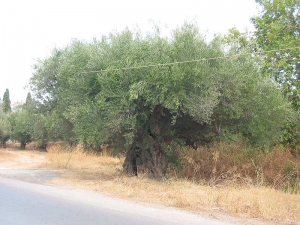
The olive tree is located on the right side of the road heading from Sitia to Piskokefalo and locals call it fourkolia, i.e. the olive tree where the Christians were drowned by hanging by the Turks. Unfortunately, the tree has been damaged severely due a car crash.
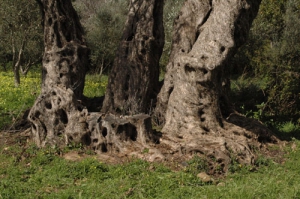
The olive tree at position Kardamiana, near Genna, has been declared by the Association of Cretan Olive Municipalities as a natural monument due to shape and relief trunk. Its variety is called throumbolia and is grafted on a rootstock of a wild olive tree.
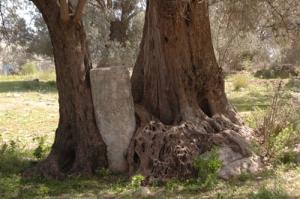
Among the villages and Agii Deka and Mitropoli there are the ruins of ancient Gortyn. Gortyn was the largest and most populous city of Crete during the Roman era. At the same place we meet an important monument of nature. This is the monumental grove of Gortyn occupying a huge area and has centuries-old olive trees. A walk through the historic grove contains many sites of archaeological interest and natural beauty. The tour starts on the main street to Mires. Everywhere around we find piles of stones that once were parts of buildings, scattered fragments of ancient walls, scattered pieces of pottery and fallen pillars.
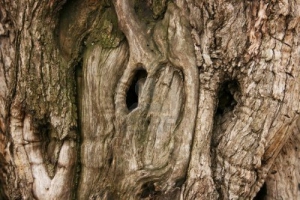
This olive tree has been declared by the Association of Cretan Olive Municipalities as a natural monument because of shape, relief trunk and its connection with historical events. It is located at position Anisaraki, by Kantanos, where there are dozens of other ancient olive trees. Its variety is called mastoid and is grafted on a rootstock of a wild olive tree.
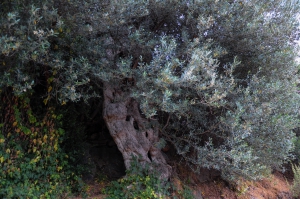
The olive tree of Mathena has been declared as monumental by the Association of Cretan Olive Municipalities as a natural monument due to shape and relief trunk, forming a cave with its adjacent rock.
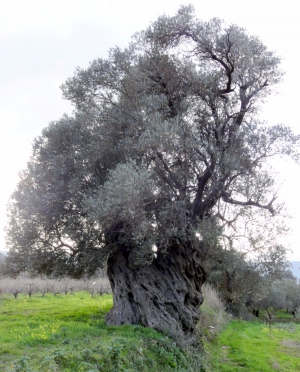
The olive tree has been declared by the Association of Cretan Olive Municipalities as a natural monument due to its relief trunk. Its variety id called hontrelia and is grafted on a rootstock of a wild olive tree. The tree belongs to the Church and at a height of 0.8m it has 4.2m diameter and 10.6m perimeter, while its base has 4.5m diameter and 12.1m perimeter.
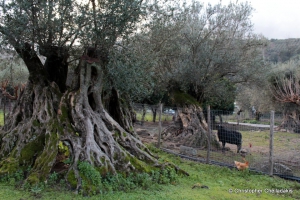
At the center of Palea Roumata in Chania there is one the officially characterized monumental olive trees in Crete. The 3000 year old olive tree is surrounded by several other very old trees as well. The perimeter is 10.50 and there is a huge hole, where the locals had hidden weapons during the Turkish Era, while in 1941 a committee against the Germans met in the tree. This is the tree where the guns that were used in the battle of Anavos were also hidden (1941).
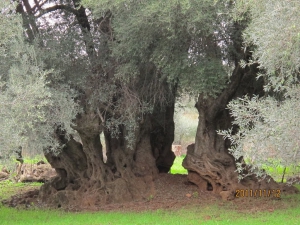
The olive tree has been declared by the Association of Cretan Olive Municipalities as a natural monument due to huge size and its location near the postminoan settlement of Kolydra. Its site is named Lakkos and hosts numerous ancient trees, with this specific tree being 3000 years old.
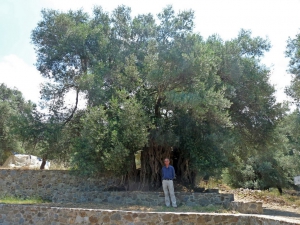
The olive tree of Saint George is one of the many ancient olive trees in the areas Anisaraki and Vardaliana near Kandanos village. It has been declared as a memorial by the Association of Cretan Olive Municipalities due to its flattened shape and textured trunk.
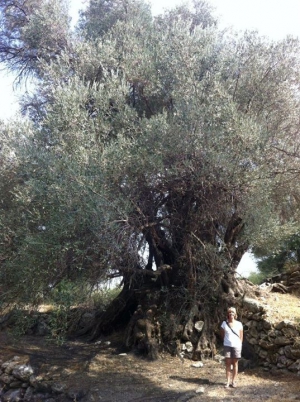
The olive tree has been declared by the Association of Cretan Olive Municipalities as a natural monument due to its size, shape and relief trunk. The name of the site is Gre Ele which means Old Olive and refers to this tree. Its variety is throumboelia and is grafted on a rootstock of a wild olive tree. It is estimated to have been planted in 650-500BC and is located very close to the archaeological site of Eleftherna.
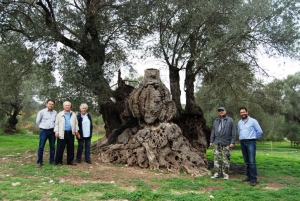
The Monumental olive grove of Amari is located at position Rovithis at Monastiraki, Amari Province and has been declared by the Association of Cretan Olive Municipalities as a natural monument. The several ancient trees are a dependency of the Agricultural School of Amari and unfortunately in 1980 about 1000 more ancient trees were uprooted.
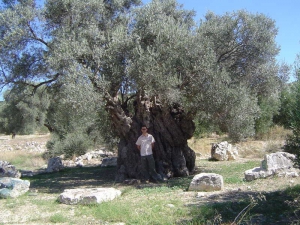
The Monumental olive tree of Kamilari has been declared by the Association of Cretan Olive Municipalities as a natural monument due to its enormous size. The exact age is unknown. Most similar trees in Crete are aged around 2000 years. But it’s a very powerful and peaceful place also worth the visit.
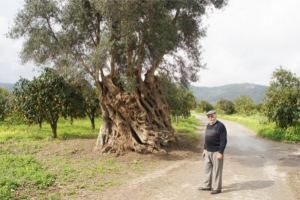
The ancient olive Tree of Vatolakkos is grafted onto wild olive subject. Because of its size it has been declared by the Association of Cretan Olive Municipalities as monumental. Access to it is very easy.
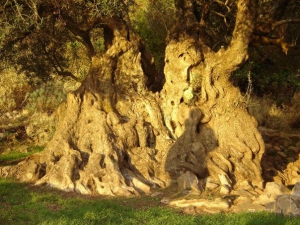
The Great Olive tree of Aerinos has been declared monumental by the Association of Cretan Olive Municipalities. It is located at an altitude of 700 meters near the settlement Felesina. The olive tree is impressive because apart from its age it has a special morphology with many stones embedded in the trunk.
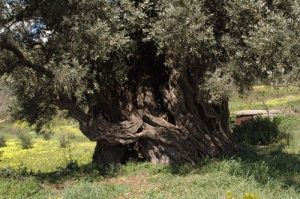
Paliamas Olive Tree has been declared monumental by the Association of Cretan Olive Municipalities due to its relief trunk and size. This olive tree dates back to the Sub-Minoan First Geometric period, produces big olives and it’s got a big cavity in its trunk, where three people can fit in. Its perimeter at its foot measures 20.40 meters and at a height of 80 cm from the ground it measures 10.50 meters.
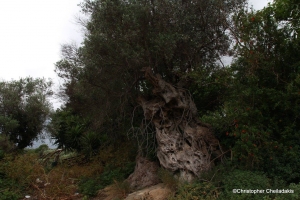
The olive of Saint George at Kamara Deliana is aged over 2000 years and is not the only case of monumental trees in the area. Not too far from St. George we meet a whole cluster with monumental olive trees.
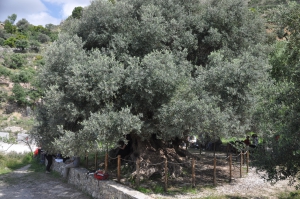
The legendary olive tree in Azorias is located 1km south of the village Kavoussi and very close to the homonymous archaeological site of Azorias. This olive tree is a natural monument; it is the oldest olive tree in the world! Indeed, it is grafted on a rootstock of a wild olive tree, making it the oldest sample of grafting in the world.
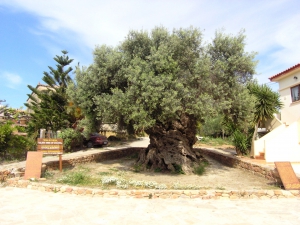
The olive tree has been declared by the Association of Cretan Olive Municipalities as a natural monument because of its shape and the exceptional aesthetics of its relied truck, reminiscent of exceptional woodwork.
Also read:
- Home
 Beaches
 Nature
 Past
Past Destinations
 Highlights
 West Crete
- Central Crete
- East Crete
- Towns
- Chania Prefecture
- Chania
- Paleochora
- Kissamos
- Georgioupolis
- Chora Sfakion
- Loutro
- Rethymnon Prefecture
- Rethymnon
- Agia Galini
- Plakias
- Spili
- Anogia
- Heraklion Prefecture
- Heraklion
- Hersonissos
- Malia
- Matala
- Agia Pelagia`
- Archanes
- Kokkinos Pirgos
- Lassithi Prefecture
- Agios Nikolaos
- Elounda
- Sitia
- Ierapetra
- Makrigialos
- Palekastro
- Zakros
- Lassithi Plateau
- Get Prepared


