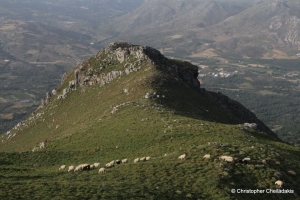
Mount Kouroupa rises in southern Rethymno and, together with the neighbouring Kryoneritis, forms the geological continuation of the White Mountains towards the east. The massif runs parallel to the southern coast, between Kotsifos Gorge to the west and Kourtaliotis Gorge to the east. Its highest summit is recorded at 984 metres on maps of the Hellenic Military Geographical Service, although other maps give an elevation of 1,001 metres.
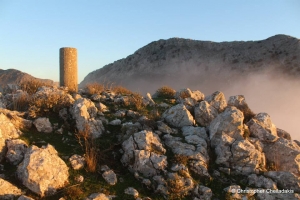
The same massif includes several lower peaks of considerable archaeological interest. At Korakias, at an elevation of 736 metres, a Minoan peak sanctuary has been identified. At Kyrimanou, at approximately 805 metres, the remains of a settlement dating from the 12th to the 8th century BC survive. These sites demonstrate the importance of the peaks of Kouroupa since ancient times.
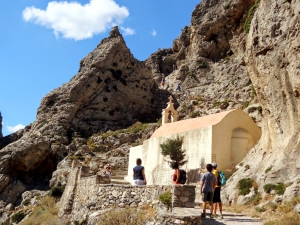
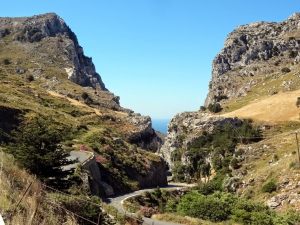
A telecommunications antenna and the church of the Holy Spirit stand on the summit of Kouroupa. The present church replaced an older building dedicated to the same feast, whose ruins survive nearby. The summit can be reached on foot or by a suitable four-wheel-drive vehicle along dirt roads beginning at Atsipades and Koxare. The terrain is particularly rugged, with sharp limestone rocks, deep ravines and steep slopes, so travelling away from the roads and established passages requires great care.
The villages of Asomatos, Mariou and Myrthios lie on the southern side of the mountain, while Kanevos is situated to the north. Dense fog, heavy rainfall and high humidity frequently occur during winter. From the summit, the view extends across the South Cretan Sea, eastern Sfakia, the southern coast of Rethymno and the surrounding settlements.
Kouroupa and the neighbouring ravines form one of the most important areas of Crete for birds of prey. The steep slopes and gorges provide refuge and nesting sites for the bearded vulture, griffon vulture, golden eagle and Bonelli’s eagle. The ecological importance of the region is also related to its geographical position, as it forms a natural passage between the White Mountains and the mountain ranges of central Crete, particularly Psiloritis and Mount Kedros.