
Cuvier's Beaked Whale
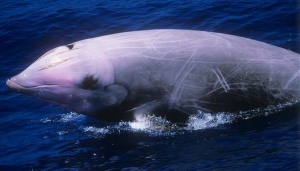
Cuvier's Beaked Whale (scient. Ziphius cavirostris) is a large whale, which is found in almost all seas of the world. They have been observed many times in several places of Greece, with Crete being one of them.





The seas around Crete support a remarkable variety of marine mammals, from the Mediterranean monk seal, which finds refuge along remote coasts and in sea caves, to dolphins and large cetaceans of the open sea. The relationship between the people of Crete and these animals dates back to antiquity, as demonstrated by the famous Minoan depictions of dolphins at Knossos.
Unlike fish, marine mammals breathe through lungs, give birth to live young and nurse them with milk. The bottlenose dolphin is mainly encountered in coastal waters around Crete, while the deeper open waters are also inhabited by the striped dolphin, the short-beaked common dolphin and Risso’s dolphin. Other species, such as the fin whale, occur more rarely or occasionally in the wider region.
The Hellenic Trench, a deep submarine system extending along western and southern Crete, is of particular importance. It constitutes one of the most significant habitats of the endangered Mediterranean population of the sperm whale, as well as an important area for Cuvier’s beaked whale, an elusive cetacean capable of exceptionally deep dives. Sperm whales use this region for feeding and reproduction and to raise their calves, giving the Hellenic Trench international importance for marine mammal conservation.
These animals are threatened by collisions with large vessels, entanglement in fishing gear, underwater noise, pollution and the ingestion of plastics. Ship strikes are among the most serious causes of mortality for the sperm whales of the Hellenic Trench. Their survival depends both on protecting their essential habitats and on reducing human pressures in the Greek seas.


 Beaches
 Nature
 Past
 Destinations
 Highlights
 West CreteCentral CreteEast CreteChaniaPaleochoraKissamosGeorgioupolisChora SfakionLoutroRethymnonAgia GaliniPlakiasSpiliAnogiaHeraklionHersonissosMaliaMatalaAgia Pelagia`ArchanesKokkinos PirgosAgios NikolaosEloundaSitiaIerapetraMakrigialosPalekastroZakrosLassithi Plateau


