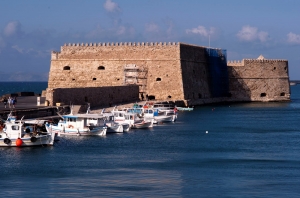
Beside the modern port of Heraklion lies the small and picturesque Venetian Harbour, which is now used as a marina. Its entrance is dominated by the imposing Rocca a Mare or Koules Fortress, which once protected the harbour and is now one of the city’s best-known landmarks.
The long breakwater of the modern port begins beside Koules and extends for approximately two kilometres. It is one of the most popular places in Heraklion for walking, jogging and fishing, offering panoramic views of the city, the old harbour and the Cretan Sea.
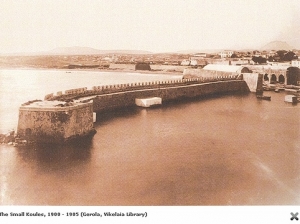
Opposite Koules, on the present Marina pier, stood a smaller fortress known as the Small Koules until the early 20th century. It protected the opposite side of the harbour entrance but was demolished during the construction and expansion of the modern port.
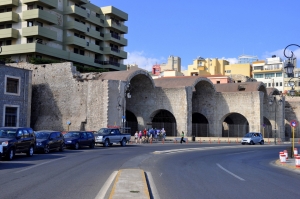
Along the coastal avenue, visitors can still see parts of the vaulted Venetian shipyards, the long buildings where ships were constructed, repaired and stored. Close to the Great Shipyards stands the Venetian Zane Cistern, while the Salt Warehouse once occupied the space between the larger and smaller shipyard complexes.
The first large-scale harbour installations were constructed during the Emirate of Crete in the 9th and 10th centuries, when Chandax served as an important base for the Arab fleet. After the Byzantine reconquest in 961, the port continued to serve the fortified city and Crete’s maritime communications.
The harbour reached its greatest prosperity during Venetian rule. Candia, as Heraklion was then known, developed into one of Venice’s most important commercial and naval ports in the eastern Mediterranean. Venetian galleys were maintained in its shipyards, while warehouses, workshops and military facilities operated around the harbour basin.
Historical descriptions indicate that by the 17th century the harbour could accommodate as many as fifty galleys. Its entrance was defended by Koules and Small Koules and could be closed with a large metal chain, particularly during wartime and throughout the Cretan War.
A wide variety of Cretan products were exported from Candia to Venice and other European markets. These included the famous Malvasia wine, salt from the island’s salt pans and particularly from Elounda, as well as honey, cheese, beeswax, silk, raisins, cotton and olive oil. The production and trade of salt were strictly controlled by Venice because they provided an important source of revenue.
Following the Ottoman conquest of Candia in 1669, the harbour remained in use and its fortifications were repaired when required. During the 20th century, however, the construction of the coastal avenue and the new modern port substantially altered the historical appearance of the area.
Large sections of the Venetian shipyards were demolished, together with Small Koules. The Gate of the Mole, which stood at the beginning of today’s 25th August Street and controlled communication between the city and the harbour, was also destroyed. Despite these extensive changes, the Venetian Harbour remains one of the most important historical landmarks of Heraklion.