Wells and Cisterns

Water

Wells - Fountains - Cisterns

Water has always been a precious resource on Crete, particularly in areas with few natural springs and long periods of drought. To supply their settlements, cultivated fields and animals, local communities constructed wells, cisterns, fountains, troughs and other waterworks, drawing on knowledge accumulated over many generations.

Wells were dug wherever underground water could be reached. Their shafts were generally lined with stone to retain the surrounding soil and protect the water. In some areas, groups of wells were created to serve the shared needs of villagers, farmers and shepherds.

In the driest regions, cisterns were constructed to collect and store rainwater. Water was gathered from roofs, courtyards or specially prepared surfaces and channelled into the reservoir through stone or ceramic conduits. Cisterns were often underground or covered by vaulted roofs, helping keep the water cool and reducing evaporation.

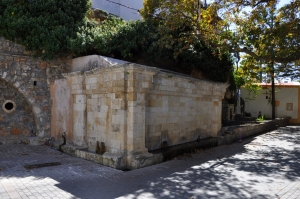
Public fountains were built beside springs, in village squares, at monasteries, at crossroads and along old routes. Besides supplying drinking water, many incorporated stone troughs for animals and basins used for washing clothes. Some were decorated with reliefs, inscriptions, arches and carved stone frames and are notable examples of vernacular, Venetian or Ottoman architecture.

Village fountains were not merely water-supply structures but important centres of social life. Residents met there, exchanged news, filled their water vessels and performed everyday tasks. Numerous Cretan place names and settlement names remain associated with springs, wells and historic fountains.

Many of these structures are no longer used, having been replaced by modern water-supply networks. They nevertheless remain valuable monuments of traditional architecture and bear witness to the ingenuity with which Cretan communities managed one of the island’s most essential natural resources.

Gavaliana Wells

Gavaliana Wells

1 1 1 1 1 1 1 1 1 1 Rating 4.00 (1 Vote)
A place of foremost interest by Gavalochori is the complex of 24 Venetian Wells. It is located about 1 km outside the village, just before the village cemetery. These wells played an important role in the society Gavalochori, both during the Venetian period and later.

Read more ...

Kissos Fountain

Kissos Fountain

1 1 1 1 1 1 1 1 1 1 Rating 3.67 (3 Votes)
What characterizes the village Kissos in the province of Agios Vasilios in Rethymnon, like all the villages located in the root of Kentros mount, are the many water springs. In the central square of the deserted village we meet the beautiful square with the old plane tree. Geroplatanos (Old plane tree) are actually two plane trees close to one another, and one specifically is one of the biggest in Crete and has a really impressive trunk.

Read more ...

Lygenia Wells

Lygenia Wells

1 1 1 1 1 1 1 1 1 1 Rating 4.00 (2 Votes)
On a plateau of Apokoronas province, by the village Paleloni, you will find the area Lygenia Wells. Is a series of stone, round and quite deep wells that the villagers constructed in the past in order to increase water source. In winter the wells overflow and shape a small lake in the area.

Read more ...

Mothiana fountain

Mothiana fountain

1 1 1 1 1 1 1 1 1 1 Rating 5.00 (1 Vote)
The fountain of Mothiana is among the most beautiful of the entire Crete and is located at the point a small spring gushes and the water is the basic source of water supply of the settlement. The beautiful stone fountain is built with local stone and bears and engraved date of 1882. The front part has some decorative elements and it also has a second water outlet on the left side.

Read more ...

Korita Spring at Pemonia

Korita Spring at Pemonia

1 1 1 1 1 1 1 1 1 1 Rating 3.00 (3 Votes)
Half a mile north of the very picturesque village Pemonia we meet the area Korita. Therein lies one of the many springs of water that irrigate the land of Apokoronas. The area around is full of ancient platan, cypress, olive and walnut trees. At the point of the spring there is a very picturesque old stone fountain built with the soft limestone of the region and two carved stone troughs.

Read more ...

Amariano Fountain

Amariano Fountain

1 1 1 1 1 1 1 1 1 1 Rating 5.00 (1 Vote)
The small village of Amariano in the province Pediada is known for its picturesque alleys, the square with the old plane tree and the traditional coffee shops. In the square there is the old fountain of 1898 and a cistern, where the visitor can drink the water of the spring that comes from the mountain area of Afentis Christos in Dikti Range.

Read more ...

Download Free Premium Joomla Templates • FREE High-quality Joomla! Designs BIGtheme.net