





Church Figures of Crete

Saints

Saints and Church Figures of Crete

Many places in Crete still preserve the memory of the island’s saints and church figures. The Acts of the Apostles records that the ship taking the Apostle Paul to Rome reached Kali Limenes, where a church now commemorates him. Church tradition links his companion, the Apostle Titus, the first bishop of Crete, with Gortyn. Saint Eumenius was one of the later bishops of Gortyn. The area also preserves the memory of the Holy Ten Martyrs, after whom the village of Agioi Deka is named. At ancient Raukos, the church and hermitage of Saint Myron are associated with the life of another bishop of Crete.

In the Asterousia Mountains, local ascetic tradition links Saint Kosmas the Hermit with Avvakospilio Cave, west of Koudoumas Monastery. Centuries later, the brothers Parthenios and Eumenios Charitakis from Pitsidia re-established Koudoumas Monastery in the late 19th century. Another Eumenios was born in Ethia in the Asterousia Mountains in 1931. Saint Eumenios the New (Saridakis) served as a priest at the Hospital for Infectious Diseases in Athens, where he ministered to people with Hansen’s disease.

In western Crete, Saint John the Stranger, who came from Sivas in the Messara Plain, is associated with Panagia Antifonitria at Myriokefala. Saint John the Hermit belongs to a separate ascetic tradition associated with the Monastery of the Holy Fathers at Azogyres and Katholiko Monastery on the Akrotiri Peninsula near Chania. According to local tradition, Saint Gerasimos of Kefalonia lived as a hermit in a cave at Modi before settling in the Ionian Islands. The church dedicated to him at Aroni also keeps alive the memory of his time in the Chania area.

The island’s church history also includes scholars and figures of the Latin Church. At the Monastery of the Three Hierarchs at Lousoudi, the monk Joseph Filagris is remembered for his work studying and copying manuscripts. In Neapolis, local tradition associates the Franciscan friar Peter Philargis with the Monastery of Saint Anthony at Fraro. The Council of Pisa elected him in 1409 during the Western Schism, and he took the name Alexander V. The Roman Catholic Church lists him as an antipope.

  • 1
  • 2
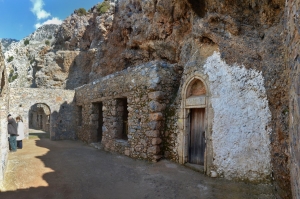
Saint Efthymios church at Zaros

Saint Efthymios church at Zaros

1 1 1 1 1 1 1 1 1 1 Rating 4.30 (5 Votes)
On the eastern side of the gorge of Rouvas, high above the monastery of Saint Nicholas, we meet the location of Kalives, where the Saints Euthymius and Nikolaos Kourtaliotis lived in the 17th century (around 1670). For some researchers, these are the same person. Inside the cavernous church there are some frescoes and there is a rock-carving with the number 1432, but it is not probably a date, as dates in that era were written with Greek symbols.

Read more ...

  • 1
  • 2
Download Free Premium Joomla Templates • FREE High-quality Joomla! Designs BIGtheme.net