Saints and Church Figures of Crete
Many places in Crete still preserve the memory of the island’s saints and church figures. The Acts of the Apostles records that the ship taking the Apostle Paul to Rome reached Kali Limenes, where a church now commemorates him. Church tradition links his companion, the Apostle Titus, the first bishop of Crete, with Gortyn. Saint Eumenius was one of the later bishops of Gortyn. The area also preserves the memory of the Holy Ten Martyrs, after whom the village of Agioi Deka is named. At ancient Raukos, the church and hermitage of Saint Myron are associated with the life of another bishop of Crete.
In the Asterousia Mountains, local ascetic tradition links Saint Kosmas the Hermit with Avvakospilio Cave, west of Koudoumas Monastery. Centuries later, the brothers Parthenios and Eumenios Charitakis from Pitsidia re-established Koudoumas Monastery in the late 19th century. Another Eumenios was born in Ethia in the Asterousia Mountains in 1931. Saint Eumenios the New (Saridakis) served as a priest at the Hospital for Infectious Diseases in Athens, where he ministered to people with Hansen’s disease.
In western Crete, Saint John the Stranger, who came from Sivas in the Messara Plain, is associated with Panagia Antifonitria at Myriokefala. Saint John the Hermit belongs to a separate ascetic tradition associated with the Monastery of the Holy Fathers at Azogyres and Katholiko Monastery on the Akrotiri Peninsula near Chania. According to local tradition, Saint Gerasimos of Kefalonia lived as a hermit in a cave at Modi before settling in the Ionian Islands. The church dedicated to him at Aroni also keeps alive the memory of his time in the Chania area.
The island’s church history also includes scholars and figures of the Latin Church. At the Monastery of the Three Hierarchs at Lousoudi, the monk Joseph Filagris is remembered for his work studying and copying manuscripts. In Neapolis, local tradition associates the Franciscan friar Peter Philargis with the Monastery of Saint Anthony at Fraro. The Council of Pisa elected him in 1409 during the Western Schism, and he took the name Alexander V. The Roman Catholic Church lists him as an antipope.

At the area Marathokefala at Spilia, 25 km west of Chania and just 3 km from Kolymbari, lies the famous historical cave of St. John the Hermit. Inside the cave there is temple of the 15th century and the foundations of old cells that date back in the 17th-18th century.
Read more ...
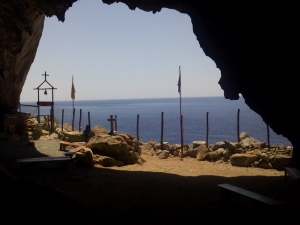
West of Koudoumas Monastery lies Avvakospilio, a cavernous church where, according to tradition, Ossios Kosmas lived as an ascetic during the 7th century and where his remains were buried.
Read more ...

The village of Agios Myron takes its name after the temple of St Myron, in which there is the tomb and the relics of St. Myron from Crete, which smell like myrrh. Under the temple there is the hermitage of the saint Myron, which has been formed into a chapel. Saint Myron was the bishop of Knossos and lived in the 4th century.
Read more ...

Two km south of the village Modi by Platanias (Chania) we meet is the cavernous chapel of St. Gerasimos. The location of this beautiful cave is accessed via dirt road that starts from Modi (there are information signs). The cave is located on a hillside that is covered by an ancient olive grove.The temple is built inside the cave, is spacious and has a courtyard along a long rock shelter.
Read more ...
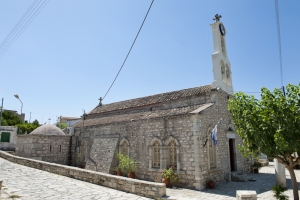
The village Agii Deka (Ten Saints) is named after the ten Cretan Christians that martyred there during the persecutions carried out by Decius in 250 AD. At the point where they martyred, at position Alonion, there is the three-aisled basilica of the 12th century.
Read more ...

The ruins of the Great Basilica (6th century AD) of Gortys are located 200m south of the main archaeological site, before arriving at Mitropolis village. The five-aisled temple, discovered accidentally in 1978, was the largest church in Crete. The temple was dedicated to St. Titus, but after its destruction by an earthquake (670AD), it was moved to the temple inside the current archaeological site.
Read more ...

Monastery of Fraro or St. Anthony' in Simeti is located 1km west of Neapolis. It is a ruined Franciscan convent dedicated to San Antonio. The name comes from the Latin word Frari, as the meaning Franciscan friars were called.
Read more ...
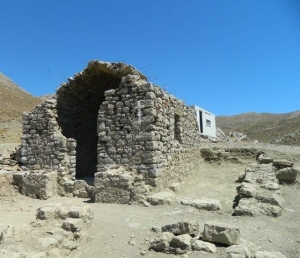
The ruined monastery of the Three Hierarchs is located at one of the most inhospitable areas of Crete, at position Lousoudi of the wild Asterousia Mountains. It was founded in the 14th century near the peak of Kofinas, at an altitude of 880m.
Read more ...