The period between the end of the Bronze Age and approximately the 8th century BC is traditionally known as the “Dark Age”, although the term Early Iron Age is now also widely used. The name does not imply that Crete became uninhabited or ceased to produce culture. Instead, it reflects the scarcity of written sources and the disappearance of the earlier palatial system. Archaeological research reveals a period of profound change, population movement and gradual reorganization.
The end of the palatial world
The decline of Minoan Crete was not a single, sudden event. After the destruction of many centres around 1450 BC, Knossos continued to operate under Mycenaean administration, while several smaller settlements preserved elements of earlier traditions. Around 1200 BC, the wider disruption that affected the eastern Mediterranean also transformed Crete, leading to the abandonment or reorganization of numerous settlements.
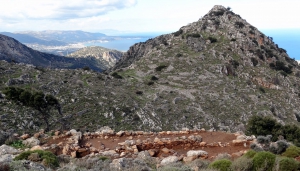
Some communities moved to inland and naturally protected locations. The choice of steep mountain sites does not mean that every coastal or lowland settlement was deserted. It reflects the need of certain groups for greater security, control of routes and access to cultivable land and water.
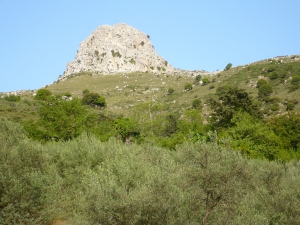
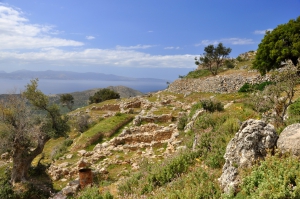
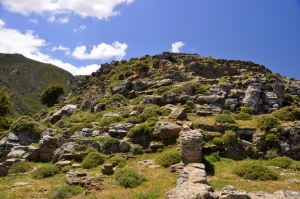
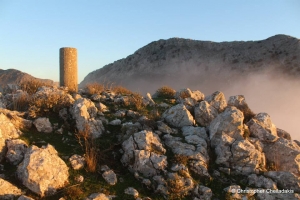
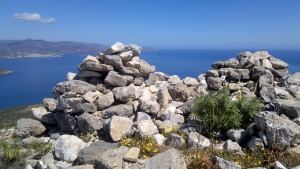
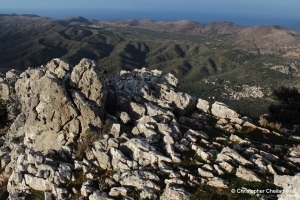
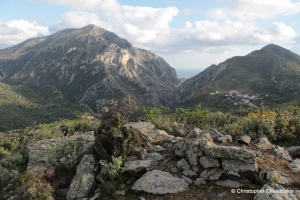
Settlements in mountainous and defensible locations
A characteristic example is the settlement of Karfi, established in a remote position above the Lassithi Plateau. Its houses, streets, sanctuaries and portable finds provide valuable information about a community that preserved elements of Minoan tradition after the collapse of the palatial centres.
The sites around Kavousi in eastern Crete are particularly important. Vronda developed on a lower ridge and was later associated with extensive burial activity, while Kastro at Kavousi, situated on a steep summit, had a long history of occupation during the Early Iron Age. Nearby, Azoria later developed into an important urban centre of the Archaic period.
Other representative sites include Vrokastro, overlooking the Mirabello region, and Anavlochos above Vrachasi. Their defensible positions offered control over roads, coastlines, plains and natural passages.
Society, burial customs and technology
Settlement patterns, social organization and funerary customs changed during this period. New forms of pottery, metalworking and weaponry appeared alongside older traditions. The use of iron gradually expanded without immediately replacing bronze, while cremation became more widespread in several regions.
Archaeological evidence reveals both continuity and transformation. Earlier religious symbols and practices survived but were adapted to new social conditions. Smaller communities gradually developed stronger local identities and new forms of authority.
Dorians and Eteocretans
Ancient literary tradition associates this period with the arrival of the Dorians in Crete. Archaeological evidence, however, does not necessarily support the idea of a single, sudden conquest of the entire island. Change appears to have occurred gradually and differently from one region to another through population movements, cultural contacts and the integration of different groups.
In parts of eastern Crete, ancient sources refer to the Eteocretans, meaning the “true Cretans”, who were regarded as descendants of the island’s earlier inhabitants. Their language, known from a small number of later inscriptions written in the Greek alphabet, has not been understood.
Towards the formation of the city-states
From the 9th and especially the 8th century BC, Crete entered a new period of development. Smaller settlements merged or evolved into organized urban centres, public spaces and sanctuaries were established and contacts with the Aegean and the eastern Mediterranean intensified. These processes gradually led to the formation of the Cretan city-states of the Archaic and Classical periods.