







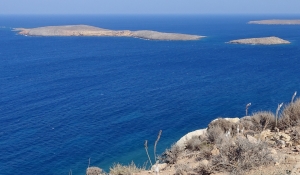
The islands of Grandes is a complex of three small lowland rocks in the province of Sitia, about half a mile opposite the beautiful beach of Hiona. In fact, the largest area (300 acres) is occupied by the middle island, known as Prasonisi, which is oblong and has the highest altitude at 31 meters. In the middle of the island there is a beautiful beach with two tamarisk trees, surrounded by rocks.

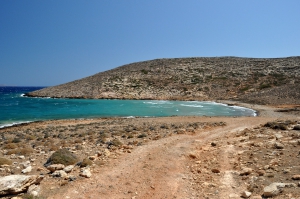
East of the main beach of Hiona, there are several small coves, where you can find a quiet place to swim alone and nude. The first sandy beach is called Bondalaki. Continuing driving along a bad dirt track to the esat, you will soon meet several coves with pebbles and enjoy the eerie landscape with gorges and wild mounts in the background. The last cove is Skaria and is the easternmost beach of Crete. It is highly affected by the sea currents (there is a lot of rubbish). The previous beach, Pilos, is formed in clay ground and is ideal for seclusion.

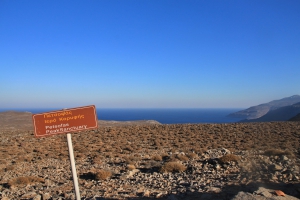
Petsofas peak is located near Palekastro and above the archaeological site of Roussolakos. In Minoan times here a peak sanctuary was founded where rituals included the deposition of clay figurines of cattle, men and women.

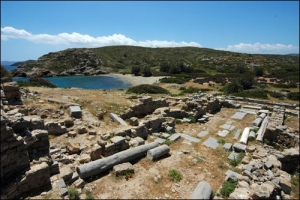
The ancient Itanos was one of the strongest cities in Crete, especially during the Hellenistic and Greco-Roman times. The name comes from its founder Itanos, who came from Phoenicia. Its territory, during its peak, stretched from Cape Samonio (current Cape Sidero) to Cape Erythrae (current Cape Goudouras).

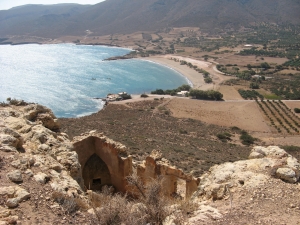
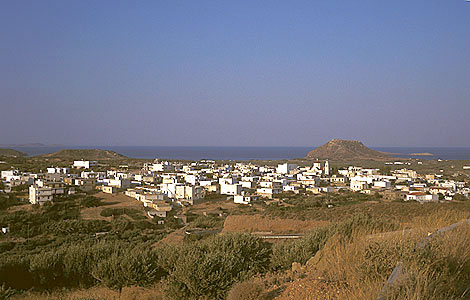
East of Paleokastro (Sitia Province) rises the steep hill Kastri, which separates the beaches of Kouremenos and Chiona. The hill was called Paleo Castro (Old Fort) by the Venetians, after which the current village is named.

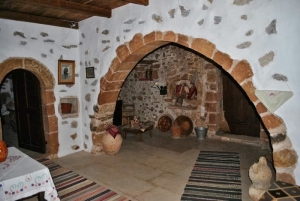
The museum exhibits many objects and tools used by the older generations from the Turkish Era until ’60s. Some of these are rare folk art samples.
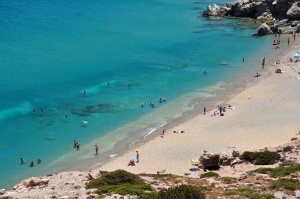
The name is taken after the ancient city Itanos, sited in the area. Next to the archaeological site of Itanos there are the three consecutive bays of Erimoupolis (a second name of the region). Thus, you can combine your visit to the archaeological site with a dip in the cool waters. It is noteworthy to tell that part of the ancient Itanos is under water. Thus, a unique experience is to snorkel above the ruins, which now house only fish!
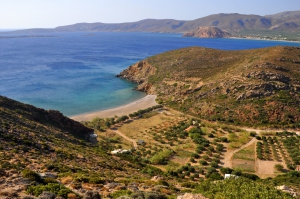
Maridati is beautiful unknown pebbly beach at a remote green valley in the area of Palekastro (6km from Palekastro). This is located 90km east of Agios Nikolaos, 21km east of Sitia and 5km north of the famous Kouremenos beach.
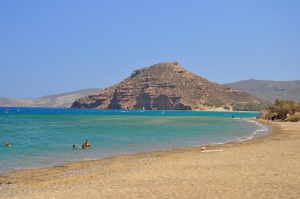
The beach is the longest in the area with a length exceeding 1.5km, bounded on the north by the Cape Tenta and on the south by the Cape Plaka. It has fine brown sand, shallow turquoise waters, and several tamarisk trees around it. It is slightly organized in some areas with umbrellas, showers, and beach bars.
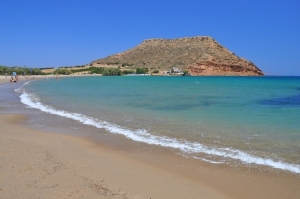
Chiona means carob storehouse in the Cretan dialect and is taken after the storehouses that were usually built next to the shore in order to transfer carobs with ships. Indeed the area was known for trading carobs. Here you can have a perfect day, especially if you combine your visit to Chiona with eating at the famous local fish taverns of Batis and Amanakis.
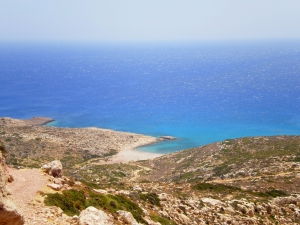
Skinias is a remote area located 94km east of Agios Nikolaos and 20km east of Sitia, in one of the most remote places on Crete. The wild area hosts three nice small coves, ideal for isolation at the exit of Katsara gorge. There are no amenities and trees around, thus you should have water and umbrella with you.
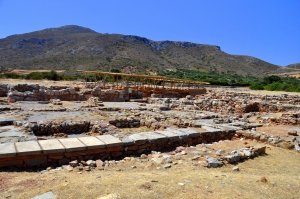
Rousolakos is located 91km southeast of Agios Nikolaos, right next to the beach of Hiona. Here, the archaeologists have discovered an important town of Minoan Crete covering an area of more than 50 acres, which flourished particularly at the end of the Minoan Age till 1450BC.

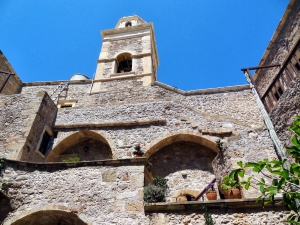
Toplou Monastery is located in the northeastern tip of Crete, at the base of Sidero Cape, 10km east of Sitia and 6km north of Palekastro. The monastery is one of the most historic monasteries of Crete and is known for its vast real property. In religious circles it is known as the Monastery of Panagia Akrotiriani, while the locals just call it the Great Monastery.
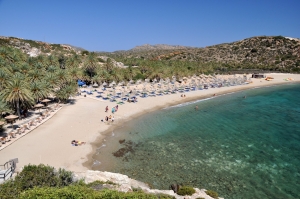
Vai was totally unknown until the early 1970s, when a popular commercial for the Bounty chocolate with coconut was filmed here, using the magical background of palm trees. In the advert, coconuts were falling from trees, however Vai palms produce dates. Consequently coconuts had to be falsely hung to create the right impression. The ad made this unknown earthly paradise renowned throughout the world.
Also read:
- Home
 Beaches
 Nature
 Past
Past Destinations
 Highlights
 West Crete
- Central Crete
- East Crete
- Towns
- Chania Prefecture
- Chania
- Paleochora
- Kissamos
- Georgioupolis
- Chora Sfakion
- Loutro
- Rethymnon Prefecture
- Rethymnon
- Agia Galini
- Plakias
- Spili
- Anogia
- Heraklion Prefecture
- Heraklion
- Hersonissos
- Malia
- Matala
- Agia Pelagia`
- Archanes
- Kokkinos Pirgos
- Lassithi Prefecture
- Agios Nikolaos
- Elounda
- Sitia
- Ierapetra
- Makrigialos
- Palekastro
- Zakros
- Lassithi Plateau
- Get Prepared


