








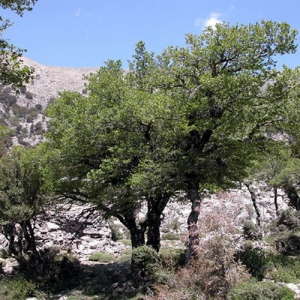
Cretan zelkova (Greek: Anegnoro or Ampelitsa) (scient. Zelkova abelicea) is an endemic bush or small tree of Crete as high as 3-5 meters. It constitutes a unique species of the genre Zelkova, of the family Ulmaceae and is characterized as a living fossil. It took the name "Anegnoro" (i.e. unknown) because when it was discovered, nobody knew its species.
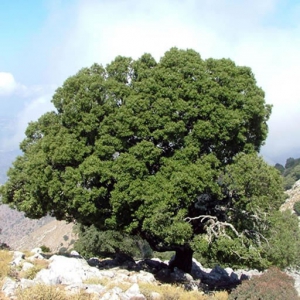
The holly or Kermes oak is a species that resembles common oak. In Crete it is met in all mountainous regions and is one of the most common trees. The oaks are met in ranges of Crete, as they can grow in rocky and dry soils and withstand the extreme weather conditions there. Indeed, the beautiful oak forest of Rouvas is the largest grove of oaks in Europe.
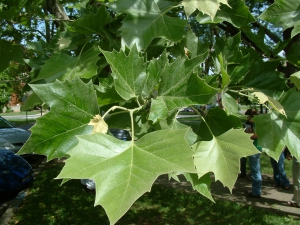
The plane tree can be met in every place of Greece (valleys, ravines, lakes, river banks and village squares). It also found almost everywhere in Crete and is one of the most typical plants of the Cretan flora. Perhaps no other tree, except the olive tree, is so closely associated with the daily life of the Cretans, as the plane tree because has been the spectator of all historical local events.
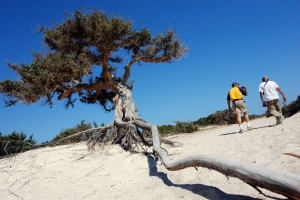
The cedars of Crete (Juniperus macrocarpa and Juniperus phoenicea) form some of the most important ecosystems in Greece, the cedar groves on the dunes of southern Crete. The ecological importance of the dunes is enormous for the biodiversity and the existence of rare animals and plants.
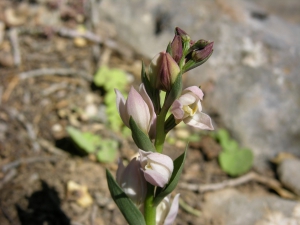
The Cretan cephalanthrera (Cephalanthera cucullata) is an endemic species of orchid that grows exclusively in the mountain forests of Crete, at an altitude of 700-1500m. It is a perennial herbaceous plant with short, creeping rhizomes. Its height reaches up to 20cm and it develops up to 24 whitepinkish flowers from May to June, but it does not bloom every year. In late June the seeds ripen and the aboveground plant parts dry.
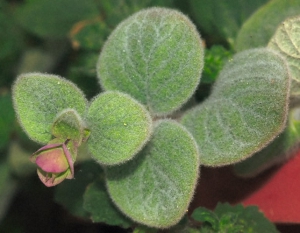
Dittany (Origanum dictamnus) (Greek: diktamos) is an endemic herb of Crete, the most famous of all, which is mainly used as a tea and as a therapeutic sip. Its name is taken after the Dikti Range (Lassithi Mountains), though it is also met in all ranges of Crete.
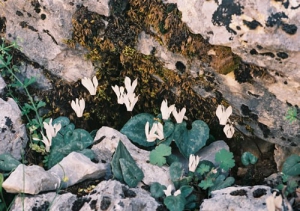
The cretan cyclamen belongs to the family of Primoulides. In many places of Greece, cyclamens are also called "hiropsomο" (i.e. bread for pig), because their roots are eaten by pigs. They grow in the middle of autumn between rock fissures or in the rubble.
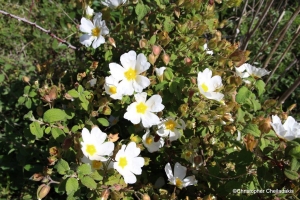
The white sage-leaved rock-rose (Cistus salvifolius) is one of the most beautiful white flowers of Crete. It is met in all counties of the island at medium altitudes up to almost 900 meters and always in phyllitic acidic grounds. It is not as well known as its related purple cousin (Cistus creticus) because it does not produce the famous laudanum.
Also read:
- Home
 Beaches
 Nature
 Past
Past Destinations
 Highlights
 West Crete
- Central Crete
- East Crete
- Towns
- Chania Prefecture
- Chania
- Paleochora
- Kissamos
- Georgioupolis
- Chora Sfakion
- Loutro
- Rethymnon Prefecture
- Rethymnon
- Agia Galini
- Plakias
- Spili
- Anogia
- Heraklion Prefecture
- Heraklion
- Hersonissos
- Malia
- Matala
- Agia Pelagia`
- Archanes
- Kokkinos Pirgos
- Lassithi Prefecture
- Agios Nikolaos
- Elounda
- Sitia
- Ierapetra
- Makrigialos
- Palekastro
- Zakros
- Lassithi Plateau
- Get Prepared


