








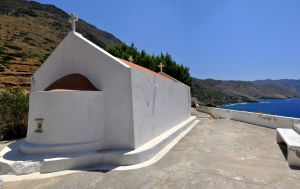
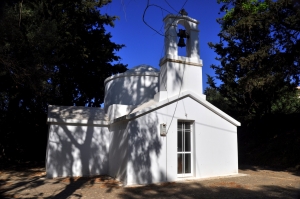
Below Liopetro Peak there is the very old church of St. John that once operated as a monastery, accessible through a very bad road starting from the main road connecting Lassithi to Sitia (initially cement road). The background to the towering phyllitic rocks of Liopetro is impressive.

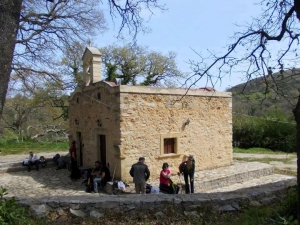
The church of Agia Paraskevi at Kastellos is a double-aisled church with a stone iconostasis. It was the temple of an old monastery, now deserted. The monastery was built at a beautiful place with tall trees perfect for a stroll.

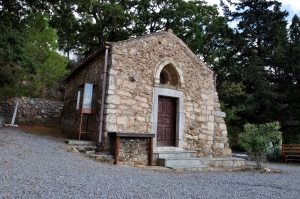
Near Diavaide there is the church of St. George Sfakiotis, bearing frescoes of the 14th century (there is an inscription of 1390). One of the frescoes represents St. George and St. Demetrius on horseback crossing the sea with octopuses, crabs, eels, and lobsters below their legs.

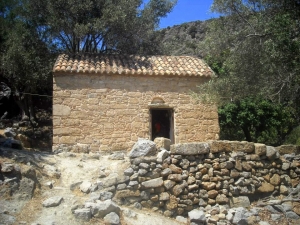
Saint Kirikos or Kirkos is located at the archaeological site of Lissos, on the site of a former Early Christian Basilica and gives its name to the entire valley of Lissos. The vaulted church has Byzantine frescoes, unfortunately damaged.

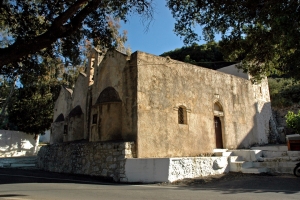
The settlement of St. John the Evangelist, whose core was the former monastic complex of the monastery of St. John, is situated between the villages Kritsa and Kroustas. According to local tradition the monastery was founded in the second Byzantine period and it is known that it functioned until the late 19th century.

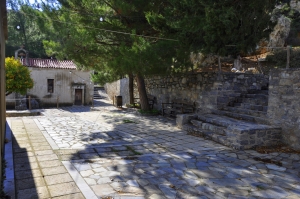
The monastery of Panagia Kera Kavallaras operated as a dependency of Dionysiou Monastery at Athos in the 15th century and was dedicated to the Virgin Mary. The temple of the ruined monastery is well maintained, but has undergone many alterations. The location oversees the plains of Malevizi and Heraklion.

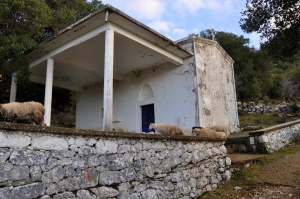
After the lifting of the ban on cultivation of the Lassithi Plateau by the Venetians, they left the land to friend-refugees from the Peloponnese. Peloponnese was occupied by the Turks since the 15th century.

- Home
 Beaches
 Nature
 Past
Past Destinations
 Highlights
 West Crete
- Central Crete
- East Crete
- Towns
- Chania Prefecture
- Chania
- Paleochora
- Kissamos
- Georgioupolis
- Chora Sfakion
- Loutro
- Rethymnon Prefecture
- Rethymnon
- Agia Galini
- Plakias
- Spili
- Anogia
- Heraklion Prefecture
- Heraklion
- Hersonissos
- Malia
- Matala
- Agia Pelagia`
- Archanes
- Kokkinos Pirgos
- Lassithi Prefecture
- Agios Nikolaos
- Elounda
- Sitia
- Ierapetra
- Makrigialos
- Palekastro
- Zakros
- Lassithi Plateau
- Get Prepared


