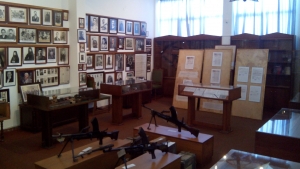



The museum exhibits many objects and tools used by the older generations from the Turkish Era until ’60s. Some of these are rare folk art samples.
The Monastery of Peter and Paul is located at Cape Rodopos (or Spatha), 40km northwest of Chania and 12.5 km from the village Rodopou and is reached through a rocky dirt road. With the abbey of Saint John in Giona, a few kilometers earlier, it flourished during the late Venetian rule. Just after the occupation of Crete by the Turks the monastery became a dependency of the powerful Hodeghetria Gonia monastery.
Археологический музей города Агиос-Николаос был основан, чтобы выставлять там экспонаты с востока Крита, которые раньше отправляли в Музей Ираклиона. Экспозиция пока не завершена, однако она охватывает длительный промежуток времени - с эпохи неолита до окончания греко-романского периода.
The non-profit cultural organization “Olivepress” was created in order to save the Old Oil Factory of the Agricultural Co-operative of Zymbragou from desolation and disappearance. The goal is to house cultural events in its premises, transforming it to a place of memory and a field of action in the island’s inland terrain.
Crete, with a population of 650.000 in the prefectures of Chania, Rethymno, Heraklion and Lassithi, is one of the 13 regions into which Greece is divided. It is the largest island in Greece and the second largest (after Cyprus) in the Eastern Mediterranean.
Οι στρατώνες του Αγ. Γεωργίου,(πρώην Νομαρχία Ηρακλείου νυν Περιφέρεια Κρήτης), οικοδομήθηκαν το 16ο αιώνα και στέγαζαν 700 περίπου στρατιώτες. Οι βενετσιάνικοι αυτοί στρατώνες καταστράφηκαν από σεισμό και στη θέση τους οι Οθωμανοί έκτισαν νέους, τους Κισλάδες, το 1883.
Κάθε άνοιξη πολλά μέρη σε όλη την Κρήτη γεμίζουν από τα μωβ-μπλε άνθη που έχουν τα άγρια λούπινα (Lupinus varius) τα οποία είναι από τα πιο όμορφα και χαρακτηριστικά φυτά όλου του Μεσογειακού χώρου. Τα λούπινα ή λουμπούνια όπως τα λένε στην Κρήτη είναι ετήσια φυτά, τριχωτά με φύλλα σε σχήμα παλάμης χεριού που αποτελείται από 9-11 φύλλα συνήθως.
At the root of the steep and imposing range of Kryoneritis in south Rethymno lies the picturesque green village Alones. Its name is taken after its shape, which resembles a huge threshing (Aloni is threshing in Greek). In the village square under a perennial plane tree there is the beautiful humble chapel of St. Onoufrios.