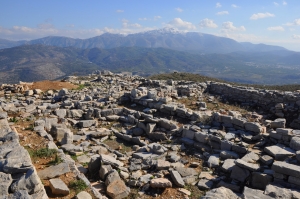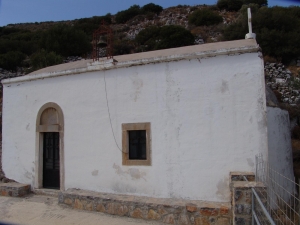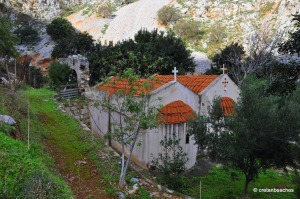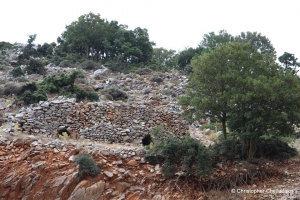



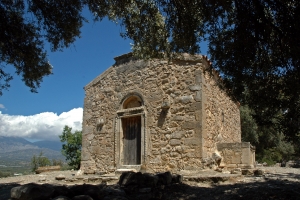
At the top of the rocky hill of the Prophet Elijah (Profitis Ilias) near Smari, at an altitude of 590m, there are the ruins of a citadel with a strong defensive wall. The place has panoramic views across the fertile planes of Kasteli and Smari. According to the archaeologist Hadjivallianou, the citadel was the actual site of ancient Lyttos mentioned by Homer. The city was inhabited from 1800 BC till 630 BC, before being abandoned by its inhabitants.
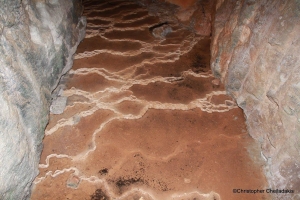
Opposite the perennial plane tree in Keramota we meet the cave of Vrissi (Fountain) of Keramota. This cave despite the relatively small depth is really amazing. From the cavern end comes out water throughout the year and is stored in the village's fountain a few meters away. Several years ago the cave of the fountain was a very small hole from where the water came out. But from this tiny hole one could see the greatest width of the interior. Thus, the inhabitants of Keramota decided to break the rock and reach deep into the cave to the original spring of the water.
In the Cretan dialect Xylodema means the makeshift fence that was built with dry shrubs to prevent the entry of goats and other animals in the rural properties. Xylodema is found as a toponym in several parts of Crete. One of them is at the entrance of plateau Askifou, at the highest point of the road that goes from the plateau to Krapi. From Xylodema the visitor has the best views across the plateau and the settlements Askifou and its forts.
The dunes of the central narrowest part of the island of Chryssi, we meet one of the most important juniper wood (sp. Juniperus macrocarpa) in Greece, which has prevailed (erroneously) with the name cedarwood. In other parts of the island, such as west and east, we encounter vegetation with Juniperus phoenicea being the main plant.
Ο ναός της Παναγίας Κεράς στην Κάτω Τύλισο είναι μονόχωρος ναός με τρούλο του 11ου αιώνα.Διατηρεί τα βασικά αρχικά του χαρακτηριστικά (έχει υποστεί ελάχιστες αλλοιώσεις). Είναι αφιερωμένος στο Γενέσιο της Θεοτόκου (εορτάζει 8 Σεπτεμβρίου).
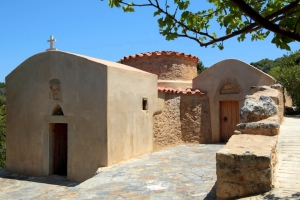
The 11th-century church of Panagia Kera is located at a panoramic position south to the village Chromonastiri. It is a cruciform temple with a dome, with two niches at the sides. To the south there is an embedded chapel of the 15th century dedicated to St. Anne.
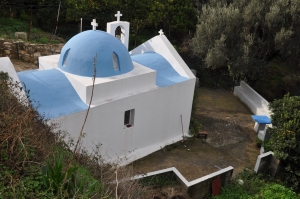
Saint George at the beautiful pine-wooded position Toupaki by Episkopi was the temple of a small monastery, which since 16th century was a dependency of the monastery Agarathos.
The ruined village Mikri Episkopi (i.e. Small Diocese) is located near Partira and was the seat of the Diocese of Arcadia. As expected, the village hosted an imposing temple, which has now collapsed. Columns and walls testify the importance of the temple.