The windmills and watermills of Crete are characteristic monuments of the island’s rural and pre-industrial history. For centuries, they harnessed the power of water and wind to grind grain, process agricultural products and, in later times, pump water for the irrigation of cultivated land.
The watermills of Crete
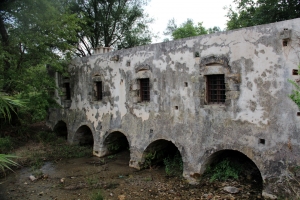
Watermills were built beside rivers, springs and streams with a sufficient and relatively reliable flow. They were therefore more common in western Crete and in mountainous areas with abundant springs. Water was channelled towards the mill through canals or stone-built aqueducts and collected in a vertical reservoir. It was then released under pressure against the mill’s horizontal wheel, setting the millstones in motion.
Many watermills formed complex rural installations that included the miller’s house, storehouses and auxiliary rooms. A characteristic example is the Gerontomylos watermill near Phaestus, an imposing structure equipped with two water channels and two wheels. Several old watermills across Crete have been restored, preserving valuable knowledge about their operation and their role in local society.
The windmill parks of eastern Crete
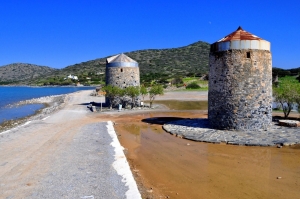
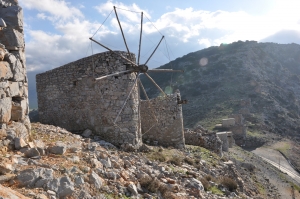
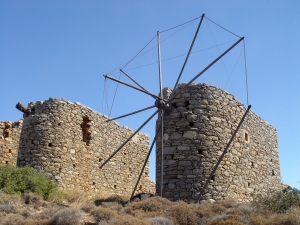
In the drier regions of eastern Crete, where there was not enough running water, inhabitants relied on the island’s strong and persistent winds. Windmills were usually erected on mountain passes, hills and exposed ridges. In many places they formed large groups known locally as milotopia, or windmill parks.
Cretan flour mills belonged to different architectural types. The axetrocharis, also known as the one-sided mill, was permanently oriented towards the direction of the prevailing wind. The xetrocharis had a circular structure that allowed its mechanism to be adjusted according to the direction of the wind. The type selected depended on the landscape, local wind conditions and the financial means of the owner.
At the northern entrance to the Lasithi Plateau stands the windmill park of Seli Ambelou, one of the most important and recognisable groups of windmills in Crete. The mills were transferred to their present location in the late 19th century from the older windmill park at Zaroma, near Potami.
Another impressive group is the Galaropetra windmill park above Fourni, where a row of mills belonging to different types has survived. Similar windmill parks can be found in several parts of mountainous Mirabello, the Dikti range and the region of Sitia, illustrating the former importance of grain cultivation and milling in eastern Crete.
Wind-powered water pumps
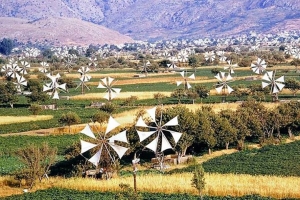
The lightweight metal windmills with white sails that became the most recognisable symbol of the Lasithi Plateau served a different purpose. Rather than grinding grain, these wind-powered pumps drew water from wells to irrigate the fields. The dense network developed across the plateau during the 20th century has often been described as one of the earliest large-scale systems for harnessing wind energy.
Most of these wind pumps were gradually abandoned or replaced by motorised pumps. Nevertheless, several have been restored and still recall the former appearance of the Lasithi Plateau with its numerous windmills.
Decline and preservation
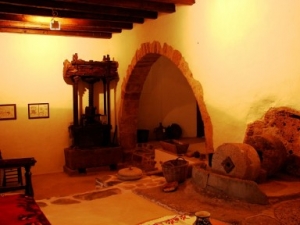
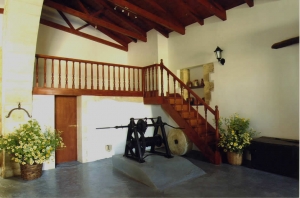
The use of traditional mills declined sharply with the spread of internal-combustion engines, electricity and modern industrial milling. Many installations were abandoned and fell into ruin, while others were converted into houses, museums or accommodation establishments.
The surviving mills are now important monuments of Cretan vernacular architecture and technological history. Their restoration helps preserve traditional knowledge concerning the management of water, wind and agricultural production.