







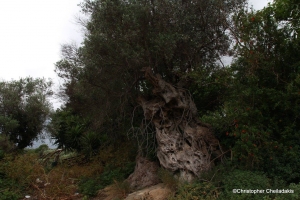
The olive of Saint George at Kamara Deliana is aged over 2000 years and is not the only case of monumental trees in the area. Not too far from St. George we meet a whole cluster with monumental olive trees.

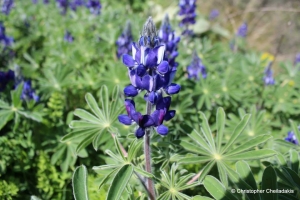
During spring, many places throughout the island of Crete are adorned with the purple - blue flowers of the wild lupines (Lupinus varius) which is one of the most beautiful and characteristic plants of the entire Mediterranean area. Lupins, known as loubinia in Crete are annual plants with hairy leaves with a shape of a hand palm consisting of 9-11 leaves usually.
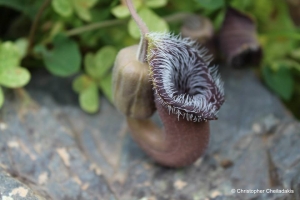
One of the most impressive spring plants of Crete is Aristolocheia (Aristolochia cretica). It is a perennial plant that creeps on the ground and has flowers that are truly impressive and have a shape resembling a saxophone or boot. This plant is typically found on dry rocky soils of Crete and Carpathos. In Crete it is found all over the island, but especially in Lassithi prefecture (east Crete).
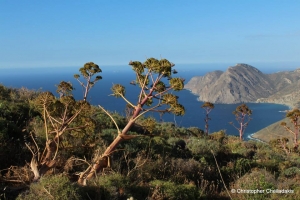
Artikas or the giant fennel (Ferula communis) has a prominent place in Greek mythology as this plant was used by Prometheus to bring people the fire from the gods. The reason is that the interior thick trunk of artikas consists of a soft foam-like flammable material and its burning lasts, making it a natural torch.
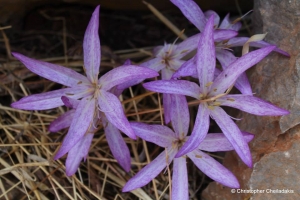
In autumn the land of Crete before the first rainfalls fall is adorned with various flowers that bloom literally in the summer dry land, signaling the resurrection of the earth that will follow. The family of Colchicum blooms in the fall and decorates the dry land. The Colchicum plants growing in Crete are all poisonous and this is the main reason they are not endangered with extinction.
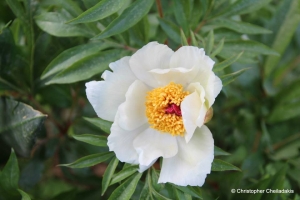
One of the most beautiful flowers that we meet in Crete is the Paeonia Clusii. This is one of the 33 species of peonies on the planet and is endemic to Crete and Karpathos isle. It belongs to the family Ranidae and is also known as the Cretan Peony. It is found only at high altitudes, especially in the mountains of Dikti and the White Mountains. The impressive flower of peony has white or pinkish purple color and only a few people have seen it.
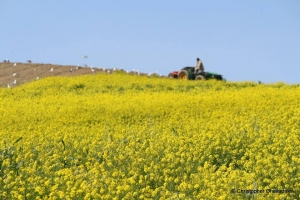
The vrouves is one of the most famous and classic family of greens found in the cultivated fields in the villages of Crete. They sprout everywhere and from ancient times the Cretans consume them. They usually gather the upper part of the plants and eat them boiled with lemon and olive oil, they also use them in pies.

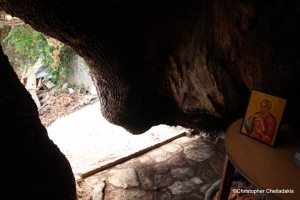
At the picturesque village Keramota in province Mylopotamos we meet one of the several monumental trees of Crete. This is the perennial plane tree at the eastern end of the village. The tree in Keramota belongs to the species of Platanus orientalis and its age is estimated at about 2000 years. It is the oldest tree in province Mylopotamos and although it is located on the main road, almost everyone ignores its existence as it is located a few meters further down the road, thus the drivers see the upper part of it.
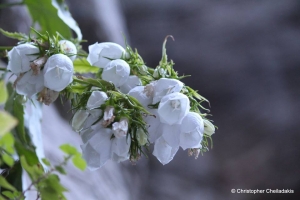
The Cretan bellflower (Campanula Cretica) is one of the most beautiful wild flowers of Crete and at the same time is one of the most rare and endangered endemic plants on the island. Despite the fact Greece is home to 70 bellflower species, making Greece as the country with the largest variety, this is met only in a small geographical area of the White Mountains, mainly Samaria Gorge, and elsewhere in the world.
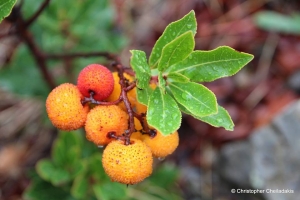
One of the most beautiful evergreen shrubs that can be met in Crete and in other regions of Greece are strawberry trees (Arbutus Unedo). The strawberry trees are found in all the prefectures of Crete and not only in the western Crete, as locals believe. Indeed at the westernmost part of the island we meet them quite often, while in the mountainous provinces of Kissamos and Selino they cover entire slopes often forming low impassable woods.
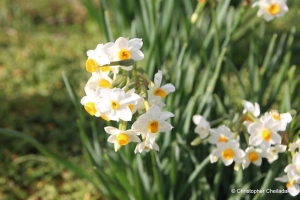
One of the most intense scents of flowers that one can meet in Crete is that of the famous Daffodils. The daffodils during the winter months adorned the vases of most houses in the villages and cities of Crete. Crete hosts 2-3 of 6 total species of narcissus growing in Greece, called Manousakia in Crete. The most common and well-known species is the Narcissus tazetta.
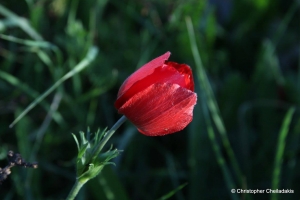
Anemones (Anemone coronaria L) are among the most beautiful flowers that adorn the nature of Crete. They are annual plants that can reach heights up to 45 cm and there is only one flower per person. Their name is taken after the wind (anemos in Greek) as the ancient Greeks believed that the wind made them bloom. The Cretans most of the time call them poppies, however poppies belong to the species Papaver rhoeas L. The anemones of Crete plants are poisonous but are very beautiful flowers.
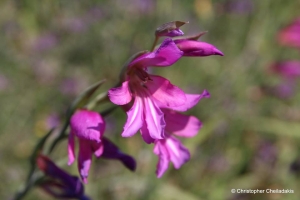
Gladiolus italicus is one of the most impressive flowers that decorates the fields of Crete in the late spring. It is distributed across southern Europe, particularly in the Mediterranean. In Crete it is called Maherida (knife plant) due to the purple and pink flowers that are oblong and sharp as knives. Their scientific name also means the same, as Gladius means sword in Latin.
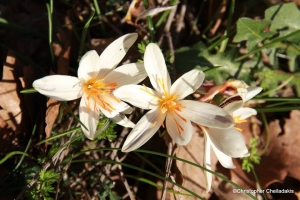
Allover Crete we meet five different species of saffron (crocus). The most common kind of it is Crocus laevigatus, the "smooth" crocus. It is called smooth in Greek because the robes of the bulb are smooth. It is endemic to southern Greece, Cyclades and Crete.
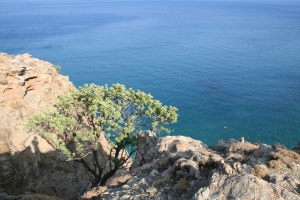
The carob tree can be met everywhere, even on the sidewalks, because of the dense shade and the zero care it needs. Its name (ceratonia) means horn in Greek and is taken after the shape of its edible seed pods. Carob tree can reach a height of 18m and the age of 100 years, while its leaves are round, hard, dense and frost- tolerant. It grows in the arid and rocky coastal areas of the island at an average distance from each other.
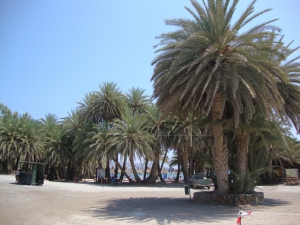
The palm of Theophrastus (Phoenix theophrasti), also known as Cretan Date Palm is a rare endemic species of the Aegean Sea, which is met all over Crete, in several Aegean islands and in Antalya (southwestern Turkey).
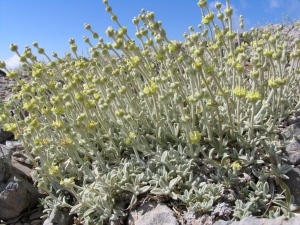
Malotira (Sideritis syriaca), also known as Cretan Mountain tea is a herbaceous plant or shrub, 10-50cm long, which is met at ranges over 900m in West Crete (over 900m). The species is endemic to Crete and the name syriaca (instead of cretica) probably comes from a confusion of the botanist who gave the name.
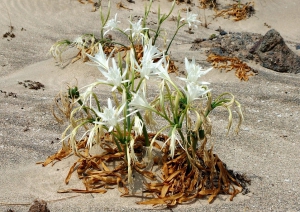
The white sand lily (scient. Pancratium maritimum), also known as sea daffodil, amaryllis, lily of Knossos, saffron or crocus is a charming plant that overwhelms the dunes of Crete from August to October. Unfortunately, in recent years its population has been limited to a few beaches, due to the shrinking of its habitats. Thus, the lily is today considered as endangered species and is protected by Greek and international legislation.

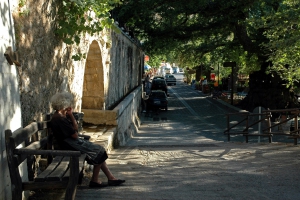
In the village square of Krasi, near Malia, there are three plane trees, the trademarks of the village. The most important of them is the platan in the center of the square, which is considered to be the oldest and most majestic of the plane trees in Crete.
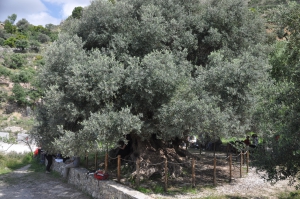
The legendary olive tree in Azorias is located 1km south of the village Kavoussi and very close to the homonymous archaeological site of Azorias. This olive tree is a natural monument; it is the oldest olive tree in the world! Indeed, it is grafted on a rootstock of a wild olive tree, making it the oldest sample of grafting in the world.
Also read:
- Home
 Beaches
 Nature
 Past
Past Destinations
 Highlights
 West Crete
- Central Crete
- East Crete
- Towns
- Chania Prefecture
- Chania
- Paleochora
- Kissamos
- Georgioupolis
- Chora Sfakion
- Loutro
- Rethymnon Prefecture
- Rethymnon
- Agia Galini
- Plakias
- Spili
- Anogia
- Heraklion Prefecture
- Heraklion
- Hersonissos
- Malia
- Matala
- Agia Pelagia`
- Archanes
- Kokkinos Pirgos
- Lassithi Prefecture
- Agios Nikolaos
- Elounda
- Sitia
- Ierapetra
- Makrigialos
- Palekastro
- Zakros
- Lassithi Plateau
- Get Prepared


