







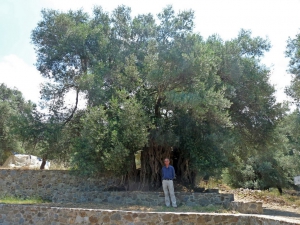
The olive tree of Saint George is one of the many ancient olive trees in the areas Anisaraki and Vardaliana near Kandanos village. It has been declared as a memorial by the Association of Cretan Olive Municipalities due to its flattened shape and textured trunk.
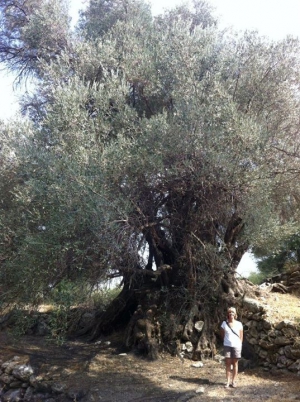
The olive tree has been declared by the Association of Cretan Olive Municipalities as a natural monument due to its size, shape and relief trunk. The name of the site is Gre Ele which means Old Olive and refers to this tree. Its variety is throumboelia and is grafted on a rootstock of a wild olive tree. It is estimated to have been planted in 650-500BC and is located very close to the archaeological site of Eleftherna.
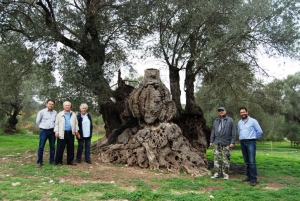
The Monumental olive grove of Amari is located at position Rovithis at Monastiraki, Amari Province and has been declared by the Association of Cretan Olive Municipalities as a natural monument. The several ancient trees are a dependency of the Agricultural School of Amari and unfortunately in 1980 about 1000 more ancient trees were uprooted.
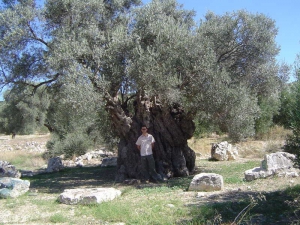
The Monumental olive tree of Kamilari has been declared by the Association of Cretan Olive Municipalities as a natural monument due to its enormous size. The exact age is unknown. Most similar trees in Crete are aged around 2000 years. But it’s a very powerful and peaceful place also worth the visit.
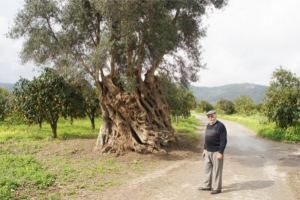
The ancient olive Tree of Vatolakkos is grafted onto wild olive subject. Because of its size it has been declared by the Association of Cretan Olive Municipalities as monumental. Access to it is very easy.
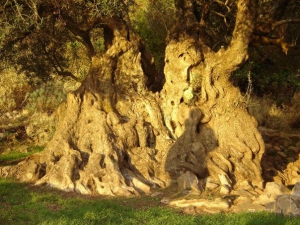
The Great Olive tree of Aerinos has been declared monumental by the Association of Cretan Olive Municipalities. It is located at an altitude of 700 meters near the settlement Felesina. The olive tree is impressive because apart from its age it has a special morphology with many stones embedded in the trunk.
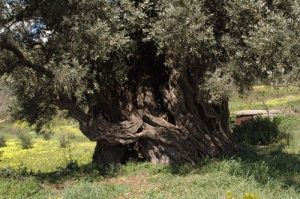
Paliamas Olive Tree has been declared monumental by the Association of Cretan Olive Municipalities due to its relief trunk and size. This olive tree dates back to the Sub-Minoan First Geometric period, produces big olives and it’s got a big cavity in its trunk, where three people can fit in. Its perimeter at its foot measures 20.40 meters and at a height of 80 cm from the ground it measures 10.50 meters.

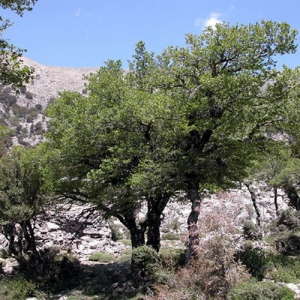
Cretan zelkova (Greek: Anegnoro or Ampelitsa) (scient. Zelkova abelicea) is an endemic bush or small tree of Crete as high as 3-5 meters. It constitutes a unique species of the genre Zelkova, of the family Ulmaceae and is characterized as a living fossil. It took the name "Anegnoro" (i.e. unknown) because when it was discovered, nobody knew its species.
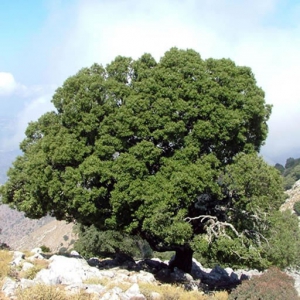
The holly or Kermes oak is a species that resembles common oak. In Crete it is met in all mountainous regions and is one of the most common trees. The oaks are met in ranges of Crete, as they can grow in rocky and dry soils and withstand the extreme weather conditions there. Indeed, the beautiful oak forest of Rouvas is the largest grove of oaks in Europe.
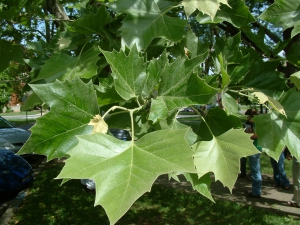
The plane tree can be met in every place of Greece (valleys, ravines, lakes, river banks and village squares). It also found almost everywhere in Crete and is one of the most typical plants of the Cretan flora. Perhaps no other tree, except the olive tree, is so closely associated with the daily life of the Cretans, as the plane tree because has been the spectator of all historical local events.
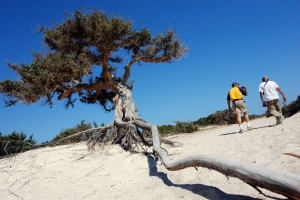
The cedars of Crete (Juniperus macrocarpa and Juniperus phoenicea) form some of the most important ecosystems in Greece, the cedar groves on the dunes of southern Crete. The ecological importance of the dunes is enormous for the biodiversity and the existence of rare animals and plants.

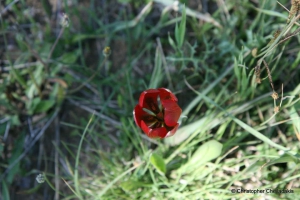
The red tulip of Crete (Tulipa doerfleri) is one of the 5 endemic tulip species of Crete. It grows exclusively at the small plateau of Gious Cambos, by Amari Valley, at an altitude ranging from 700-800m. In spring (April) this small plateau is covered by a red carpet made of tulips.
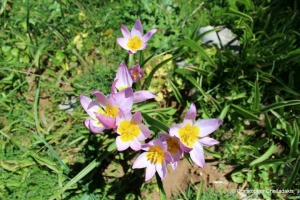
The rocky tulip (Tulipa saxatilis) is a rare species of tulip scattered around Crete, Karpathos, Rhodos and southern Turkey. There is also the endemic rocky tulip of Baker (Tulipa saxatilis subsp. bakeri), that was initially separated from the saxatilis species, but in 2009 was reconsidered as a subspecies of saxatilis.
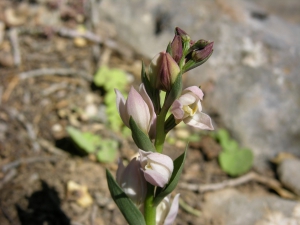
The Cretan cephalanthrera (Cephalanthera cucullata) is an endemic species of orchid that grows exclusively in the mountain forests of Crete, at an altitude of 700-1500m. It is a perennial herbaceous plant with short, creeping rhizomes. Its height reaches up to 20cm and it develops up to 24 whitepinkish flowers from May to June, but it does not bloom every year. In late June the seeds ripen and the aboveground plant parts dry.
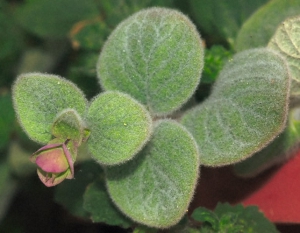
Dittany (Origanum dictamnus) (Greek: diktamos) is an endemic herb of Crete, the most famous of all, which is mainly used as a tea and as a therapeutic sip. Its name is taken after the Dikti Range (Lassithi Mountains), though it is also met in all ranges of Crete.
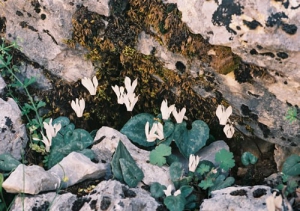
The cretan cyclamen belongs to the family of Primoulides. In many places of Greece, cyclamens are also called "hiropsomο" (i.e. bread for pig), because their roots are eaten by pigs. They grow in the middle of autumn between rock fissures or in the rubble.

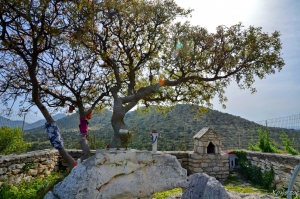
On the hill Grivila near the village Ahlade there is built the church of Saint Fanourios. Approximately 100 meters from the church there is a special tree, which is connected with a religious tradition dating back from the ancient tree-worship traditions in Crete. The tree position is called Evresi (Finding) as they say that the miraculous icon of St. Fanourios was found here.
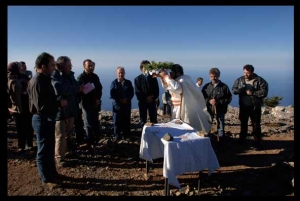
Atop the highest peak of Asterousia, Kofinas, stands the church of the Holy Cross and is accessed through a steep trail. On the Feast of Holy Cross, on September 14, dozens of people climb up there to participate in a ritual that has its roots in the Minoan times, when nature and trees were worshiped.

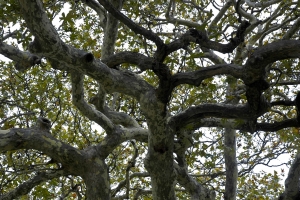
The surrounding area of the old and deserted monastery Kaloeidena near Ano Meros is dominated by rich vegetation of plane trees, watered by a large water spring. But the tree that stands out is the plane tree of Kaloeidena just above the spring as it is the oldest of all the trees that surround the monastery, but it is also the most impressive tree of the whole region and can be listed to the monumental trees in Crete.
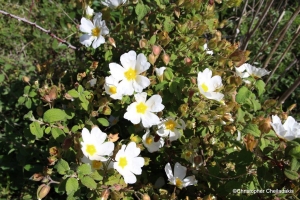
The white sage-leaved rock-rose (Cistus salvifolius) is one of the most beautiful white flowers of Crete. It is met in all counties of the island at medium altitudes up to almost 900 meters and always in phyllitic acidic grounds. It is not as well known as its related purple cousin (Cistus creticus) because it does not produce the famous laudanum.
Also read:
- Home
 Beaches
 Nature
 Past
Past Destinations
 Highlights
 West Crete
- Central Crete
- East Crete
- Towns
- Chania Prefecture
- Chania
- Paleochora
- Kissamos
- Georgioupolis
- Chora Sfakion
- Loutro
- Rethymnon Prefecture
- Rethymnon
- Agia Galini
- Plakias
- Spili
- Anogia
- Heraklion Prefecture
- Heraklion
- Hersonissos
- Malia
- Matala
- Agia Pelagia`
- Archanes
- Kokkinos Pirgos
- Lassithi Prefecture
- Agios Nikolaos
- Elounda
- Sitia
- Ierapetra
- Makrigialos
- Palekastro
- Zakros
- Lassithi Plateau
- Get Prepared


